
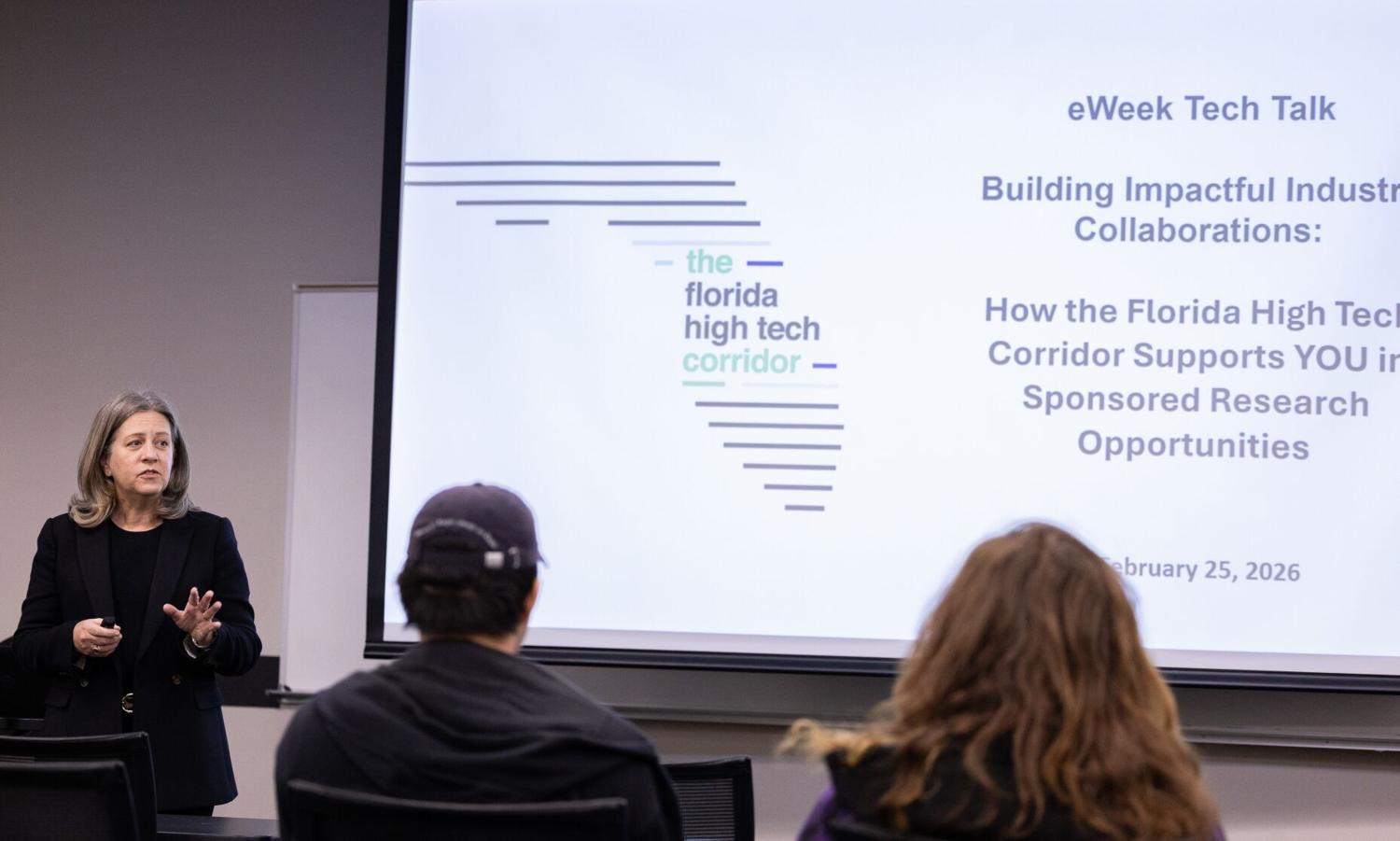

First-year engineering students Jackson Lee (left) and Richard Hammingh (right) listen to Jennifer McKinley’s eWeek Tech Talk event Thursday in the L3Harris Engineering Center.
Courtesy of Antoine Hart
Students and faculty gathered in the L3Harris Engineering Center Thursday to attend a UCF Engineers Week Tech Talk to learn about research opportunities made possible through a local nonprofit.
Jennifer McKinley, host of the discussion, works with the Florida High Tech Corridor, a nonprofit organization dedicated to securing additional funding for regional universities’ research.
The organization, which recently celebrated its 30th anniversary, works to create industry opportunities for STEM research-based members of Florida universities, according to the company’s LinkedIn.
Dr. Alexander Cartwright, president of UCF, serves as a council co-chair for The Corridor alongside other university presidents. Cartwright works in direct conjunction with The Corridor to fund research initiatives and project start-ups for qualifying program applicants at UCF.
Thursday’s events featured several different avenues The Corridor uses to fund individual research projects. One of the main assistance programs used by UCF is the Matching Grants Research Program.
“How do we give these projects every opportunity for success,” McKinley said. “How do we introduce more students to opportunities like this? How do we make targeted investments like this?”
The matching grant program fosters applied research among different industry partners, faculty and student researchers. The program also funds the work of expert faculty and creates an opportunity for students to participate in collaborative research with industry partners in the 23-county region, according to McKinley’s presentation.
“We can really track not just where these projects start and what impact metrics they have at the beginning, but also decades down the line,” McKinley said during the talk. “We have stories of students who worked on industry research projects that went out and got jobs that elevated their position, to where they could now decide whether to fund research back to the university.”
A successful example of The Corridor’s grant funding includes research work done in collaboration with NASA, known as project LOXSAT. Supported by a grant of more than $67,000 from The Corridor’s program, research partners Eta Space and selected UCF applicants created optical imaging technology to help astronauts estimate the mass of liquid available in liquid oxygen storage tanks, according to The Corridor.
Jennifer McKinley, Florida High Tech Corridor UCF program director, introduces herself to faculty and students attending The Corridors’ industry connection eWeek event Thursday in the L3Harris Engineering Center.
Courtesy of Antoine Hart
One collaborator on the project LOXSAT is Shuo Pang, an assistant professor who worked the College of Optics and Photonics.
“From imaging to communication, optical technologies have been playing key roles in information acquisition and transmission,” Pang said in a prior interview with the nonprofit. “With help from the MGRP, we are able to support graduate students who are helping solve challenging problems in the space industry with optics, especially with the leading experts in cryogenic fluid management technology at Eta Space.”
Students attending the eWeek Tech Talk event made new industry connections and had the opportunity to ask questions regarding how this funding affects their own areas of study.
Richard Hammingh, freshman computer engineering major, attended Thursday’s event to gather more information about how to get started in developing research.
“I want to get into research, so getting this information early and kind of learning about what goes into this aspect is very useful for me,” Hammingh said. “I’m probably going to go into research like CPU design and developing better CPUs in the future.”
Jackson Lee, freshman aerospace engineering major, attended both Tuesday and Thursday’s Tech Talk events in hopes of securing new connections.
“I’m looking forward most to seeing how I can use this in the future,” Lee said. “I’m hoping they’ll work with more heated experimental propulsion or experimental design of aircraft research projects.”