
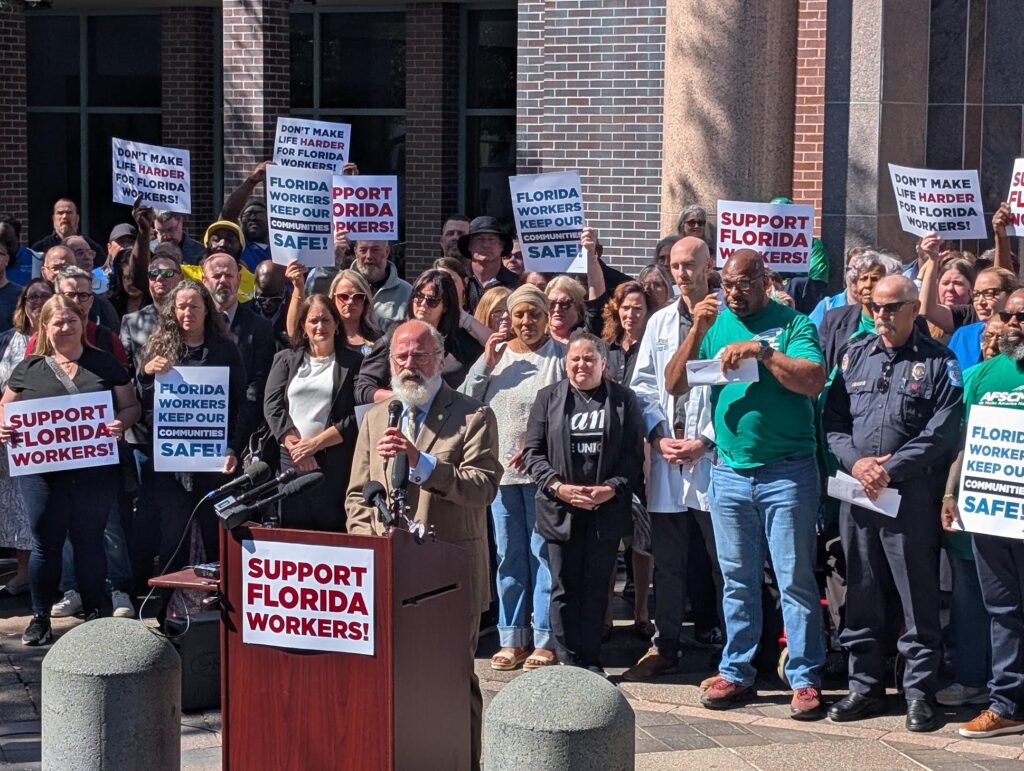
A proposal that would change how public sector union certifications are decided was approved in a Senate committee meeting Monday. The measure is fiercely contested by organized labor, which contends it could dramatically weaken or even crush unions throughout the state.
Instead of a union being re-certified if it gains the simple majority of votes, the bill (SB 1296) would require approval from 25% of the entire bargaining unit, not just those who actually participate in a union election. They would have to approve recertification by 60%.
Although still strongly opposed by Democrats and organized labor, the bill was amended from its original language — which called for re-certification of a union only if it received approval from 50% plus one of the entire bargaining unit (the companion House bill still contains that 50% plus one language).
Sen. Corey Simon offered that amendment. He’s a Republican in Tallahassee, with its many state workers.
Notably, the bill excludes police, firefighter, and correction officer unions, who tend to vote Republican, but applies to unions representing teachers and others who support Democrats. Though there were plenty of rank-and-file workers testifying on Monday who described themselves as Republican union members who oppose the bill.
The Senate Fiscal Policy passed the measure, with two Republicans — Alexis Calatayud and Ana Maria Rodriguez — joining all of the Democrats in opposition.
“This bill is the unions’ nail in the coffin,” said Sen. Shevrin Jones, D-Miami Gardens, right before the vote.
The bill now heads to the full Senate for consideration.
Workers from across the state speak out
Forty-five minutes before debate on the bill began, more than 150 public sector union members from a variety of professions gathered in front of Tallahassee City Hall across the street from the Capitol to plead with GOP lawmakers to vote against the bill.
“If this bill is passed, resident physicians would be disenfranchised and unable to advocate for the conditions needed to deliver the care that all Floridians deserve,” said Casey Mohrien, who works as a resident physician in internal medicine and pediatrics at Jackson Memorial Hospital in Miami. “I look to my lawmakers so that I can continue to focus on my patients and not what’s going on in Tallahassee. Every day I wake up in the morning and I try to do right by my patients. I’m asking them to do the same.”
“Our union is paramount to not only providing our ability to advocate for ourselves and our own working conditions, but the working conditions in the hospital that can lead to worse patient care if we’re not there advocating for it,” he added.
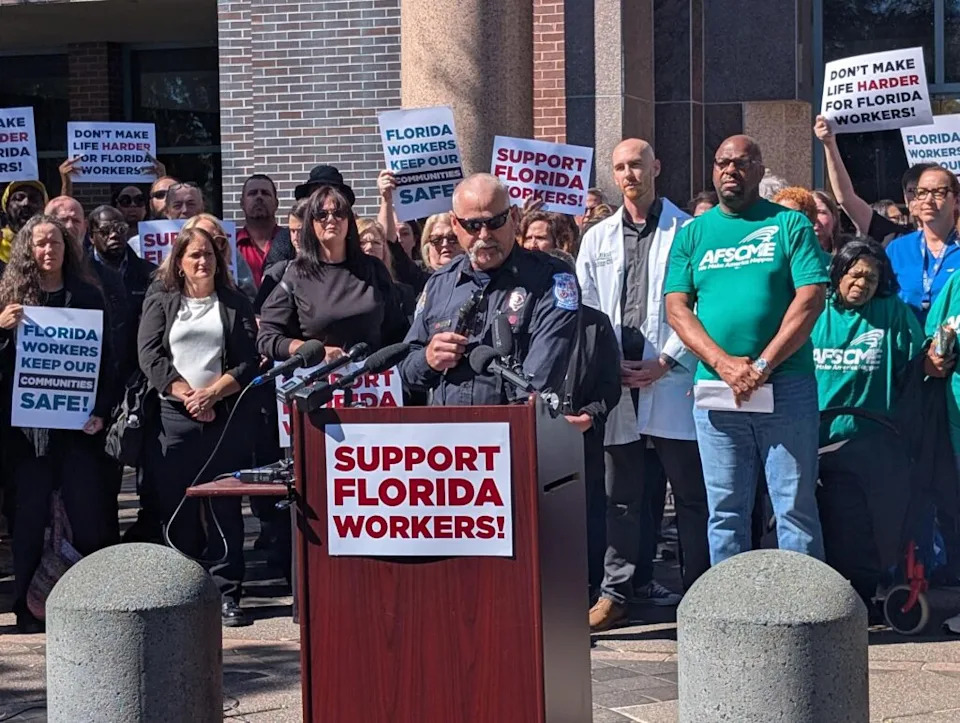
Ellery Farmer is a former Polk County firefighter. He spoke against SB 1296 in Tallahassee on March 2, 2026. (Photo by Mitch Perry/Florida Phoenix)
Ellery Farmer is a retired Polk County firefighter who spoke against the bill even though it wouldn’t apply to public-safety workers.
Through the hard work of his unions (including the Florida Professional Firefighters, the International Association of Fire Fighters, and its local Polk County Local Chapter 351), he said, he was able to recently retire successfully.
“The benefit of retiring is that I’m able to take care of my elderly father, and I believe that all workers across the state should be able to retire with good benefits and a good pension,” he said. “I believe that this bill infringes on our personal beliefs as a Republican, and the passing of this bill would be detrimental to my entire family and all workers and their families across this great state of Florida.”
During the committee meeting, more than 100 people signed up to speak against the bill.
“I believe that legislators like you want to help working people like me, but I promise that this bill is not going to help us,” said Jodi Fiddia, a bus driver from Ocala. “If you want to help other public service workers like me, figure out how to make home ownership easier and more affordable. Whatever it is you choose to do to support public service workers, this bill should not be one of them. Please, because it does not help us, it only hurts us. Please vote no on this bill.”
Rusty Brown, a member of the Freedom Foundation, a libertarian think tank focused in part on dismantling public and private sector unions, acknowledged to Sen. Jones that the organization “consulted” in drafting the bill.
Jones earlier had asked the bill sponsor, Sen. Jonathan Martin, R-Lee County, whether he agreed with the statement from the Freedom Foundation listed on its website which says that “government unions are a root cause of every growing national dysfunction in America.”
Martin responded by referring to an incentive that took place last fall in Lee County. That’s where the local teacher’s union filed a lawsuit against the Lee County School District after the superintendent offered financial bonuses to teachers to work in some of the worst performing schools in the district. The union complained it hadn’t been consulted.
“What I saw in Southwest Florida disgusted me,” Martin said. “We have kids with one shot at the American dream, and the TALC [Teachers Association of Lee County] getting in the way of those kids’ success and opportunity to do what you and I do, which is believe in their abilities.”
Another crackdown
The bill comes three years after the Legislature passed and Gov. DeSantis signed SB 256, designed to make it harder for public sector unions to collect dues and qualify to represent a bargaining unit. That law now requires teacher unions and others (but not police or firefighters) to stop automatically deducting dues from members’ paychecks, instead requiring them to write checks. The law also says that unions’ membership has to constitute 60% of a bargaining unit, an increase from the old threshold of 50%.
The passage of SB 256 has resulted in more than 100 public sector bargaining units representing more than 63,000 public employees in Florida being dissolved by the state.
According to the Senate bill analysis, there are constitutional problems with how the bill is written.
Specifically, the proposal could violate the 14th Amendment of the U.S. Constitution by creating two distinct class of public employees (police, fire, and corrections) and every other collective bargaining unit. When questioned about why the bill carved out first responders, Martin said it was important to look at the differences between a teacher and a first responder.
“I don’t think that there’s any question about what the differences are,” he said. “Some put bullet proof vests when they go to work. Some don’t.”
The Senate bill analysis also says that the bill might violate the single-subject rule in Article III, Section 6, of the Florida Constitution. The title of the bill says that it is an act of “the Public Employees Relations Commission,” but, the analysis says, several parts of the bill deal with hearing procedures relating to unfair labor practices alleged by a public employee.
A handful of public school superintendents came to Tallahassee to speak in support of the bill.
“I want to comment on the hundreds and thousands of dollars school districts spend every year, responding to frivolous lawsuits filed by unions,” said Brevard County Public School Superintendent Mark Rendell.
“Union leadership will privately acknowledge that a termination is justified. But they will still file a grievance knowing they will lose. That is member dues and taxpayer money. And it’s wasted. Not in improving classrooms. Not in supporting teachers. But on litigation. They pursue, simply because they feel obligated to defend every case. They do this because they only represent a small portion of their membership. Not the majority.”
Other supporters, such as former Florida Supreme Court Justice Alan Lawson, have called the proposal a “reasonable reform” that could hold teacher unions in check. However, opponents note that it will affect many more union members than those from the public school system.
Its companion bill (HB 995) is sponsored by Rep. Jenna Persons-Mulicka, R-Fort Myers. During a House State Affairs Committee meeting last week, she said there have been times during a recertification vote when only a small percentage of union members voted at all.
“Since the passage of that bill, there have now been hundreds of elections for recertification because these unions are not maintaining 60% support for employees.” she said.
That House bill has passed all three of its assigned committees and now awaits a vote by the full House.