
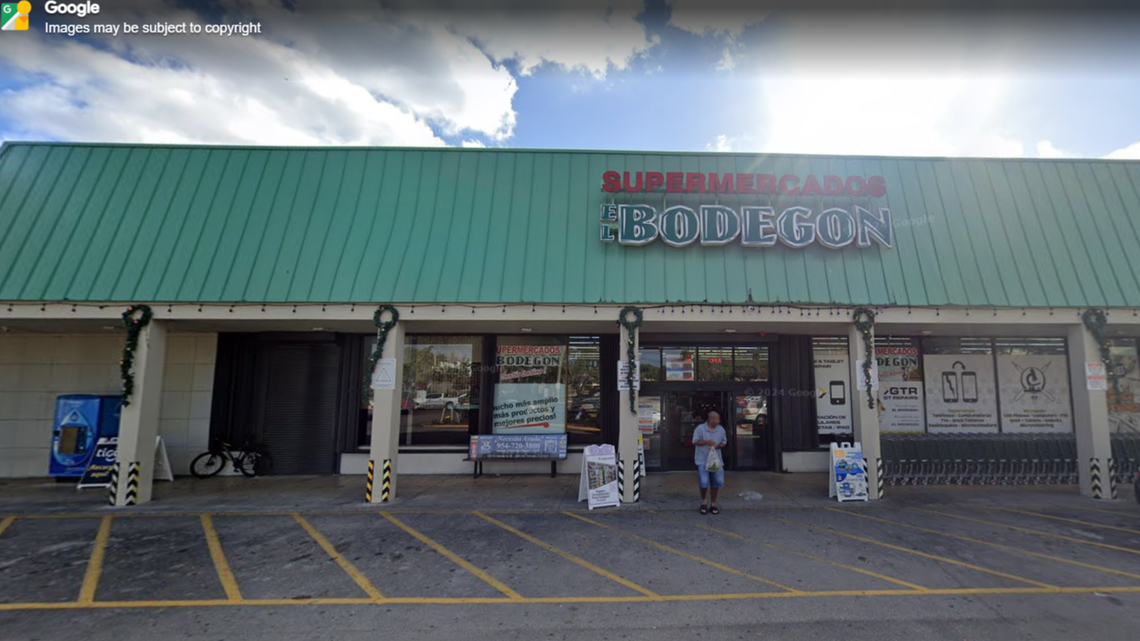
Supermercados El Bodegon, 8022 W. Sample Rd.
Google Earth
Food that was old, food with mold, food that was too cold and food that wasn’t cold enough packed last week’s poor inspection of a Margate supermarket.
Wednesday’s stop at Supermercados El Bodegon, 8022 W. Sample Rd., by Florida Department of Agriculture and Consumer Services inspectors Ashley Montanez Bradshaw and Timothy O’Neil turned into a 14-page failed inspection. El Bodegon remains open because shutting down a place isn’t in the powers of Consumer Services inspectors.
Five days after the inspection, an El Bodegon found some luck: A customer hit for $50,000 in the Florida Lottery Fantasy 5 game, getting the store a bonus for selling the winning ticket.
READ MORE: A Publix and an El Bodegon sold Monday’s lottery jackpot tickets
Despite no shutdown powers, agency inspectors do have Stop Sale Orders and Stop Use Orders in their holsters, and the firing started early.
In the backroom, a container of raw salmon on a walk-in cooler shelf was “covered in a white mold-like substance.” Stop Sale on the salmon.
The produce area needed more shelves because “cleaned cutting boards were stored directly on the floor between the walk-in cooler and the storage rack.” Also, those cutting boards had “heavy score marks and black stains.”
The cutting boards, knives and cutting gloves in the meat service area first used at 8 a.m. needed to be cleaned and sanitized by noon. Instead, they were still in use without cleaning at 3 p.m.
Then again, the sanitizer for Part 3 of the meat area’s three-compartment sink had a sanitizer concentration of zero parts per million. So, basically, water.
But in the same meat service area, the buckets of sanitizer under the meat cutting tables tested at 500 parts per million, way too high as sanitizer soup.
So maybe it’s best that the wiping cloths used to wipe the cutting board sat on the prep tables between uses and not in the sanitizer buckets, as they normally should. No matter the sanitizer strength or over strength, cloths not resting in the bucks remains a violation.
READ MORE: Day-old food on equipment among a Miami supermarket’s inspection issues
In the meat cutting room, the “band saw closest to the food service door had the cutting guide stored on top of a saw that had a buildup of dried old food particles.”
The meat cuber machine still had a “buildup of dried food particles” from the day before.
The gloves worn by someone in the bakery area were “damaged” but the employee “continued to prepare beverages and handle exposed foods for customers.”
A bakery area employee washed hands for less than 10 seconds and in cold water. A kitchen employee did the same. That’s a problem with both time and temperature.
The kitchen area handwash sink handles leaked when in use. Another handwash sink was “slow to drain.”
Also in the kitchen, standing water covered the floor near the bay door and dishwashing machine.
The produce area walk-in cooler’s air condenser had “a buildup of ice and the fan guards on the air condenser has a buildup of dust particles.”
A bug zapper hung “above the prep table and deli slicers.”
The inspectors saw “frozen fish stored in a container of standing water on the drainboard of the warewash sink” in the kitchen. That’s improper thawing, unless you’re running cold water over the frozen fish for a rapid defrost.
Now, we get to the foods that need to be stored at or under 41 degrees or risk breeding bacteria.
Bread pudding made two days before and sitting on a counter registered at 78 degrees. “Various breads stuffed with cheese in the bakery reach-in case made since 4 a.m. Wednesday” measured 78 and 79 degrees. Cooked pork shoulder on the bottom of a storage rack, prepared since 8 a.m. Wednesday, measured 110 to 115 degrees at 12:05 p.m.
All of the above, Stop Sales.
In the produce walk-in cooler, containers of cut watermelon, cut cabbage and cooked corn soup measured 45 or 46 degrees. A hat trick of Stop Sales there.
Containers of pigs feet and pork skins that included “keep refrigerated after opening” sat on a reach-in deli case for more than 24 hours. Stop Sale and Stop Sale.
Perhaps the store could put that lottery bonus toward a new reach-in hot holding case, one that would do the one job it’s assigned instead of getting hit with a Stop Use Order and causing the food inside to get slapped with Stop Sale Orders.
The air in this reach-in hot holding unit measured 105 to 123 degrees. That’s a problem when the unit’s raison d’etre is keeping food at or above 135 degrees. Stop Use Order on the hot holding unit.
That unit held “various types of arepas, various types of empanadas stuffed with cheese and/or meat, breads stuffed with cheese and/or meats, stuffed potato balls, different types of sausage links, and chicken patties.” All measured 98 to 131 degrees. All got hit with Stop Sales.
French fries and cooked plantains that had been in the steam table next to the grill less than two hours had internal temperatures of 99 to 126 degrees. The plantains got reheated to 165 degrees and the fries got tossed.
“Containers of in-store-made chimichurri sauce containing fresh garlic and oil in the reach-in deli case weren’t date marked and held for two weeks.” That shoots past the seven-day limit by seven days. Stop Sale.

Miami Herald
Since 1989, David J. Neal’s domain at the Miami Herald has expanded to include writing about Panthers (NHL and FIU), Dolphins, old school animation, food safety, fraud, naughty lawyers, bad doctors and all manner of breaking news. He drinks coladas whole. He does not work Indianapolis 500 Race Day.