
Republican lawmakers in the Florida House decided to sharply cap international student enrollment at the state’s public universities, threatening millions in research funding for campuses that fail to comply.
But legislation to do so (HB 1279) now heads to the state’s Senate, where a similar bill has yet to be heard in any committee, suggesting the Senate – though also GOP-controlled – has no appetite for the proposal.
And since identical measures must be passed by both chambers for a bill to be sent to the governor, the initiative is likely dead for the 2026 legislative session.
The House of Representatives on March 3 approved its sweeping “Florida First” higher education bill, sponsored by Rep. Jennifer Kincart Jonsson, that would limit non–U.S. citizens to 5% of fall enrollment at Florida’s designated preeminent research universities and cap students from any single foreign country at 5% at other state colleges and universities.
“Florida universities should serve Florida students first. Doing so strengthens our system, protect our standards and keeps opportunity rooted right here. This is Florida first, plain and simple,” Jonsson said in debate before the chamber OK’d the measure 84–25.
The move targeting non-U.S. citizens at state schools comes as Florida continues to position itself as a leader in support of President Donald J. Trump’s immigration enforcement push. The state spent an estimated $500 million last year to arrest nearly 20,000 allegedly undocumented immigrants and has asked all 67 county sheriffs to assist with federal immigration enforcement.
The proposal emerged a year after the state university system’s Board of Governors voted to increase student fees for out-of-state students. Despite the inflated price, according to Bestcolleges.com, Florida’s out-of-state tuition is 28% lower than the national average.
Universities could have been punished by loss of funding
Under the House bill, the state’s preeminent universities risk losing an annual $25 million allocation to fund research and hire top faculty for failing to comply.
The University of Florida, Florida State University, University of South Florida, and Florida International University are designated as preeminent state research universities; the University of Central Florida is expected to be certified by the Board of Governors as a preeminent state research university later this year.
These schools are the state’s most popular and currently have enrollments above Jonsson’s threshold, with FSU and UF having 15% and 20% of this year’s freshmen classes being international students, according to a WUSF analysis. The State University System Board of Governors reports the average out-of-state enrollment at Florida 12 public universities is 22%. And according to the Florida Department of Education non-residents pay about three-and-a-half times more for tuition, or about $18,000 more than residents do.
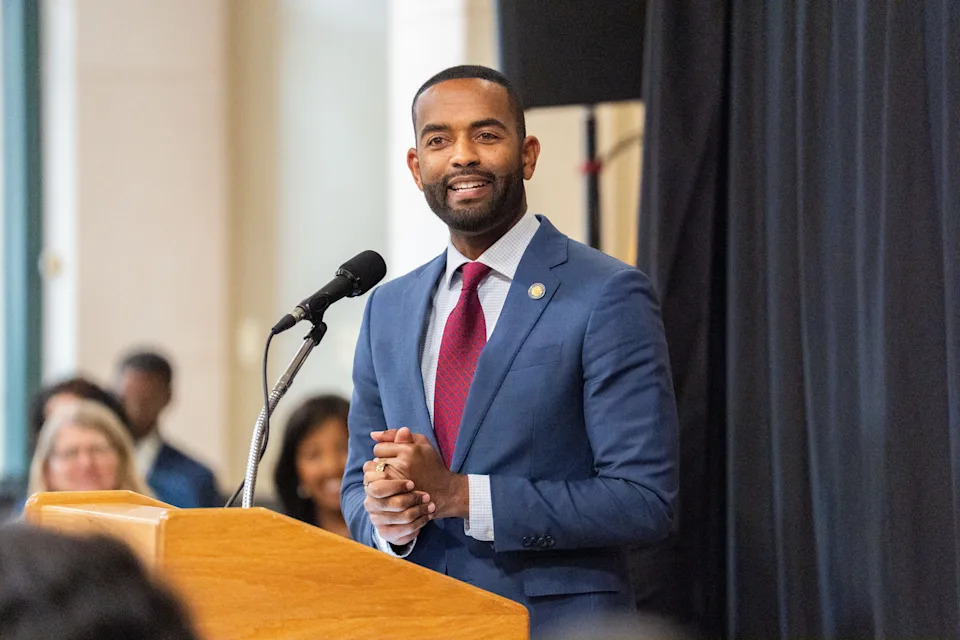
Rep. Gallop Franklin presented as the keynote speaker for the Leon County Annual MLK Day Celebration at the Leon County Courthouse on Wednesday, Jan. 14. 2026.
Opponents argue higher education policy is short-sighted
“I do believe in merit. I also believe that we should take care of Florida students first, but only when they are exactly the same profile as out-of-state students,” Rep. Gallop Franklin, D-Tallahassee, said. “It’s important that we ensure that the highest quality students come here, get a quality education, and start companies here that boost our economy here in Florida.”
But supporters countered Franklin’s argument by saying Florida schools should prioritize Florida students. That’s the mission the Legislature gives them – and why taxpayers provide them money.
“When you are growing up in this state, you expect the state to serve you. No student in Florida should be losing a seat from a kid in Georgia, whether that’s the state of Georgia, or the nation of Georgia,” said Rep. Berny Jacques, R-Seminole.
Jacques and others argued that Jonsson’s bill ensures that state money is not “subsidizing” the education of non-residents. The measure also requires students be a U.S. citizen to receive state financial aid.
James Call is a member of the USA TODAY NETWORK-Florida Capital Bureau. He can be reached at jcall@tallahassee.com. Follow on him X: @CallTallahassee.
This article originally appeared on Tallahassee Democrat: Florida House passes bill to cap number of international students