
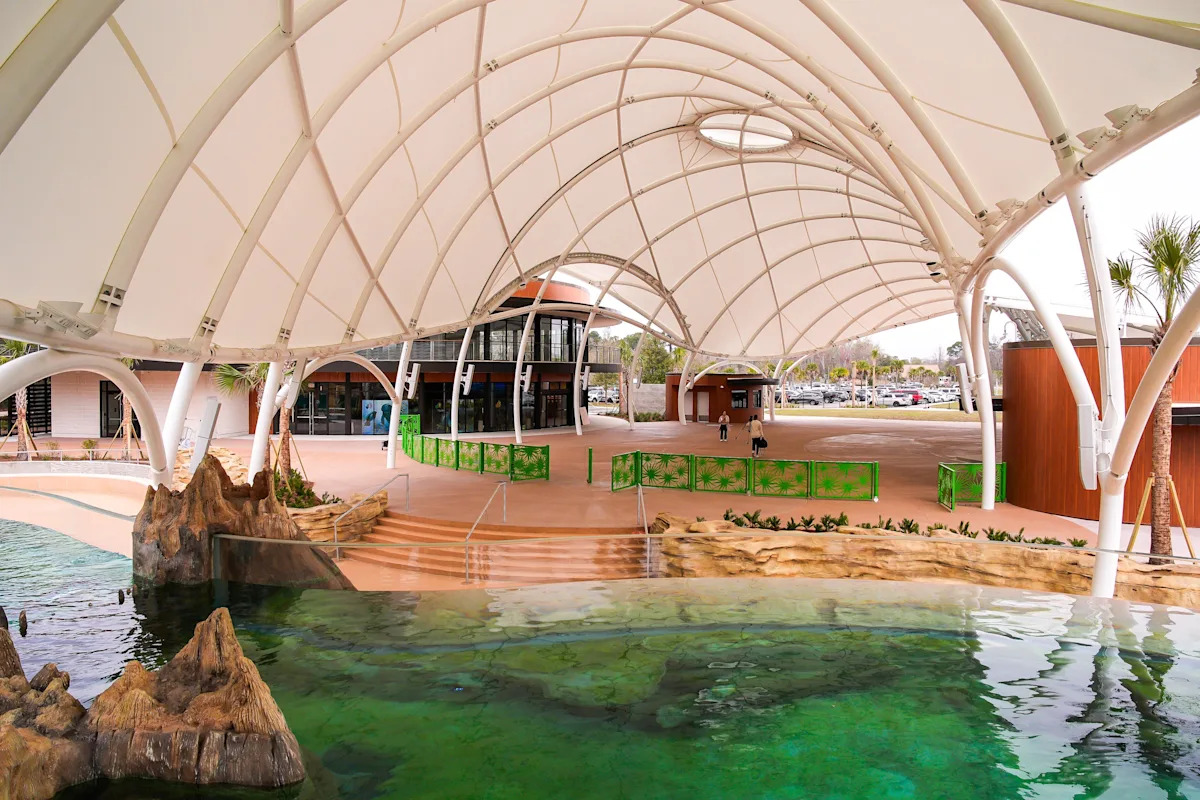
Alpine, Francesco and Cullen are just about ready to meet the public.
The three are manatees living in the new J. Wayne and Delores Barr Weaver Manatee River Habitat, which opens Friday at the Jacksonville Zoo and Botanical Gardens. The manatees are the first thing visitors will see when they walk through the new VyStar SkyScape entrance, which also opens on Friday.
The two projects totaled $72 million. Construction began in October 2023.
The SkyScape features a 25,000-square-foot entry canopy, which covers a large courtyard that includes a new ticket office, gift shop and cafe, plus a 630-square-foot video screen that will display information about the zoo. A recent fundraising event put 800 people under the canopy.
Sneak peek: New Manatee River Habitat set to open at Jacksonville Zoo
1 of 33
Employees of the Jacksonville Zoo and Botanical Gardens, stand in the entrance to the $72 million J. Wayne and Delores Barr Weaver Manatee River Habitat and VyStar SkyScape Entrance Tuesday March 3, 2026 in Jacksonville, Fla. [Doug Engle/Florida Times-Union]
The SkyScape features an oculus at the top that allows heat to escape and reportedly can reduce heat in the area underneath by up to 20 degrees. There is also a large banquet space and boardroom above the gift shop.
A large grassy circle just outside the canopy will be a perfect spot for kids to blow off a little steam.
A short green fence decorated with palms separates the entryway from the zoo. Pass through the ticket gate and the manatee exhibit is the first thing you will see. Depending on the time of your visit, you might see manatees swimming in the pools, or you might see divers, who are on the zoo staff and clean the inside of the 330,000-gallon pools every day.
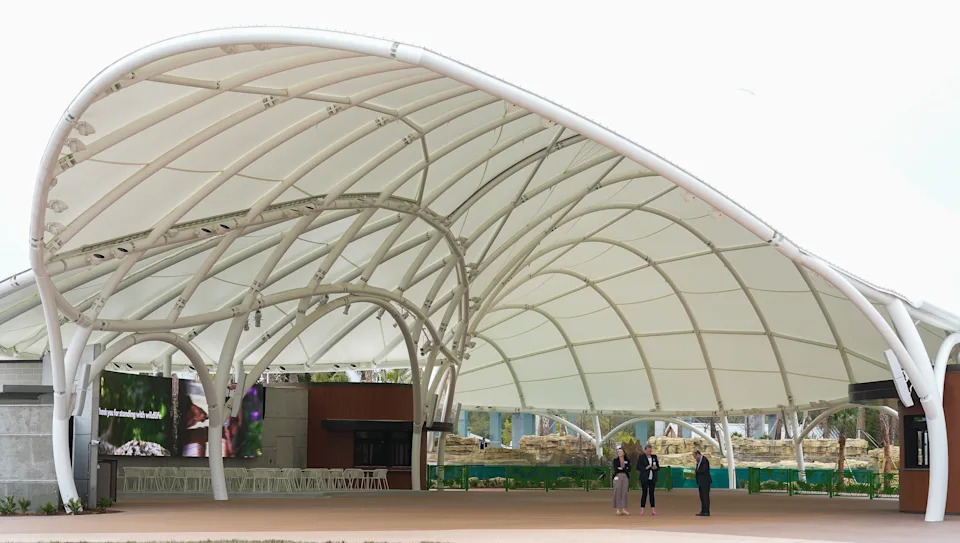
Employees of the Jacksonville Zoo and Botanical Gardens, stand in the entrance to the $72 million J. Wayne and Delores Barr Weaver Manatee River Habitat and VyStar SkyScape Entrance Tuesday March 3, 2026 in Jacksonville, Fla.
Currently, there are three manatees at the zoo. All three were rescued by other groups in the state and were transferred to Jacksonville to complete their rehabilitation. No manatee is expected to stay at the zoo for long; the point of the exhibit is to treat them for injuries or malnutrition, then return them to the wild. It’s a critical care facility first and a zoo exhibit second, said Jeffrey Ettling, the zoo’s president and CEO, and in an ideal situation, the pools would be empty.
The zoo can handle up to 20 manatees if needed, he said, but he’s not anxious to see that happen. “If we were at capacity, that would be about $650,000 a year in romaine lettuce,” Ettling said.
He said it’s no coincidence that the manatee care facility is the first and last thing visitors to the zoo will see. The zoo wanted to put its conservation efforts front and center, he said.
Ettling said the three manatees currently at the zoo are there because the state’s other critical-care manatee centers are near capacity. Zoo Tampa, SeaWorld Orlando and Homosassa Springs Wildlife Park are the only other federally permitted acute care facilities in Florida. The Living Seas attraction at Epcot and the Parker Manatee Aquarium in South Florida are secondary holding facilities.
In the future, the state Fish and Wildlife Conservation Commission, which deals with injured manatees, may bring them directly to the zoo for rehabilitation. Of the three manatees at the zoo now, one is eligible for release this winter and the others will probably spend another year recovering. Two of the manatees already had names when they arrived in Jacksonville, but the third was named in honor of Cullen Richart, the exhibit’s project manager.
On the job: Any given day, Jacksonville zoo vets treat jaguars, manatees, gorillas or venomous snakes
A pathway to the right of the manatees leads into the zoo’s Wild Florida area, right by the old manatee treatment facility, which is still operational. A new pathway, to the left of the manatees, leads to the Land of the Tiger area and gives visitors a view of the massive equipment needed to support the manatee pools and purify the water to mimic Florida springs. The pathways also eliminate the old “out-and-back” design of the zoo.
Behind-the-scenes tours will be available, taking visitors to the special pools used to treat manatees. Sick or injured manatees arrive behind the tanks by truck. A built-in overhead crane system uses a sling to lift the injured animals, then lowers them into the tanks, which have floors that can be raised or lowered to adjust depth.
To make room for the new entryway and manatee facility, the zoo’s education facilities were torn down and moved to temporary facilities. The zoo’s old entryway will be renovated into new quarters for the education programs.
This article originally appeared on Florida Times-Union: Jacksonville Zoo opens new entryway, manatee-care facility