
Political drama and concerns over state retaliation permeated a City Council discussion Thursday. At issue was St. Petersburg adopting two alternative city flags to show solidarity with marginalized communities.
City Councilmember Gina Driscoll is leading those efforts in response to the state’s removal of similarly themed street murals. The city has long supported diversity and inclusivity, while acknowledging past and ongoing disparities.
Driscoll was temporarily overcome with emotion as it became apparent that she lacked the votes to pass a resolution. Councilmember Brandi Gabbard had a tense exchange with Mayor Ken Welch, who atypically interjected in the debate to address what he called “theatrics.”
“Someone could decide that I’ll be removed from office tomorrow just for bringing this forward,” Driscoll said of the state. “Here I am. I’m not afraid of this because I believe in it.”
Multiple council members wanted feedback from the community and additional information regarding potential state-led retaliation. The Florida Department of Transportation threatened to withhold funding if local governments failed to comply with the street art ban.
“What I don’t want to have is this not to pass today, and then there’s no further conversation,” said Councilmember Deborah Figgs Sanders. “I do want to know what our constituents have to say.”
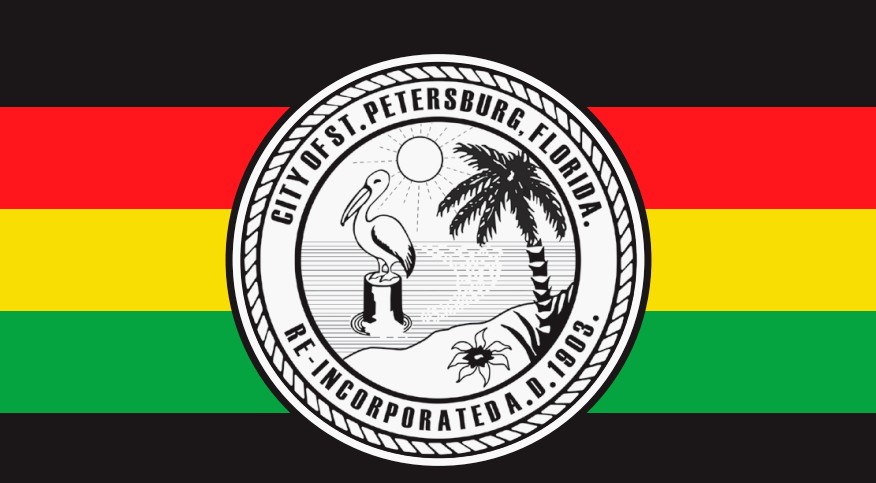
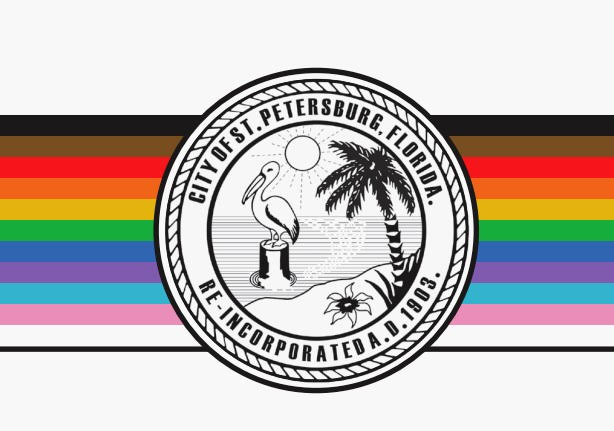
The resolution states that St. Petersburg would fly the “Harmony” and “History” flags, which both include the official municipal seal, at “appropriate times of the year” at city facilities. “As with most art, these flags and their colors have a meaning to each person that is as unique as we are,” Driscoll said.
The Harmony flag features a rainbow design with added colors, including white, brown, black and pink. Driscoll noted it varies from the Pride flag officials raise annually in June.
The History flag’s red, yellow and green horizontal stripes represent African ancestry. St. Petersburg annually raises the Dr. Carter G. Woodson flag in February to celebrate Black History Month.
Driscoll said Terri Lipsey Scott, executive director of the Woodson African American Museum of Florida, offered her stamp of approval. “This takes it to the next level, where it’s not just about one group of people,” Driscoll explained.
“These flags have been created to be about everybody – to be about everyone in our city.”
She expressed concern that the state could preempt the city from flying the flags before a subsequent committee discussion. Councilmember Lisset Hanewicz noted a local broadcaster had already contacted the governor’s office for comment.
Molly Best, a spokesperson for Gov. Ron DeSantis, told the Seattle Times that the symbols are unnecessary because “we already have a flag that represents everyone.”
Council Chair Copley Gerdes said “everyone wants to make a stand” after the state unceremoniously erased five murals over Labor Day weekend. Welch’s administration has already met with 20 stakeholders, released a memo outlining a path forward and conducted a community feedback survey that ended Thursday.
Gerdes suggested delaying the vote until an Oct. 23 Committee of the Whole meeting. Administrators could discuss the survey’s results, and officials could collectively unleash “multiple different ways that we stand up to what happened.”
“I want to throw a haymaker,” Gerdes added. “I don’t want to throw a jab.”
Council members will further discuss the flags in two weeks.
St. Petersburg adopted its first municipal flag in 1927. The city now uses a version redesigned in 1984.
The Republican-led Legislature has repeatedly attempted to pass a bill that would restrict the flying of municipal flags. Assistant City Attorney Brett Pettigrew reiterated that the state could abolish St. Petersburg, which lacks First Amendment free-speech protections.
“I just have some real concerns, in terms of doing something that the state’s going to turn around and completely preempt,” Hanewicz said. “And once they preempt it, you’re not getting it back.”
Gabbard took issue with the mayoral administration unveiling “an entire plan” without consulting the council. She also said Driscoll “didn’t have to do this alone.”
“Here we are, being asked to look at something that was done in a silo, and if we don’t vote for it, then it’s going to be pitted as though we don’t support our community. And that is unfair,” Gabbard continued. “Every single person up here supports every single part of our community.”
She believes the city is teetering on the brink of allowing the state’s erasures to “cause a divide between all of us, and I’m not going to stand for it.” Gabbard, who said she was late for a previously scheduled appointment, told residents that she will “always support you, but these flags are not it.”
She added that the city would be “that much more divided” if the mayor chose not to fly the flags. Gabbard waited to hear Welch address her “accusations.”
“The only plan was to listen to the community, listen to the ideas, listen to the council when that meeting happened and find the most sustainable way forward,” Welch said. “If you want to talk about this, give me a call, and we’ll do that.
“But the theatrics up here – I’m not going to deal with it. You’re setting up division.”
Welch said he would let council members finish their discussion before deciding on whether to utilize the flags. That will occur Oct. 23.
Driscoll amicably withdrew her motion and referred the resolution to a Committee of the Whole meeting. Gerdes had already scheduled the date.
Gabbard was absent, and Councilmember Mike Harting provided the lone “no” vote. “I think we can get to a good place on this,” Driscoll said.