
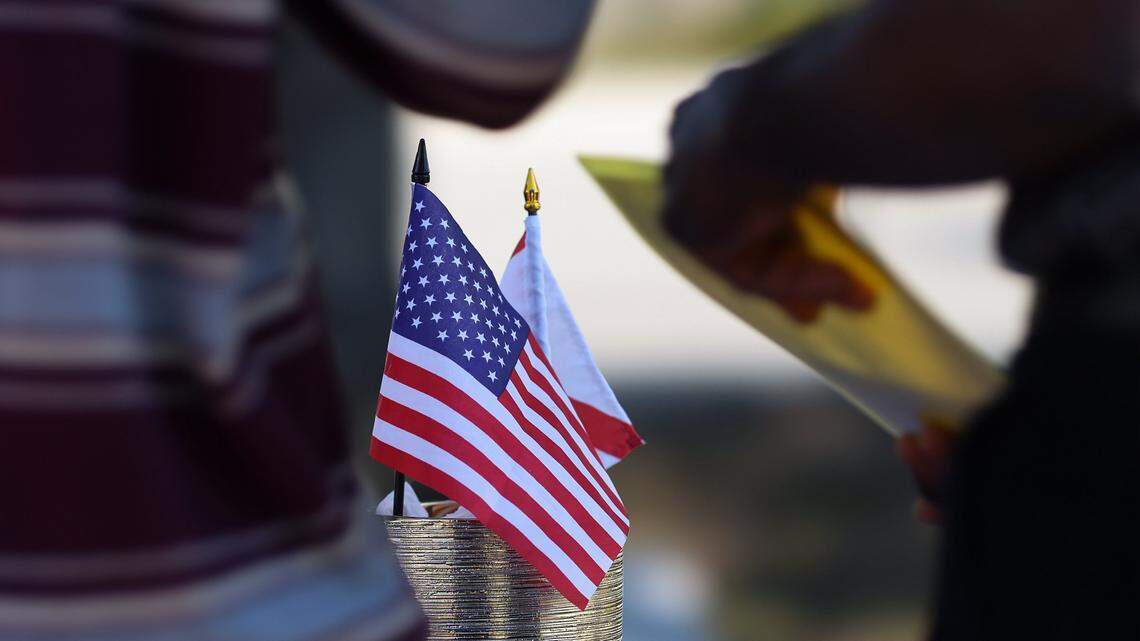
The American and Florida flags are on display at an event in West Park in February to help Haitian immigrants and others update their licenses.
Carl Juste
cjuste@miamiherald.com
I am the daughter of a Holocaust refugee — a fact that has shaped my life.
The Nazis’ genocidal assault on the Jews is not abstract to me; it is my family’s history. My father was born on a ship bound for Panama after our family’s displacement from Vienna, a journey marked by fear and loss. That rupture shaped a bold and purposeful life. He carried an unshakable belief that silence in the face of injustice is a form of complicity, guiding his evolution from a professor of English literature to Holocaust studies.
In our home, the courage to speak up was not optional. It was survival itself.
Today, when I hear immigrants described as threats, burdens or criminals, I recognize the rhetoric of repression, the language of dehumanization. It reduces people to caricatures and statistics and flattens stories of courage and resilience until they can be treated as disposable. It creates an atmosphere in which cruelty becomes easier to justify and to ignore.
We are living through a moment when attacks on immigrants have grown more coordinated, violent and political. This hostility does not exist in isolation but parallels efforts to limit free expression, discredit journalists, intimidate educators and delegitimize artists. Together, these impulses threaten something fundamental: our shared capacity to see one another’s humanity.
For artists, that ability is our oxygen.
As co-artistic director of Dance NOW! Miami, I work daily with dancers whose bodies carry diaspora stories. Our company reflects the metropolis we call home: multilingual, multicultural, layered with memory and aspiration. In rehearsals, we are constantly translating — between languages, traditions, aesthetics and lived experiences. Movement reveals what politics often obscures: that we share more than we are taught to fear.
Art does not exist to provide comfort alone. It exists to challenge, question and insist on complexity in a culture that often prefers slogans. When public figures vilify immigrants, they are not only targeting a population; they are narrowing the emotional and moral vocabulary available to all of us. They signal which stories are acceptable and which should remain invisible.
That is why free expression matters so deeply in moments like this. Democracies depend not only on laws and elections, but on imagination, the ability to picture lives different from our own and still care about their outcomes. Art nurtures that imagination. It slows us down. It asks us to feel before we judge. Persistent threats to arts funding are aimed at silencing our voices, yet again.
This spring, our company will present a performance that grapples with migration, belonging and the fragile act of communication across differences. The work itself is not the message — the message is the act of creating it at all by choosing connection over retreat, dialogue over dismissal, curiosity over fear. We premiered this one-act work in 2017. We return to it now because its themes feel even more urgently relevant.
In Miami, a city built by immigrants, these questions are not abstract. They live in our neighborhoods, classrooms, businesses and kitchens. They shape the rhythms of daily life. When we allow immigrants to be spoken about as problems rather than people, we corrode the civic fabric that makes cities like ours possible.
The arts cannot fix broken policy. But they can help repair broken language. They remind us that behind every headline is a human being with a past, a family and a future. The arts offer a space where disagreement does not require dehumanization.
My father survived a world that collapsed when fear replaced empathy. He rebuilt his life in a country that promised liberty, dignity and refuge. I carry that legacy onto the stage, into rehearsal studios and into public conversation.
We do not need fewer voices. We need more — more stories, more perspectives, more courage to speak when silence feels safer. In times of division, building bridges is not sentimental. It is essential.
And for artists, it is our responsibility.
Hannah Baumgarten is the co-artistic director of Dance NOW! Miami. The company performs “Bridges NOT Walls” as part of its Program II on March 15 at the Aventura Arts & Cultural Center. For more information, visit www.dancenowmiami.org.