
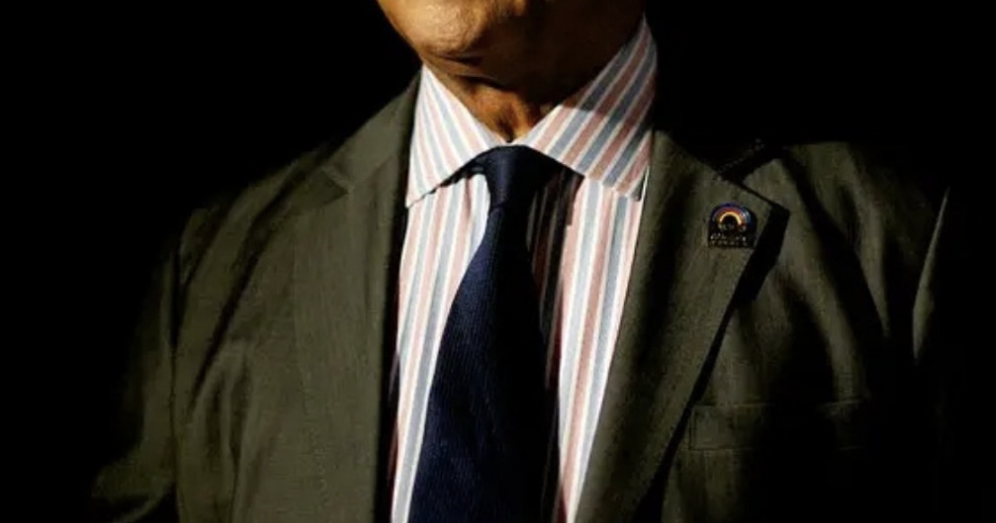
“I am somebody! I may be poor, but I am somebody. I may be young, but I am somebody. I may be on welfare, but I am somebody.”
Those iconic words intoned by the Rev. Jesse Louis Jackson Sr. decades ago to instill pride in marginalized communities echoed through the Marshall Davis African Heritage Cultural Arts Center on Thursday, Feb. 26.
Members of the Miami-Dade community gathered to pay homage to the civil rights icon, founder of Operation PUSH, protégé of Dr. Martin Luther King Jr., and two-time presidential candidate who passed away on Feb. 17, 2026, at the age of 84, following a lengthy battle with progressive supranuclear palsy.
The Miami tribute unfolded as memorials continued in Chicago, South Carolina, and Washington, D.C. But in Miami, a city Jackson visited repeatedly during some of its most turbulent moments, the service felt deeply personal.

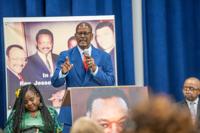
Former State Rep. Dr. the Rev. James Bush III speaking at the memorial service at the Marshall Davis African Heritage Cultural Arts Center
(Gregory Reed)
A farewell in Miami
Former State Rep. the Rev. Dr. James Bush III, a longtime leader and former Operation PUSH president in Miami, watched Jackson’s final years with somber preparation.
“When I heard the news, I got quiet in my spirit,” Bush said. “Because I was somewhat expecting it, just by looking at him. I just felt that he was on a decline.”
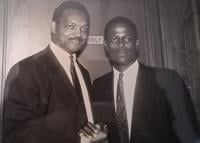
(L/R) The Rev. Jesse Jackson and former State Rep. Dr. Rev. James Bush III.
(Courtesy of James Bush III)
Bush’s connection to Jackson grew from admiration into direct organizing.
“I had been following Reverend Jesse Jackson’s leadership even back when Dr. Martin Luther King Jr. was assassinated,” Bush said. “I’ve always admired his leadership, his activism, his ability to articulate issues on the world platform.”
Through music, dance and testimony, leaders including Bush, the Rev. Richard P. Dunn II, and Rubin Young reflected on Jackson’s national stature and his specific imprint on South Florida.
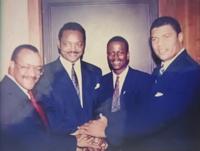
(L/R) Former County Commissioner and State Rep. James “Jimmy” C. Burke, the Rev. Jesse Jackson, former State Rep. Dr. Rev. James Bush III, and former Miami Commissioner Rev. Richard P. Dunn II.
(Courtesy of James Bush III)
“Jesse Jackson had done a lot to contain the dream of Dr. King. He kept on going when everyone else was going to other ventures,” Young said. “He kept the dream alive. He kept hope alive.”
For Dunn, Jackson was an inspiration. Dunn first met Jackson as a 17-year-old student at Miami Northwestern Senior High during a trip to Washington, D.C., in a hotel where Jackson was a guest.
“He came over to the hotel, and we got a chance to meet him, and I was just, ‘Oh my God, here’s a guy that you see on television all the time,’” Dunn said.
Years later, at Central State University, Dunn shared a stage with Jackson when the civil rights leader served as the keynote speaker.
“He rattled the students,” Dunn said. “But I’m on the stage with him. So I’m like, man, this is big time.”
That early exposure left what Dunn called an “indelible impression” that would shape his own activism.
Operation PUSH in Miami
Jackson founded Operation PUSH in 1971 and the National Rainbow Coalition in 1984, merging them into the Rainbow PUSH Coalition in 1996 to focus on economic justice, corporate accountability, and voter registration. He aimed to elevate marginalized communities through nonviolent direct action.
In 1986, a young Bush was appointed president of the Miami chapter.
“He really did a magnificent job in making sure that those corporations invest in the African-American community,” Bush said.
Bush recalled the intensity of the anti-apartheid movement, specifically boycotting corporations doing business with the South African regime.
“Jesse was calling national boycotts on Revlon hair products,” Bush said. “We were downtown in front of Walgreens, because these were companies that were doing business with the South African regime that was inflicting injustices.”
Bush traveled to Chicago for strategy sessions.
“They would give us all kinds of information, research that they had done on South Africa,” he said. “I would bring the information back and show it to young people and try to absorb everything you can.”
Local cosmetologists Ellen Bentley and Bertha Sneed even removed products from their shelves in solidarity.
“They were willing to take their products from their shelves and join us in the press conference,” Bush recalled.
Jackson’s influence also catalyzed local institutional change. Following the 1980 McDuffie riots, Jackson insisted that Miami’s Black ministerial leadership create its own organization, which became People United to Lead the Struggle for Equality (P.U.L.S.E.).
Inspired by Jackson’s tactics, Dunn helped organize a 1991 one-day boycott of Miami-Dade County Public Schools after a qualified Black deputy superintendent was passed over for the top job.
“We boycotted the school system for one day, and over 85,000 students didn’t go to school that day,” Dunn said. “Out of 1,000 bus drivers, 700 of them did not drive their buses. So we paralyzed the Miami-Dade County exclusively that one day.”
He said that the model of coordinated economic and political pressure mirrored Jackson’s national playbook.
“Rev. James Bush was the president of PUSH,” Dunn said. “And we were just helping whenever there was something that we were doing together, fighting for social justice and equality.”
Advocacy for the Haitian community
Jackson’s South Florida legacy is also inseparable from Haitian rights advocacy during the 1980s and 1990s, when asylum seekers fleeing repression were detained in large numbers. Bush described Jackson’s bond with the late Father Gerard Jean-Juste as central to that work.
In April 1980, Jackson marched in Miami alongside Haitians demanding political asylum. In 1982, he traveled to the Krome Avenue Detention Center to support detainees on hunger strikes. After being blocked from entry, he reportedly called Vice President George H.W. Bush directly from the facility.
“He spent 50% of his time coming here, in and out of Miami, addressing the Haitian plight,” Bush said. “He was the equalizer in helping the country see how important it was to stabilize the relationship in Haiti, as well as help those Haitians that were here in Miami-Dade County.”
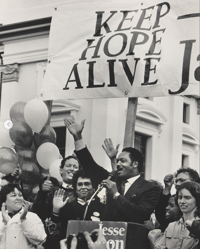
The Rev. Jesse Jackson during his presidential campaign.
(Instagram@revjjackson)
Young, who calls himself a “son of the movement,” remembered the electricity Jackson brought to Little Haiti.
“I ain’t never seen the masses of people scream a man’s name the way they screamed Rev. Jackson’s name,” he said. “When he echoed the saying, ‘I am somebody, I am somebody, keep hope alive,’ you can feel the electricity.”
A lasting impact
Jackson’s presence in Miami extended beyond protests. Following Hurricane Andrew in 1992, he partnered with Sweet Home Missionary Baptist Church in South Dade to aid recovery efforts. Bush, then a state legislator, recalled guiding him through devastated neighborhoods.
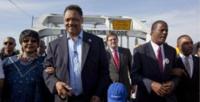
(L/R) Winnie Mandela, the Rev. Jesse Jackson, former State Rep. Dr. Rev. James Bush III, and Rubin Young at the 45th anniversary of the Civil Rights March from Selma, Alabama to Montgomery, Alabama.
(Courtesy of Rubin Young)
“He did not abandon Miami. He did not give up on Miami when the going got tough,” Bush said.
Moreover, Young and Bush shared stories of being on the front lines with Jackson, including a 2010 march across the Edmund Pettus Bridge in Selma alongside figures like John Lewis and Winnie Mandela.
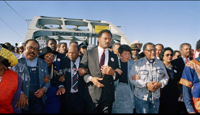
March 4, 1990 file photo: Civil rights figures lead marchers across the Edmund Pettus Bridge during the recreation of the 1965 Selma to Montgomery march in Selma, Ala. From left are Hosea Williams of Atlanta, Georgia Congressman John Lewis, the Rev. Jesse Jackson, Evelyn Lowery, SCLC President Joseph Lowery and Coretta Scott King.
(Courtesy of James Bush III)
Dunn emphasized that Jackson’s two presidential runs paved the way for the future. Jackson won 13 primaries and caucuses in 1988, a feat then unprecedented for a Black candidate.
“There would be no President Barack Obama if there were no Shirley Chisholm, if there was no Rev. Jesse Jackson,” Dunn said.
The tribute concluded with a call to action. Bush emphasized that the responsibility now belongs to the next generation to pick up the banner.
“If you are too big to respect the past, you are too small to lead the future,” he said. “We have to take the banner from Jesse and make sure we address injustice wherever it raises its ugly head.”
Young echoed the sentiment, linking the lineage of the Civil Rights Movement from its inception to the present.
“Dr. King took us to the River Jordan but wasn’t able to cross. Jesse Jackson took us through the water. Now, somebody’s going to take off from what Jesse Jackson left.”