
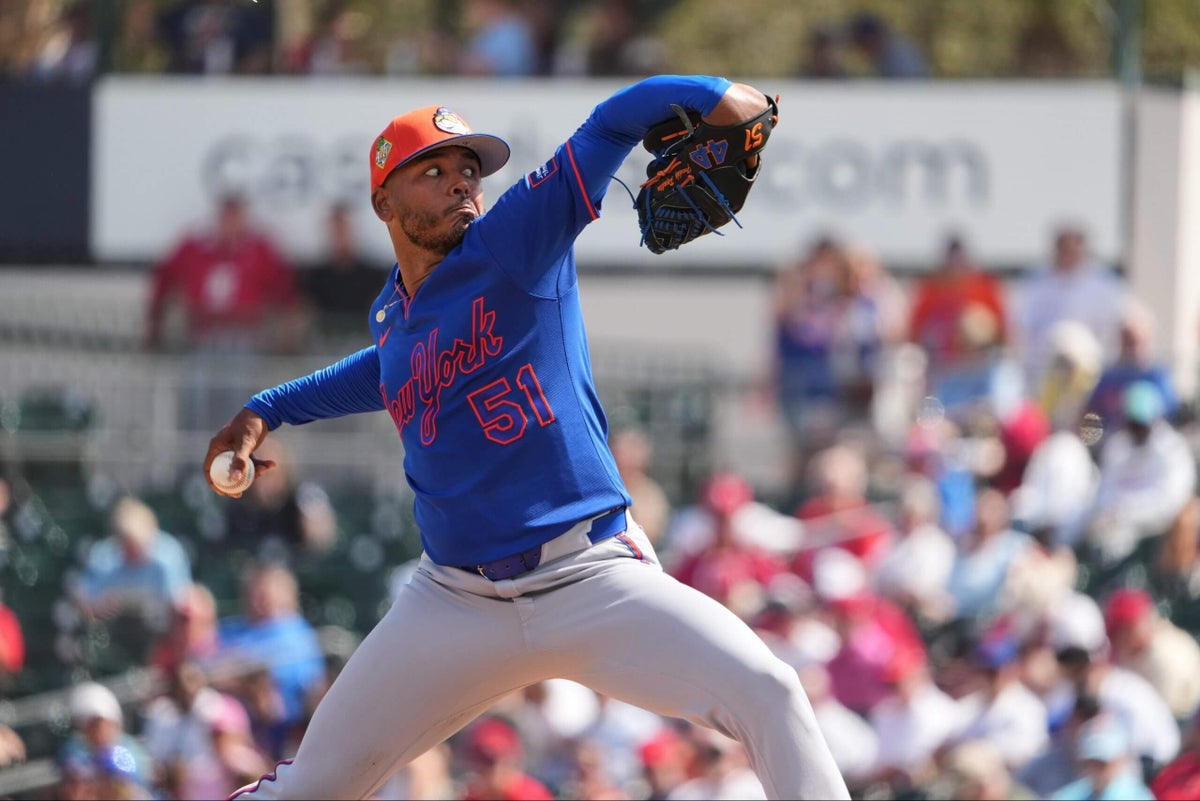
PORT ST. LUCIE, Fla. — If ever a player seemed destined to sign a contract extension with the New York Mets, it’s right-hander Freddy Peralta.
The only potential roadblock: Peralta, entering his age 30 season, said he doesn’t want one of the high-dollar, short-term deals that suddenly are in fashion – and the kind that make Mets president of baseball operations David Stearns most comfortable.
“I would prefer to go long and make sure I’m going to be in the place where I want to finish my career,” Peralta said.
Peralta, his agents at ACES and the Mets will get to the details in due course. When asked by reporters Friday if extension talks have occurred this spring, Peralta grinned and replied, “No comment.” But according to a person familiar with the Mets’ thinking, no serious discussions have taken place.
Not to worry. Peralta has deep ties to Stearns and Mets vice president/special assistant Eduardo Brizuela from their time together with the Milwaukee Brewers. And for Peralta and other players who are natives of the Dominican Republic, both the Mets and Yankees are always natural fits as Dominicans form the largest immigrant population in New York.
When Peralta was 11, his Little League team from the Dominican spent a summer month in New York. Citi Field was the first major-league park he visited. He even threw a no-hitter against a team in the Bronx.
Last Opening Day, when Peralta’s Milwaukee Brewers visited Yankee Stadium, he reserved 40 tickets for friends and family to watch his start. Ask him if he has a lot of relatives in New York, and Peralta responds in the affirmative, saying they are in the Bronx, Queens, Manhattan, “everywhere.”
“And when I say a lot,” Peralta said, flashing his trademark smile, “it’s a lot.”
Stearns and Brizuela aren’t quite family, but by baseball standards, they’re close to it. Peralta is the only player Stearns has traded for twice, first with the Brewers at the 2015 winter meetings, then with the Mets just over 10 years later.
Matt Arnold, the Brewers’ current president of baseball operations, was the first to inform Peralta of the more recent deal, on Jan. 21 – Peralta and righty Tobias Myers for infielder/outfielder Jett Williams and righty Brandon Sproat. Peralta said when Stearns contacted him, “I could feel his smile in the phone call.”
Stearns said, “I could feel his smile, too.”
Cincinnati Reds third baseman Eugenio Suárez is renowned for his “good vibes only” catchphrase. Peralta is the pitching version of Suárez, beloved by players from all cultures and backgrounds. If ever a player could help bridge whatever rift developed between Mets stars Juan Soto and Francisco Lindor last season, that would be Peralta, too.
Naturally, Peralta already is loving life in the Mets clubhouse. He initially feared his new team might try to change his routine, but nothing of the sort has occurred. The Mets, from the players to the coaches to the athletic trainers, have been easy to work with, Peralta said.
“The way that they welcomed me was amazing,” Peralta said. “Honestly, coming from the bottom of my heart, I’m very happy to be here.”
So, with Peralta earning $8 million in the final season of his current deal, how difficult can it be to work out an extension?
Stearns liked him enough to extend him once already, with the Brewers in February 2020. But Peralta’s next deal is almost certain to be much larger than that five-year, $15.5 million steal.
As Stearns enters his third season with the Mets, he has yet to sign a pitcher for more than three years. According to The Athletic’s Will Sammon, he did offer Yoshinobu Yamamoto the same terms the Japanese right-hander received from the Los Angeles Dodgers – 12 years, $325 million. But Yamamoto was 25 then, five years younger than Peralta is now.
Comparing Peralta to pitchers of similar age and accomplishment, Sammon and Tim Britton project a four-year, $112 million extension for Peralta. If Peralta indeed wants a longer deal, the Mets could find other paths to satisfy him, perhaps by adding years but at a lower average annual value.
Though extensions frequently are completed in late March, the Mets need not get a deal done by Opening Day. They could negotiate with Peralta during the season, similar to what the San Diego Padres did with righty Joe Musgrove in 2022, signing him to a five-year, $100 million extension on Aug. 1. They could also wait until the end of the season and bid for Peralta before and after he hits the open market.
Free-agent contracts for pitchers are often unpredictable. A year ago, few would have expected right-hander Dylan Cease to secure a top-of-the-market deal coming off arguably his worst season. Likewise, few would have expected righty Zac Gallen to end up with a one-year deal at a present-day value lower than the qualifying offer he rejected.
Peralta last season threw a career-high 176 2/3 innings and produced the best league- and park-adjusted ERA of his career, finishing fifth in National League Cy Young voting. His one goal this season is to reduce his walk rate, which generally is in the 9 percent range.
He might not be a pure ace – his expected 3.43 ERA last season was well above his actual 2.70 mark – but he’s certainly a quality and fairly durable starter. His last trip to the injured list for arm trouble was in 2022.
The first time Stearns traded for Peralta, the pitcher was 19 and in rookie ball with the Seattle Mariners. Stearns was 30 and in his first year as Brewers general manager. First baseman Adam Lind was the lure that brought Peralta and two other minor-league pitchers to the Brewers. Neither Carlos Herrera nor Daniel Missaki reached the majors. But Peralta developed into a two-time All-Star.
The Brewers easily could have afforded Peralta’s salary this season. But Peralta said he knew, “inside of me,” that he would meet the same fate as former Brewers pitchers Josh Hader, Corbin Burnes and Devin Williams, all of whom were traded before they reached free agency.
It didn’t bother him.
“I kind of knew that they wanted to keep me, but probably couldn’t afford my value in the future,” Peralta said. “I knew it was better for them at that moment because they could get players for me, multiple players.”
He was home in Miami when Arnold called to inform him of the trade. They had a great conversation, Peralta said, reminiscing about his achievements in Milwaukee. In the moment, Peralta felt he was going to cry.
Stearns called next, welcoming him to the Mets.
“It was crazy,” Peralta said. “I couldn’t sleep, thinking about everything, about Milwaukee, where I was headed to.”
He was headed back to a team run by Stearns, back to a city that already seemed like home. Baseball teaches us to expect the unexpected, but a contract extension for Peralta seems inevitable. It’s already difficult to imagine him anyplace else.