
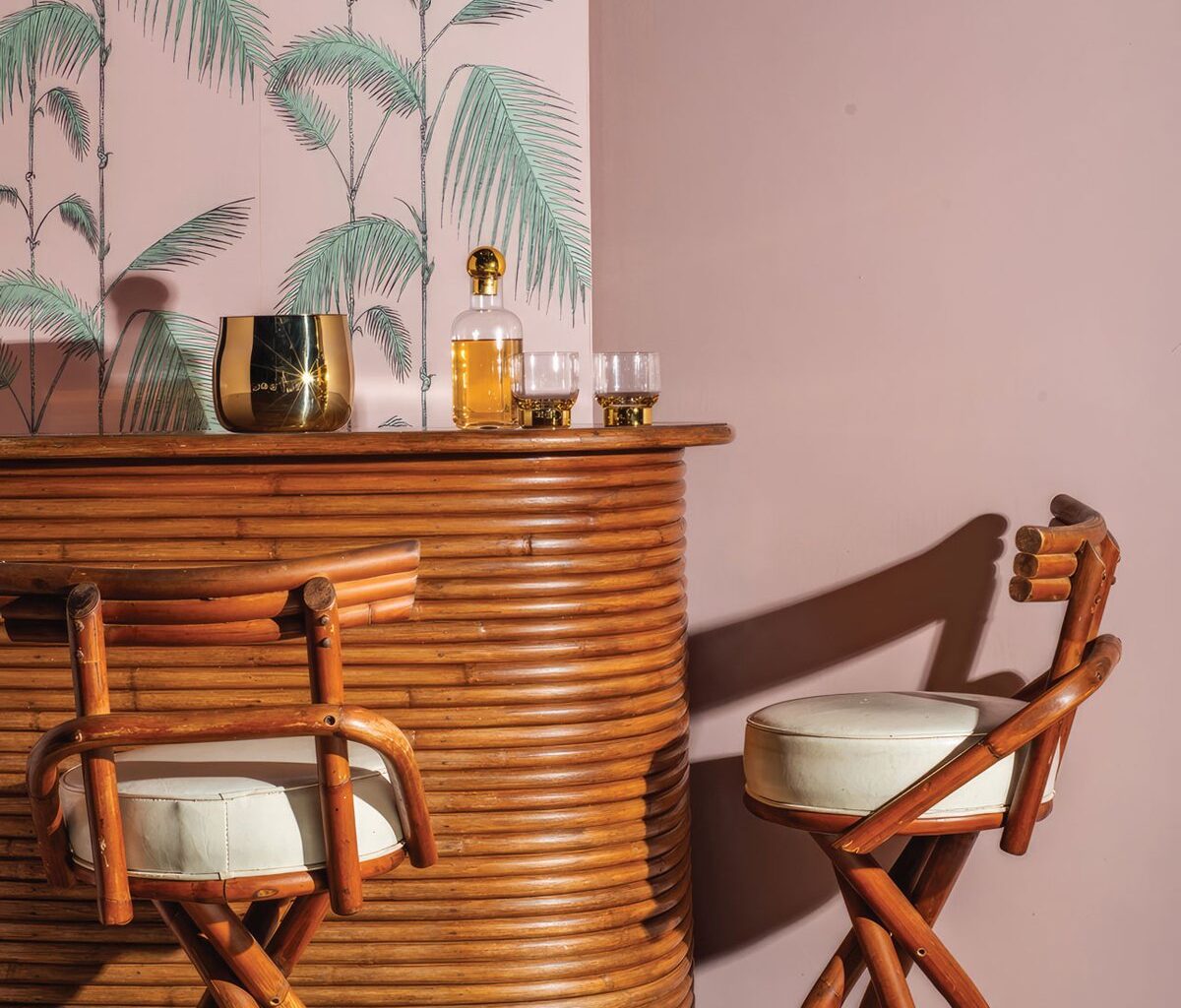
Brittany Greenwood strolls through the maze of rattan and bamboo furnishings in the barn behind her rural Fort Myers home. It’s well past dinner time, and she’s already changed into sweats for the night, but she flips the lights on in her appointment-only showroom for a returning client who’s just flown in for season and can’t wait to shop. She’s known to pour a glass of wine or shots of tequila as she shows off her trove of furniture.
Brittany’s Bamboo Barn operates as her oversized treasure chest. Gilt mirrors and lacquered chairs glow among honey-toned textures and saturated ceramics filling the rows of Brittany’s curated inventory. “I guess I’m kind of like Kevin Costner. If you build it, they will come. But it’s not a baseball field. It’s Old Florida regency furniture,” she laughs. Clients regularly trek an hour or more from Port Royal and Boca Grande to shop her concentration of furnishings born of Florida’s early resort culture.
Though never codified academically as a distinct style, the aesthetic is often referred to as Palm Beach regency. Brittany bristles at the term’s limiting nature, pinning it only on the Sunshine State’s east coast. “I think the West Coast is the forgotten stepchild,” she says. The genre proliferated throughout South Florida in the 20th century, wherever seasonal wealth met subtropical climate. Drawing on the high-gloss confidence of Hollywood regency, designers translated stately Neoclassical silhouettes into breathable bamboo, rattan and sawgrass. Citrusy hues, tactile finishes and playful coastal allusions loosened the mood, while the genre’s structured forms kept the pieces elegant. She coined the term Old Florida regency to describe her stock. For Brittany, preserving the style is part of a larger desire to honor Florida history as a whole—the environment, the culture, the family memories.
A Kentucky native, Brittany first came to Southwest Florida as a child in the 1970s, visiting her great-grandparents in their Fort Myers Beach mobile home—a place built for gathering, not display, filled with bamboo tables, shell lamps and palm tree motifs. “I can’t tell you how many of these chairs I saw as a little girl,” she says, pointing to a wicker armchair.
She moved to Fort Myers Beach permanently with her mother, Sondra, in 1988. The duo opened and ran three furniture consignment shops in the coastal town, where Brittany sharpened her instincts and developed a near-immediate sense of what works. She found herself drawn to the Florida regency pieces, enamored by their warmth and timelessness. “It connects design directly to Florida’s history and lifestyle in a way that still feels fresh today,” she says.
Brittany sources, restores and sells everything from daybeds to framed prints online—through her website and via reputable retailers Chairish and 1stDibs—and by appointment in her oak-shaded barn. “People will come in here and go, ‘Oh my gosh, what a cute hobby you have,’” she says. Brittany stiffens at the reference, which reduces a decade of expertise to something crafty. It’s her livelihood.
Her decisive nature extends beyond business. She married her husband, Jeffrey, within two months of their first date, and two decades later, she credits him for her successes. She bought the 10-acre property in 2019 at his urging and launched the showroom the following spring. After crunching numbers, Jeffrey gave her a challenge: Bring in at least $8,000 a month for the first three months. “Jeff had a great idea. I’ve gotta tell him every day he was right—and it sucks,” she says with a laugh. He remains steadily by her side as the business grows, overseeing the operational and technical side.
In early days of the business, the pandemic limited in-person shopping, so Brittany turned to social media. “Anytime I would post it on Instagram, it was gone,” she says. Within weeks, she was shipping furniture to the Bahamas, California, Australia and the Mediterranean. Her timing coincided with the long-dismissed style’s resurgence alongside a renewed interest in vintage furnishings and a cooling toward beach-house minimalism.
Her work has since been featured in Veranda and Design + Decor. Last year, Brittany’s Bamboo Barn was named one of House Beautiful’s Best Home Shops of 2025. The year prior, she was accepted as a vendor on 1stDibs, a luxury marketplace known for its rigorous vetting process. She’s also become a go-to source for designers hunting vintage Florida furnishings, like Bahamian design titan Amanda Lindroth. “This is a joke, right?” she said when the designer first called her. Amanda is credited with elevating the subtropical furnishings from nostalgic relics to coveted acquisitions for high-end homes. In Southwest Florida, Brittany works with Julia Liegeois and Annie Brahler, though many of her local homeowners come directly to the barn. “I built this place so people could come,” she says. “People come here and don’t wanna leave.”
Most of Brittany’s inventory dates from the 1930s through the 1980s, spanning the genre’s evolution, from foundational prewar refinement through midcentury panache and the later years, when the style spread beyond winter estates. A handful of 19th-century bamboo pieces reflect early influences of the style.
A network of buyers scans estate sales nationwide on her behalf, flagging pieces, even when their condition is compromised. She restores about 90% of her inventory through a process refined over years of research and trial and error. At minimum, that means scrubbing years of grime and re-caning worn seats. “I’m not going to over-refinish those,” she says, alluding to a set of 1940s Adirondacks. “I love the whole rustic vibe and the distressing.” At its most exacting, Brittany and Jeffrey may take a piece apart to stabilize the frame, re-wrapping joints in the original pattern, and rebuilding the finish slowly so the material regains its natural warmth rather than looking stripped or newly coated.
Many of the pieces in the barn have already lived several lives—through 1950s socialite homes, hotel lobbies, estate sales and long periods of neglect. Brittany’s restoration work absorbs that history. Furnishings leave the barn carrying their age lightly, their lineage still legible. For Brittany, all the stories circle back home. “Old Florida style feels like my childhood,” she says. “It’s important to me to keep the past in the present for as long as I can breathe life into these pieces.”