
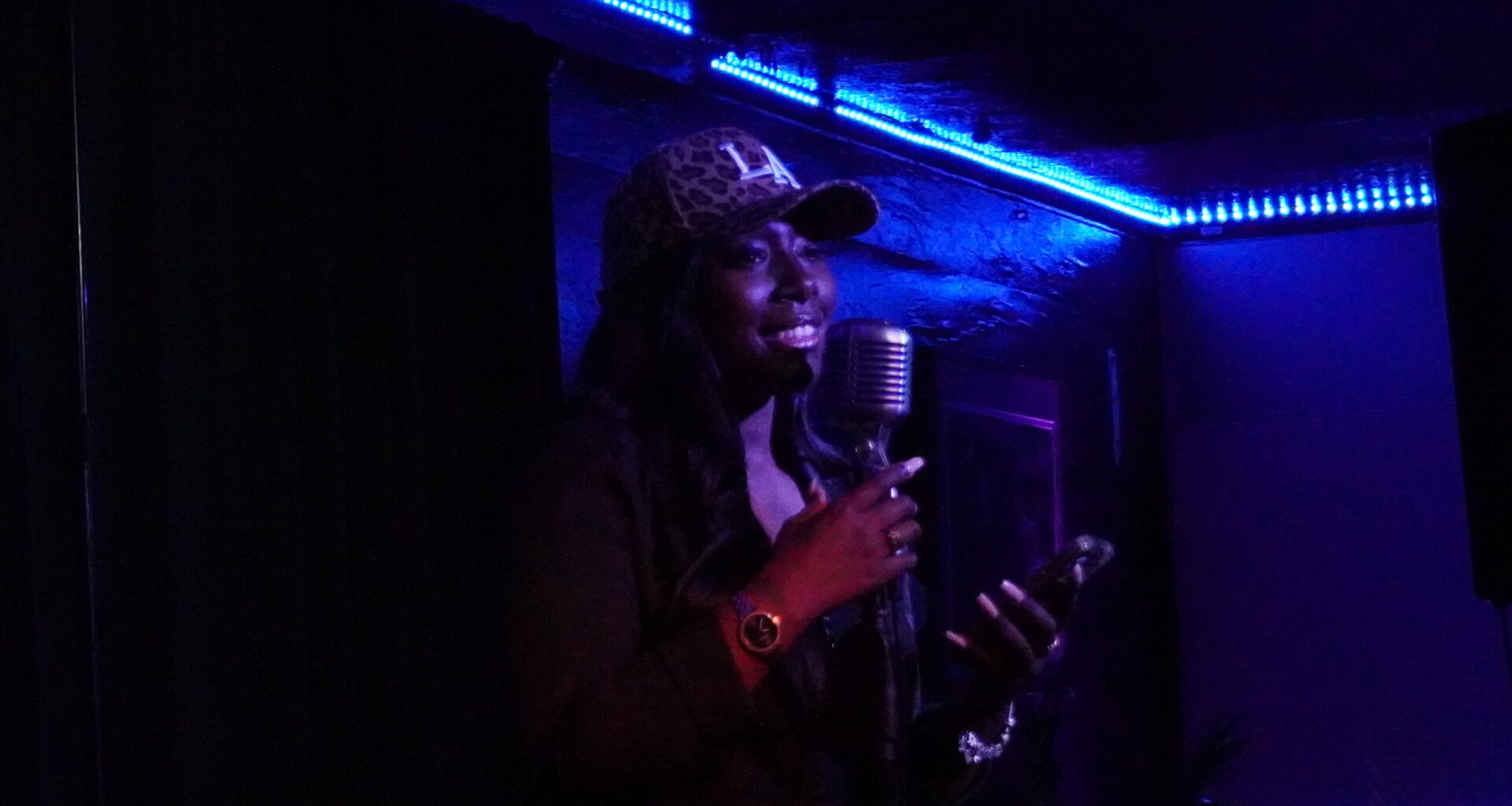
Performer at The Signature Lounge. (Jace Hopkins/FAMUAN)
When the call rings out — “Back talk!” — the crowd answers in unison: “Talk back!” The room hums before the first word is spoken.
Inside The Signature Lounge in Tallahassee on Feb. 6, poets, singers and listeners pack into dim lighting, incense curling through the air as anticipation builds. A community open mic reflects the spirit of the Harlem Renaissance, highlighting Black creative expression transitioning from struggle to storytelling.
This is Black on Black Rhyme, a community open mic held every first and third Friday of the month, where spoken word becomes both performance and release. During the 100-year anniversary of Black History Month, the event feels especially rooted in history, echoing a tradition that stretches back to the Harlem Renaissance.
During the 1920s, Black artists used poetry, music and performance to define themselves on their own terms amid systemic racism and social constraint. A century later, Black on Black Rhyme carries that same purpose forward, offering a space where Black voices are centered, affirmed and heard.
Keith Rodgers, founder and creator of Black-on-Black Rhyme, said the name itself reflects that mission.
“Back in the day, there was this thing called ‘Black-on-Black crime,’” Rodgers said. “So we took a negative and made a positive out of it. Instead of crime, we say ‘see the rhyme.’”
Rodgers, a U.S. Army veteran, began the event in the late 1990s in his apartment, inviting poets to gather with little more than notebooks, incense and shared food. What started as an informal creative outlet grew into a movement with chapters across the South and internationally.
“We didn’t start this intentionally as a business,” Rodgers said. “It became a need. People needed a place to say what they had inside.”
That need remains evident today.
The event’s audience included a mixture of generations bound by shared experience, ranging from students at Florida A&M University and Florida State University to high schoolers and longtime community leaders.
For artists like Lunchbox, who perform under a stage name, the space is about freedom.
“It’s important for people to express themselves,” Lunchbox said. “To speak what’s on their mind and express their experiences. I love being able to tell my story to people I’ve never met and know we’re hearing each other.”
Another performer, who goes by the stage name Outspoken, described Black on Black Rhyme as “soulful,” crediting the space for giving him a voice.
“It gave me a pen and a pad,” he said. “A lot of times we have things to say, but don’t know how to say them. This gives you that option.”
Rodgers sees spoken word performance as timeless. Not a continuation, but a constant.
“In the beginning, it was the word,” he said. “As long as you can talk, poetry is going to be here.”
As the night winds down, applause fills the room after one final performance. A poet steps offstage, embraced by cheers instead of silence. The crowd lingers, still talking, still listening.
Like the Harlem Renaissance before it, Black on Black Rhyme proves that Black creativity doesn’t fade with time, but instead adapts, survives, and speaks back.