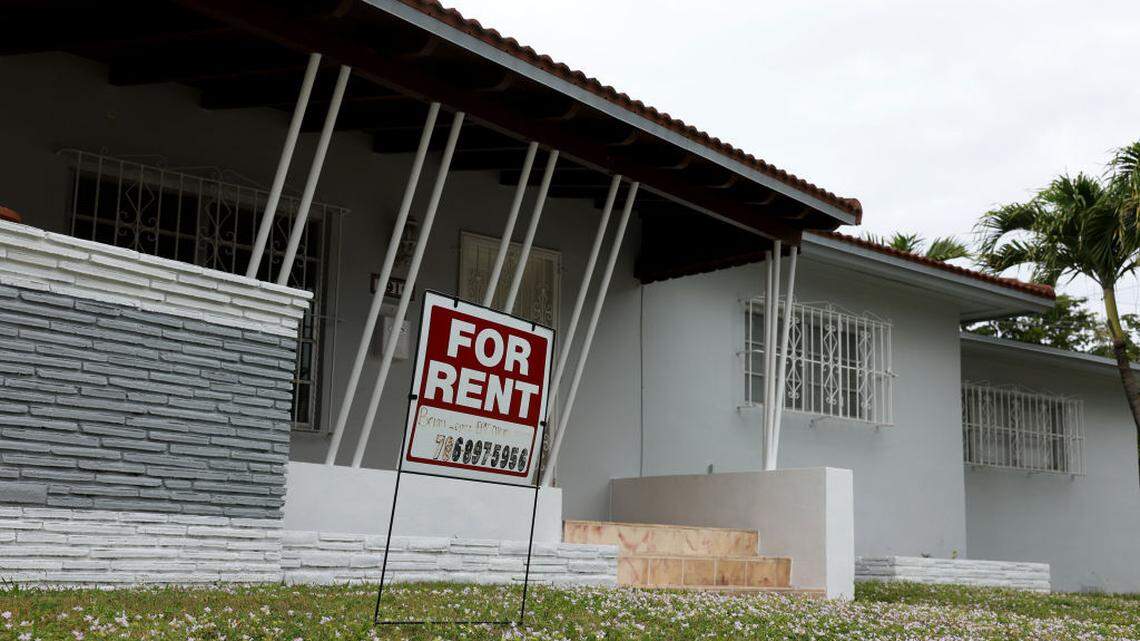
A “For rent” sign is posted in front of a home on Dec. 12, 2023 in Miami.
Joe Raedle
Getty Images
Housing costs strain Greater Miami residents more than those in nearly any other major U.S. metropolitan area, a new report has found.
The median income for a two-person household in the Miami metro area is about $99,100 — roughly $86,800 for a single person or $123,900 for a family of four.
Households earning those amounts or less face among the greatest housing cost burdens of residents in the country’s 50 largest metro areas, a new report from the National Low Income Housing Coalition shows.
Since the start of the pandemic, housing costs have risen far faster than incomes. That’s true across the country, but even more so in Florida — and most acutely in Greater Miami, said Anne Ray, director of the Shimberg Center for Housing Studies at the University of Florida.
In 2024, the U.S. Department of Housing and Urban Development estimated that $2,324 was a fair monthly rent for a two-bedroom apartment in the Miami metro area, a nearly 60% jump from the $1,454 HUD considered fair in 2019.
Over that same period, the median household income in Greater Miami increased by only 34%, according to U.S. Census Bureau data.
But Florida — and especially Miami — isn’t just short on affordable housing for the poorest renters. It is the worst or near-worst state in the country for housing affordability across almost every income level below the median, the report found.
A shortage of homes
The less money you have, the harder time you’ll have finding a place to rent.
For every 100 Florida renters with extremely low incomes — less than 30% of their area’s median income — there are just 26 affordable homes available, the seventh-greatest shortfall of any state in the country.
But moving up the income ladder, Florida — and Miami-Dade in particular — faces housing shortages seen almost nowhere else in the United States, the report shows.
In the Greater Miami area, there are just 27 affordable homes for every 100 renters earning less than half the area median income — roughly $50,000 for a household of four. The average across major U.S. metropolitan areas is double that.
Statewide, that translates to a shortage of roughly 655,900 rental homes affordable to those households, according to the report. Nearly a third of those missing homes are in Greater Miami.
Those earners overwhelmingly work in Florida’s most common jobs, according to data from the UF’s Shimberg Center.
They’re customer service workers and retail salespeople. They’re cashiers, drivers and nursing assistants. They tend lawns, cook and serve food, clean buildings and make sure the goods we all rely on are trucked from point A to point B.
And they struggle to afford to live. Nearly half of Floridians can’t make ends meet, a reality that holds for 54% of Greater Miami-Dade households.
Why is Florida so expensive?
Since the 1990s, but particularly since 2020, Florida’s growing population, which contributed to the rising cost of housing, combined with stagnant wages has put pressure on Florida renters.
“This is a long-term trend nationally but much more accelerated in Florida, where rents and home prices have risen much more quickly than incomes have,” said Ray, of the Shimberg Center.
Especially during the pandemic, when wealthy out-of-staters flooded into Florida, home prices skyrocketed. Between the middle of 2020 and 2021, the average sale price of a single-family home in Miami-Dade almost doubled, according to the Miami Association of Realtors.
That put homeownership out of reach for many, keeping would-be homeowners in the rental market for longer, a dynamic Ray says “puts pressure on rental markets,” driving up prices and making it difficult for renters to afford their homes.
What can be done?
During the pandemic, “we briefly built out the safety net,” Ray recalled. Emergency rental assistance and eviction prevention measures helped keep people in their homes.
An expansion of rental assistance and affordable housing supply could help relieve the pressure so many in the rental market are feeling, she said. So, too, could homeownership initiatives.
Ultimately, the problem boils down to one simple fact: “There’s a wide and growing gap between what wages pay and what housing costs,” said Ray.
This story was produced with financial support from supporters including The Green Family Foundation Trust and Ken O’Keefe, in partnership with Journalism Funding Partners. The Miami Herald maintains full editorial control of this work.