
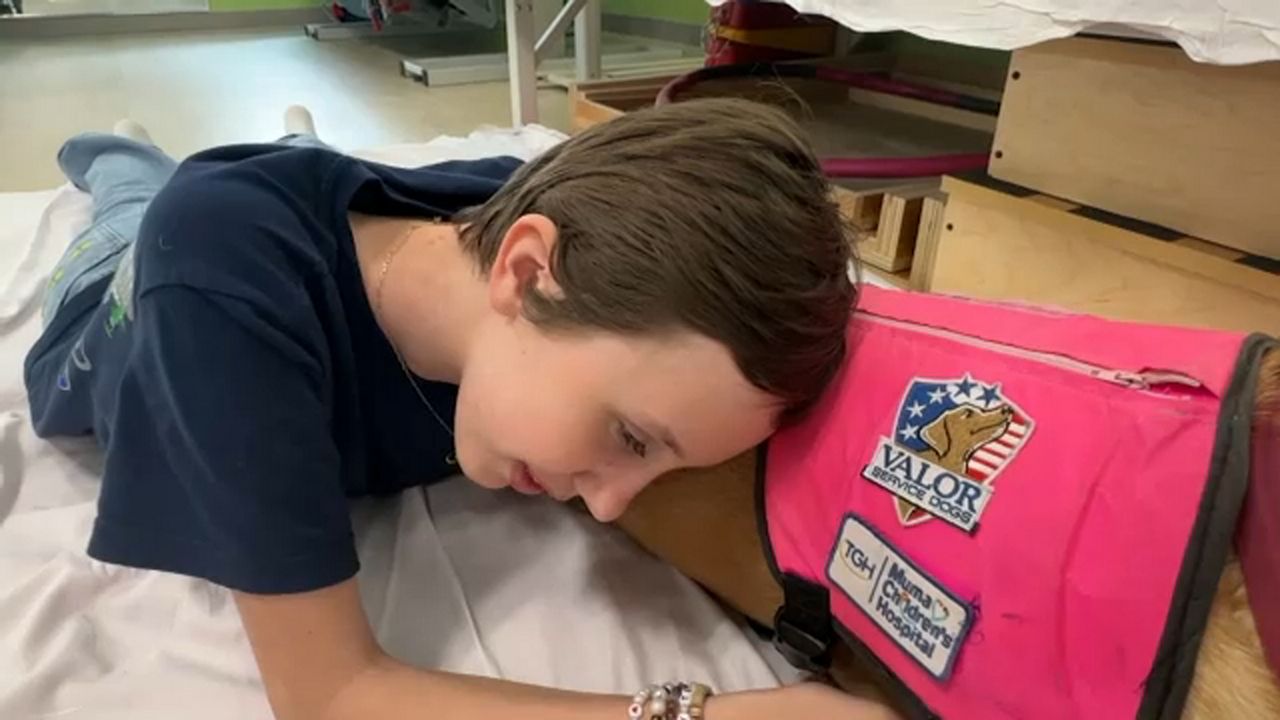
TAMPA, Fla. — Animal lovers know how much comfort and unconditional love can come from four-legged friends.
The Muma Children’s Hospital at Tampa General Hospital wanted to find out more about the effect of animal-assisted therapy on a child’s rehabilitation. The hospital is leading research to quantify that impact. USF Health is also participating in the study.
“As a child specialist working with these pediatric facility dogs, we see the impact that these dogs make on the kids,” said Paige Rechsteiner, Child Life coordinator at Muma Children’s Hospital at TGH. Rechsteiner is “Millie’s” handler.
ABOVE: Watch Melissa Eichman’s report.
“She is the chief snuggle officer here at Muma Children’s Hospital,” Rechsteiner said of Millie’s official title.
Together, they have about 2,000 encounters with pediatric patients a year.
“We see that they tend to be a little less anxious when they’re in these procedures, when they’re in these rehab sessions, and so we wanted to see if we could quantify what we were seeing, if we could actually track that and get it in numbers,” Rechsteiner said.
Research began in the fall of 2023.
“We looked at different markers of anxiety and heart rate to see if those things were changing during therapy sessions and to see if the kids were less anxious, but also more cooperative with their rehab sessions as well,” said Rechsteiner.
Fifteen-year-old Caddie Schelle says Millie made her feel more at ease after suffering a brain bleed last summer.
And those snuggles and time with Millie helped build her strength.
“Having our kids throw a ball for Millie helps them keep their balance, but also works on their arm strength as well,” said Rechsteiner, who says activities with Millie are intentional for a patient’s progress.
Millie was with Schelle through her time in the ICU and during physical therapy.
“She’s the sweetest thing ever, makes me laugh,” said Schelle.
Those are moments Caddie’s father also appreciates.
“The worst thing for a parent is to see your child in pain or afraid,” said Rob Schelle. “So, to give her just a few moments of calm is always relaxing to you as well.”
Once the data that measures that calm and comfort has been analyzed, which is expected in a few months, Rechsteiner hopes the findings will help create guidelines for hospitals across the country.
“How to best help those patients in rehab programs and how to include that animal-assisted therapy,” she said.
Better understanding therapy that helps distract and comfort kids with the strength of unconditional love.
“Gets you a bit more motivated,” said Caddie Schelle.