
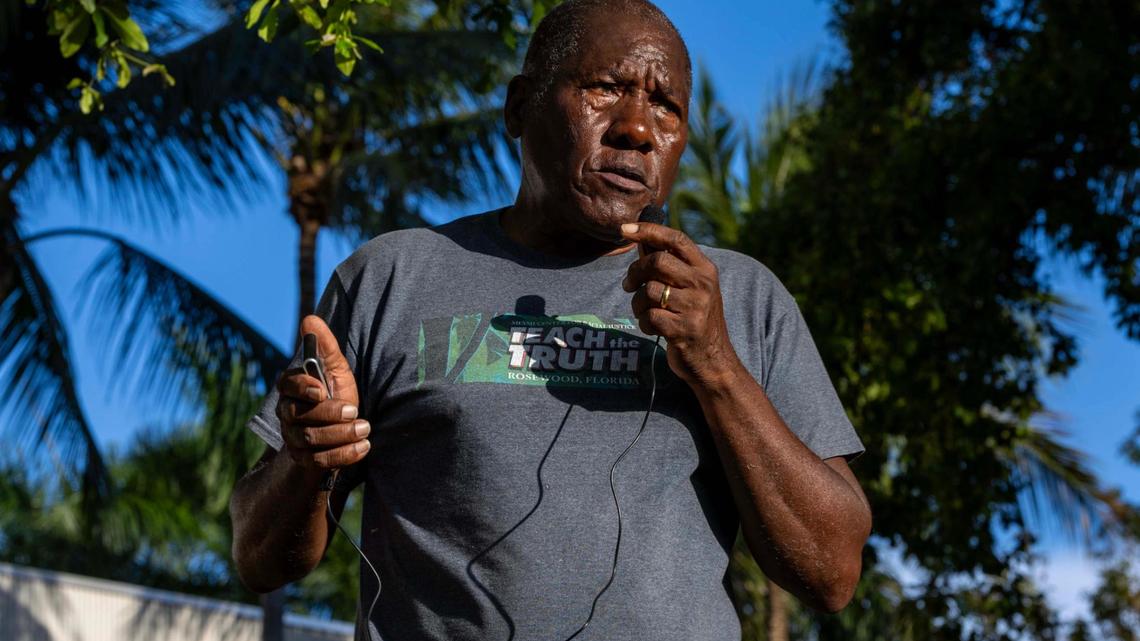
Former Florida International University professor and historian Marvin Dunn speaks to attendees about the Rosewood Massacre during a “Black History Learning Tree” event at FIU on Tuesday, April 1, 2025, in Miami, Fla.
D.A. Varela
dvarela@miamiherald.com
Historian and activist Marvin Dunn’s job is to bring Florida’s Black history to life — whether through his Teach the Truth Tours, the under the Black history tree at Florida International University, speaking at schools about racism and discrimination, or through the many protests he’s held to fight injustices.
Now, Dunn, an 85-year-old Florida native and former professor at Florida International University, has detailed his research and findings in a textbook geared toward middle school children, with the hopes they will learn the state’s Black history — the painful parts and the triumphs— and understand how it informs their future.
“I just want them to understand the scope of Black history,” Dunn said. “That is not to make anybody feel guilty or bad, but to simply tell the truth about the difficult struggle that Black people have had in Florida.”
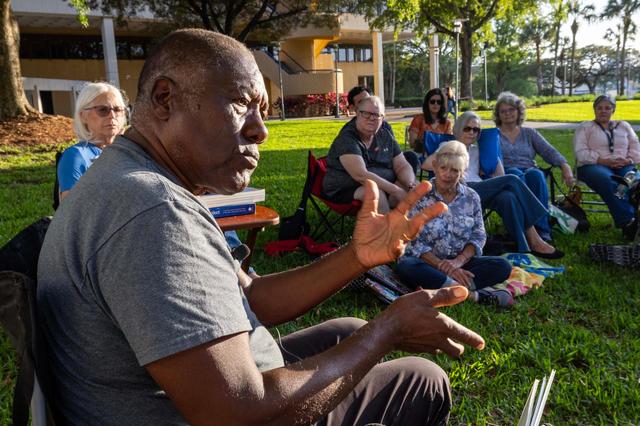 Former Florida International University professor and historian Marvin Dunn speaks to attendees about the Rosewood Massacre during a “Black History Learning Tree” event at FIU on Tuesday, April 1, 2025, in Miami, Fla. D.A. Varela dvarela@miamiherald.com
The textbook, “The History of African Americans in Florida,” was born out of a desire to accurately tell the history of Black Americans in the state and the United States at a time when textbooks are altering Black history. Dunn said his Teach the Truth Tours, which he holds across various parts of the Southeast to educate students about Black history, also motivated him to write the book.
READ: ‘Telling our history correctly’: Activist hosts Black history class under a tree at FIU
Dunn’s textbook comes at a time when the state has limited how Black history is taught in school, and as state-approved sociology textbooks for universities omit units on race, gender and sexuality. It is also a trend seen nationally as the Trump administration has signed executive orders to eliminate what they consider diversity, equity and inclusion initiatives and threatening to withhold funding from schools that they find ideologically out of line.
Dunn is hoping he can work with state legislators to get the book in classrooms though it’s available for purchase online for $30. He’s already made trips to Tallahassee to speak with Florida state legislators about the book and the response so far has been positive.
Florida’s Black history
The 244-page book begins with 1513, when a few Black men first arrived in what is now Florida with Spanish conquistador Juan Ponce de Leon, chronicles the state’s history with slavery, the Civil War, Jim Crow, the civil rights movement and Florida’s more recent Black history, with the mention of U.S. Supreme Court Justice Kentaji Brown Jackson and late State Sen. Carrie Meek. He also features biographies of prominent Black pioneers such as astronaut Mae Jamison and author Zora Neale Hurston, entertainers such as rappers Flo-Rida and Doechii and athletes Deion Sanders and Coco Gauff. The book also includes landmarks such as the Lyric Theatre in Overtown and Lincolnville Museum and Cultural Center in St. Augustine.
The book delves into Florida’s rich Black history including the Fort Mose, the first free Black community in what is now St. Augustine Florida, history on Black Seminole leaders, the history of Kingsley Plantation in Jacksonville and segregated beaches and wade-ins, and includes several pictures of historic figures, landmarks and artifacts for middle school students.
The book does not, however, include references to incidents of racial violence, such as the lynching of Willie James Howard or the Rosewood Massacre, stories Dunn has told plenty of times during this Teach the Truth Tours and at the Black History tree he established on Florida International University’s campus. He said he didn’t believe it was appropriate for middle school students to learn about racial violence just yet, but he doesn’t shy away from the harm inflicted upon Black people.
“I was very intentional in the language to make sure that the truth was before them. I didn’t hold back anything that I thought they needed to know,” Dunn said, adding students interested in learning more can visit his website dunnhistory.com. “I tried not to use language that would frighten them or upset them, but I used direct language that I thought middle school kids could incorporate it and learn from, and that was very intentional.”
Dunn said he wanted to address institutional racism, policies and practices put into place that limit the economic, political and legal viability of a specific group of people, with the hopes students understand how it affects their future. Dunn said children understanding how those policies affected all aspects of Black life would better inform their future.
“I refuse to let the idea, the concept, the practice of institutional racism be lost to our kids,” Dunn said. “If they know that these rules, these unfair rules and practices were realities, then they would understand why you have a higher degree of poverty and disadvantages among plants compared to white people. That was an important concept for me to get over to them.”
But Dunn stressed that the textbook highlights Black people’s triumphs as much as it highlights their struggles. “We need to know that we have people who stood up and fought and everybody didn’t turn the other cheek,” he said.
Miami Herald
Raisa Habersham is the race and culture reporter for the Miami Herald. She previously covered Hollywood and Fort Lauderdale for the Herald with a focus on housing and affordability. Habersham is a graduate of the University of Georgia. She joined the Herald in 2022.