

 Chéshona Shapiro, Maggi Van Der Poel, Lana Bernstein, and Mia Glick get together for mah-jongg. Photo by Lauren Alexis Rodriguez
If it feels like everyone in Miami is suddenly playing mah-jongg, it’s because they are. Moms share meetup invites at school drop-offs. The posh members’ club at The Moore hosts a weekly open play on Monday evenings. The funky ceramics collective Ocisly introduced a make-your-own game-set class, which sold out within four hours. A local tournament at a Miami Beach synagogue had to set up extra tables to accommodate overflow crowds.
Miami has always been a city that loves whatever is in vogue, so it should come as no surprise that if there’s a mah-jongg wave sweeping the nation, Miami is getting in on the tile-clacking. The so-called “granny game” has gotten a Miami-style glow-up, with $1,500 sets and private-chef-catered game nights—par for the course in a city that rewards splashy, maximalist moments.
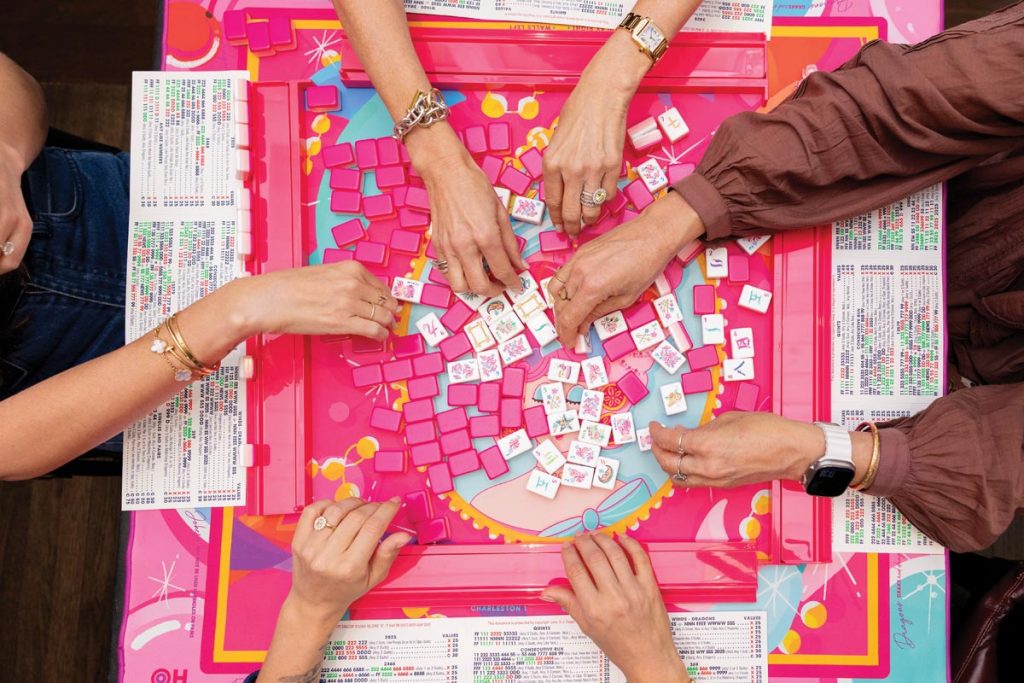 The tile-based game is originally from China but was “Americanized” in the 1920s. Photo by Lauren Alexis Rodriguez
Mah-jongg originated in China during the mid-nineteenth century and gained popularity with the American upper classes in the 1920s, when businessman Joseph Babcock Americanized a version of the pastime. In the 1950s, the tradition spread within Jewish women’s networks, most notably in the Catskills. The kinship between Miami and the Catskills is well-established, and until recently, mah-jongg thrived among the city’s senior set.
 Mia Glick has been teaching mah-jongg for a decade, from private homes to friendly competitions. Photo by Lauren Alexis Rodriguez
Interest in mah-jongg surged during the COVID pandemic, driven by the influx of New Yorkers, social media, the soothing nature of the tiles, and networking opportunities. Celebrity fans—including Sarah Jessica Parker, Julia Roberts, and Kelly Ripa—only added to the cultural cachet. The National Mah-Jongg League today claims more than 400,000 members, based on sales of its annual card, which acts as a kind of playbook, with rules and different hand patterns introduced each year to keep the practice fresh.
“What personally drew me to it was that I found myself sitting at home during the pandemic, watching Netflix, doom-scrolling, and feeling like I lacked community,” explains fashion blogger Maria Tettamanti. “I wasn’t using my brain, and mah-jongg just felt like the perfect fit. Between padel, pickleball, knitting, and cross-stitching, mah-jongg was the hobby that spoke to me the most. So, I decided to get three friends together and take lessons, and that’s how we learned.”
The social aspect of the game is what hooked writer and actress Jill Kargman. The self-professed “mah-jongg slut” even found time to play while in town promoting her film Influenced at the Miami Jewish Film Festival, drawn to the social ritual it creates. “It’s about community,” Kargman explains. “I’m bitching or gossiping, socializing, and being with my girls. Our phones are down, and it’s about conversation and challenge. Plus, you’re also staving off dementia because of the pattern recognition.”
 Chéshona Shapiro, Maggi Van Der Poel, Lana Bernstein, and Mia Glick. Photo by Lauren Alexis Rodriguez
Many Miamians are similarly drawn to the cognitive benefits of the tile-based pastime, which research has linked to improved brain health in older adults, including better memory, attention, and problem-solving skills, and the potential to slow cognitive decline by engaging in complex processes such as pattern recognition and strategy.
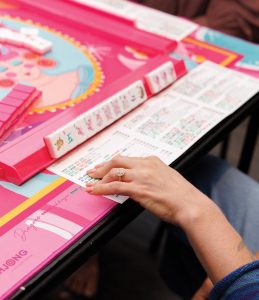 The board. Photo by Lauren Alexis Rodriguez
“My mother-in-law passed away three years ago with Alzheimer’s, and there’s all this research on how board games and mah-jongg are stimulating for neurodegenerative issues,” explains publicist Lana Bernstein, who plays in a weekly group. “I thought this would be a good idea, even though I don’t have any degenerative issues in my family. It wasn’t super easy to learn, but I stuck with it because it was a fun group to play with, and it’s been entertaining ever since.”
One thing is for sure—mah-jongg is a complicated and initially confusing pursuit. Mia Glick, a former model, yoga teacher, and now mah-jongg maestro, went from teaching classes at the Miami Beach JCC to maintaining a full roster of private students who keep her zigzagging across the city. “I tell people playing mah-jongg is like patting your head, rubbing your stomach, and stomping your feet at the same time,” Glick says with a laugh.
“It takes time to see the value of the game,” Glick continues. “There’s a click that happens, but sometimes it can take up to four lessons for that to happen.” She emphasizes that mah-jongg can evolve into an almost hallowed ritual that gives players a sense of belonging and consistency, noting that she had a regular group she played with for 10 years. “It becomes a sacred time in your week, where you know that on a specific day you’re going to be meeting with the same friends.”
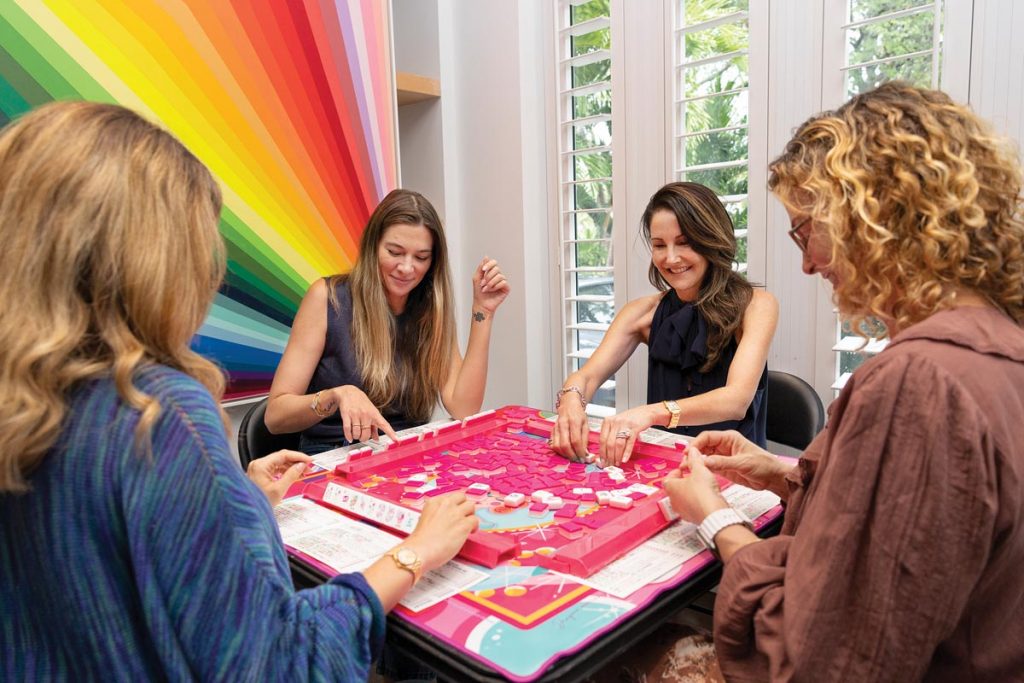 Mah-jongg is underway. Photo by Lauren Alexis Rodriguez
There’s also a chance to show off your tile tactics. On March 5, the Miami Beach JCC hosted a mah-jongg tournament spearheaded by Bernstein and Glick. Designed for both beginners and advanced players, the event offered a welcoming introduction to tournament-style play while reinforcing the social ritual at the heart of the pastime.
For a more low-key experience, there’s Stack’d Society in North Miami, the city’s first mah-jongg members’ club and lounge. Created by mah-jongg aficionados Dana Segal and Shana Benhayoun, Stack’d Society is a stylish space outfitted with multiple game tables dressed in batik tablecloths and colorful mah-jongg sets, upholstered chairs, and a lounge area with potted orchids and soothing design elements.
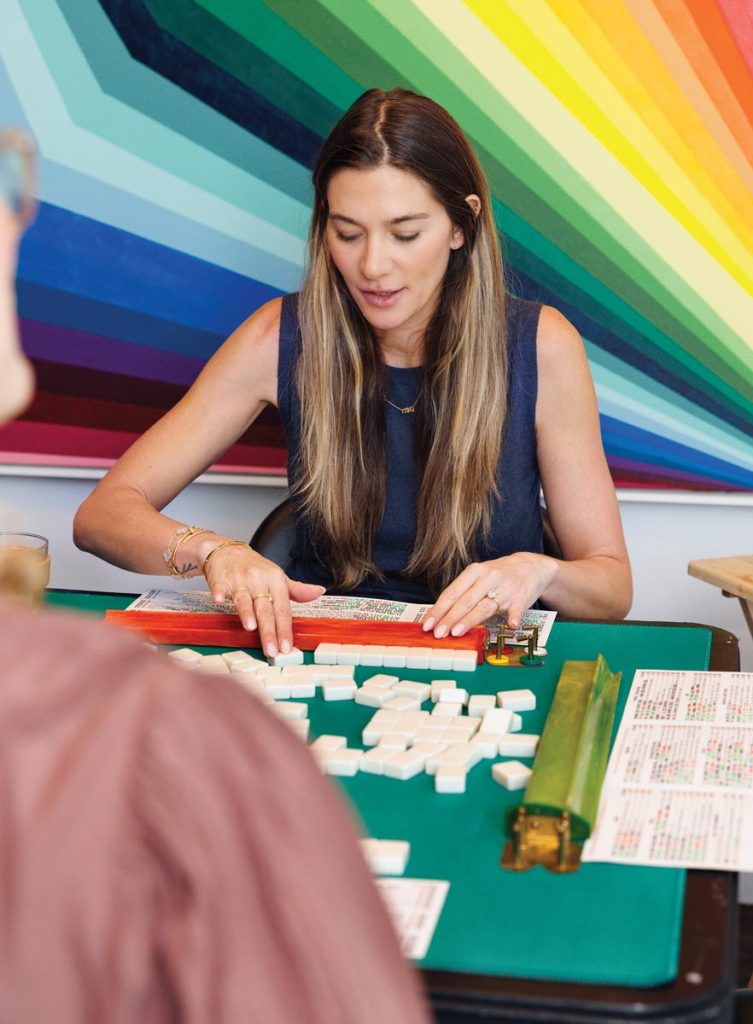 Mah-jongg’s intricate rules, ever-changing hands, and new cards issued every year keep the game mentally stimulating and engaging. Photo by Lauren Alexis Rodriguez
Originally, Benhayoun was hosting classes on an informal basis at her main business, SBT Stitches, a personalization store that specializes in high-quality embroidery and gifts. “I’d been playing mah-jongg for years, but I was playing with older ladies, and I wanted to find people my own age to play with,” says Benhayoun, who is in her thirties and has two small children. “I introduced mah-jongg classes at my store and started teaching people on a monthly basis. Then I began hosting free weekly games, and they blew up. I had anywhere from five to 10 tables of players every Wednesday night.”
 Chéshona Shapiro. Photo by Lauren Alexis Rodriguez
Segal became a regular and eventually proposed that the two open a space together. The duo designed Stack’d Society to be a neighborhood “third place,” where members can connect and build community through the simple joy of play. The club isn’t limited to mah-jongg—they also offer canasta classes—and there are plans for an after-school program for kids and charity events.
For busy Miami socialites tired of the lunching-ladies scene, this moment offers a stimulating new option. And for many of these women—who are CEOs of their home lives and have a talent for turning overwhelming situations into manageable structures through proactive organization—mah-jongg is perfectly suited to occupy a great deal of brain bandwidth, with the added benefit of sensory stimulation.
“I love the ritual because it’s all about making sense out of chaos,” says Segal. “You get your tiles, and it’s chaotic and you don’t know what to do. Then suddenly you need to make sense and come up with the lines. It’s kind of like what’s happening in life.”
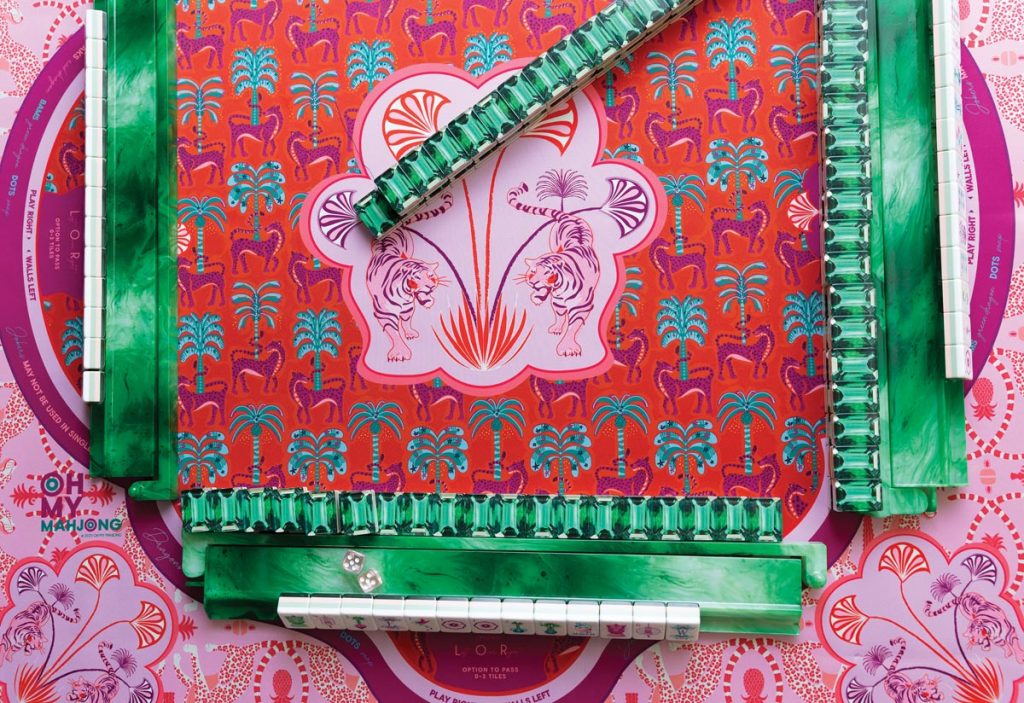 Mahj Market taps into the game’s latest trend with a chic rental concept. Photo by Lauren Alexis RodriguezMahj Market
Launched last fall by Miami moms and mah-jongg players Courtney Zinn and Jessie Veador, Mahj Market taps into the game’s latest trend with a chic rental concept. The company offers everything needed for play—tiles, racks, tables, and mats—for private parties, nonprofit and corporate events, brand activations, and more. Individual rentals are also available for visitors from out of town, whether they’re in Miami for a week or a long weekend. The curated selection features high-end sets from brands like Oh My Mahjong, Peace Love Mahjong, and My Fair Mahjong, with vibrant, rustic, and tropical designs and customization for every occasion—including a Labubu-themed mat.