
by Miranda Mattingly, USF Research Development Institute
The USF Future of Food Think Tank launched in January 2025 with a bold aim: to build a university–community movement
capable of reshaping Tampa Bay’s food future. One year later, that movement has become
a network of more than 265 members and 94 partner organizations—spanning community
agencies, government, nonprofits, and industry—anchored by faculty across USF’s 14
colleges and four food‑focused centers and initiatives. Together, they’ve created
a level of collaboration that turns ideas into action and action into a shared regional
narrative.
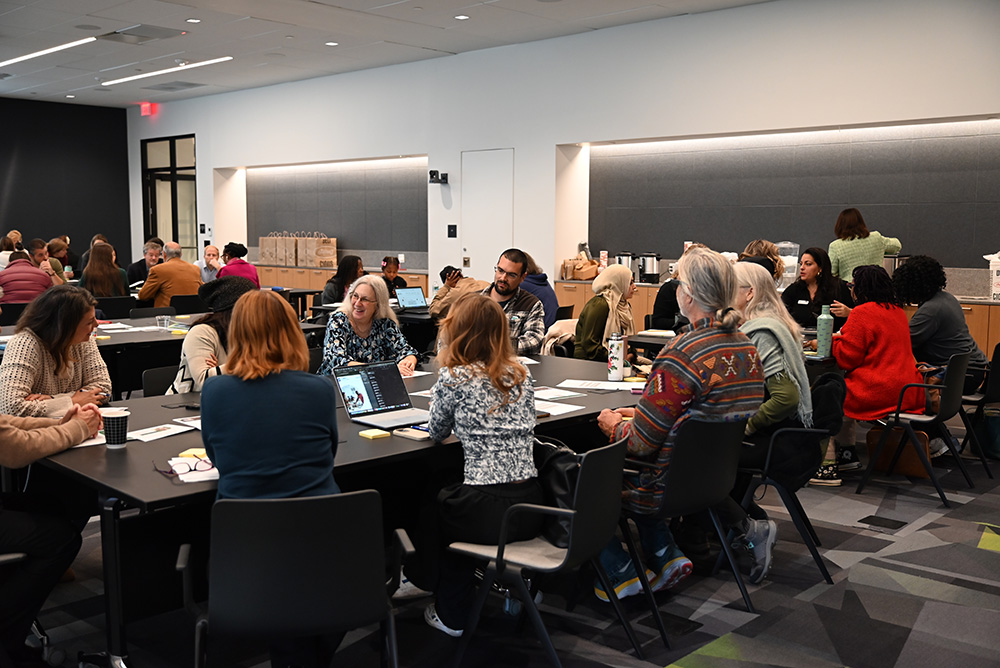
The think tank marked its first anniversary during the Community Resiliency Hub Stakeholder
Forum on January 30. Seventy partners used the milestone as a working strategy session—stress‑testing
the concept of a campus–community engine, studying hub models at UC Davis and Arizona
State, and shaping a localized roadmap centered on regenerative agriculture, education
and workforce development, food‑as‑medicine and community health, and food system
research and resilience. The forum closed with a public Commitment Wall capturing
concrete partnerships and next steps, signaling that the coalition is not simply growing—it
is aligning, coordinating, and accelerating.
That same co‑design spirit drives Sowing Strategic Stories, a new pilot project with
Dr. Tingting Zhang and the Novel Approaches to Agriculture working group. The initiative
pairs USF master’s business students with local farms and food system providers—Packet
Line Urban Farm, 813 HoodGarden, Homegrown Hillsborough, and Kitchen Wit Teaching
Kitchen—to create research‑based marketing narratives that highlight the economic,
agricultural, and community value of emerging food production models. The pilot delivers
usable communication tools now while showcasing a compelling regional identity that
elevates the work—and the worth—of Tampa Bay’s local food system.
The Think Tank’s first year also affirmed a central principle: data must guide direction
and impact. Poor diet quality is now the leading risk factor for death in the United
States, surpassing tobacco. Nearly 90% of patients want to rely more on healthy eating
than medication, yet fewer than half report receiving clear dietary guidance in primary
care. These gaps point to a critical Tampa Bay opportunity: align care delivery, insurance
coverage, and community infrastructure so nutrition becomes a consistent, accessible
component of health.
That data-to-action approach was on display at Feeding Tampa Bay’s inaugural Health
+ Hunger Summit, where USF faculty Drs. David Himmelgreen and Heewon Gray connected
food insecurity directly to chronic disease. Their insights underscored emerging evidence
that food insecurity is now a measurable driver of poor health outcomes and a contributor
to the nation’s leading causes of death—helping frame Feeding Tampa Bay’s shift toward
a health‑focused, food‑as‑medicine strategy.
Building resilience also requires operational readiness. After the 2024 hurricane
season exposed vulnerabilities across the regional food system, the Think Tank’s Emergency
Food Response working group worked to initiate a partnership with United Way Suncoast
to bring business continuity training to the Tampa Bay area. Launching next month,
sessions on April 7 and May 5 at the Hillsborough County Public Safety Operations
Complex will help organizations protect cold chains and inventory, plan for disruptions,
and speed recovery.
One year in, the USF Future of Food Think Tank shows what coordinated growth can achieve:
a coalition that learns, decides, and acts together; a portfolio that turns research
into tools, training, and policy insight; and a region actively co‑designing the engine
that will scale what works. Year two has already begun with accelerating momentum
and a movement ready to build the food future Tampa Bay deserves.