
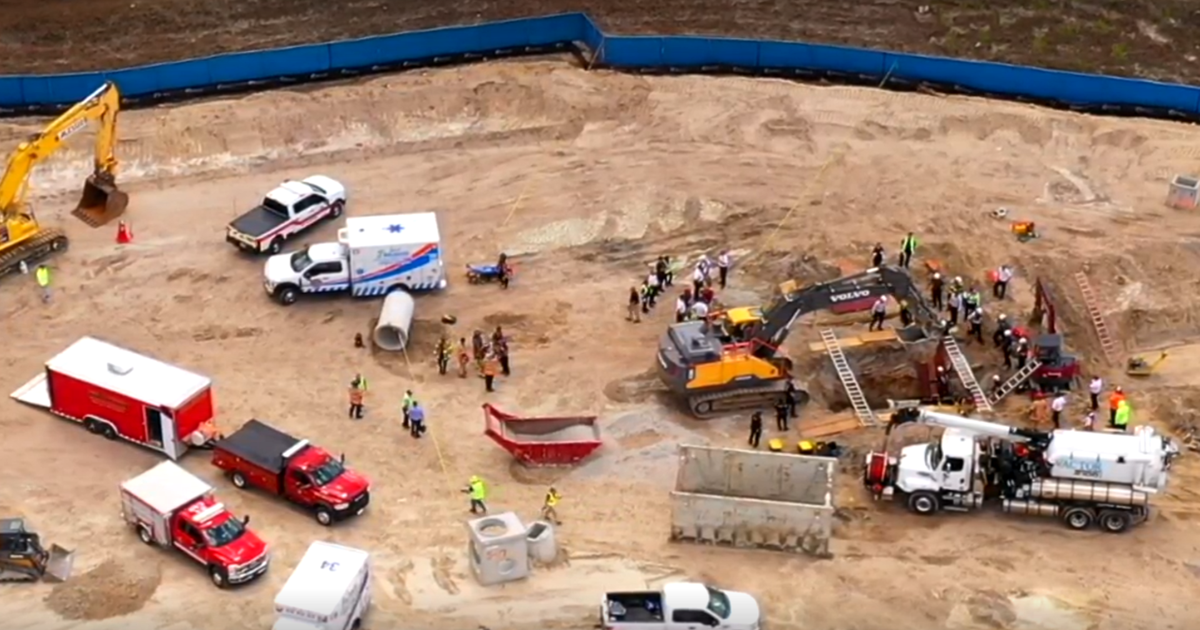
CAPE CORAL, Fla. (WINK)—A deep construction trench collapse is now the center of a federal investigation.
While first responders successfully pulled a man from the 12-foot-deep hole Monday afternoon, the focus has shifted from rescue to regulation as OSHA (Occupational Safety and Health Administration) investigators arrived on-site to determine if safety protocols were ignored.
The Cape Coral Fire Department has confirmed OSHA arrived on scene Monday. Chief WINK Investigates Reporter Chorus Nylander made repeated inquiries with OSHA but the agency hasn’t provided any comments.
The incident occurred at a construction site for a new two-story Lee Health medical facility. The general contractor, Naples-based DeAngelis Diamond, confirmed they are cooperating with federal authorities but declined to comment further on the active investigation.
“Yesterday there was accident involving a trade partner, team member who became temporarily pinned at a site in Cape Coral. Emergency responders arrived quickly and were able to safely extricate the individual. We are grateful for their efforts. We have secured the work area and are cooperating fully with the responding agencies and any subsequent investigations, because this is an active investigation we can not provide additional details at this time.” – Kaisa Schmidt – VP Marketing and PR
The Danger of “Type C” Soil
In Florida, the earth beneath a construction site is often a hidden enemy. According to Wade Kundinger, Executive Director of the Cape Coral Construction Industry Association (CCCIA), the region’s geography plays a major role in site stability.
“I think about Florida, and I think about how loose and sandy our soil is,” Kundinger said. “It’s not as firm as other areas of the country. It’s a little scary.”
OSHA classifies most of Florida’s sandy soil as Type C, the least stable category. Because this soil lacks cohesion, federal law is uncompromising:
The Five-Foot Rule: Any excavation deeper than five feet must utilize shoring, bracing, or a trench box.The “Competent Person” Requirement: A designated expert must inspect the trench daily and after any change in conditions (like rain) to deem it safe for entry.Investigating the Records
The investigation will look beyond the physical site. Records show the project had passed multiple permit inspections, including one on the very morning of the collapse. However, Dr. Ehab Shaheen, an OSHA-certified instructor at FGCU, notes that investigators will be looking for specific technical failures.
“First of all, they secure the site, take measurements, and samples of soils,” Dr. Shaheen explained. He added that the presence of water—common in Florida’s high water table—drastically weakens soil structures. “If you add water to the system, soil gets weakened.”
Trench safety is a recurring nightmare for Southwest Florida. In 2022, a similar project in Cape Coral turned fatal when two workers were killed in a cave-in. Nationally, the stakes remain high; OSHA reported 13 trench-related deaths across the country in 2024, the most recent data available.
If violations are found, OSHA has the authority to impose significant financial penalties. The investigation is expected to take up to six months.
“This is a reminder of just how dangerous construction sites can be. When we are talking to our members, everything we say is slow down, look around, pay attention. Primarily when you’re digging… it’s frightening,” Kundinger said.
WINK News has confirmed that OSHA has opened an investigation into this incident. OSHA has six months to complete this investigation. During that time, no additional information can be provided.