
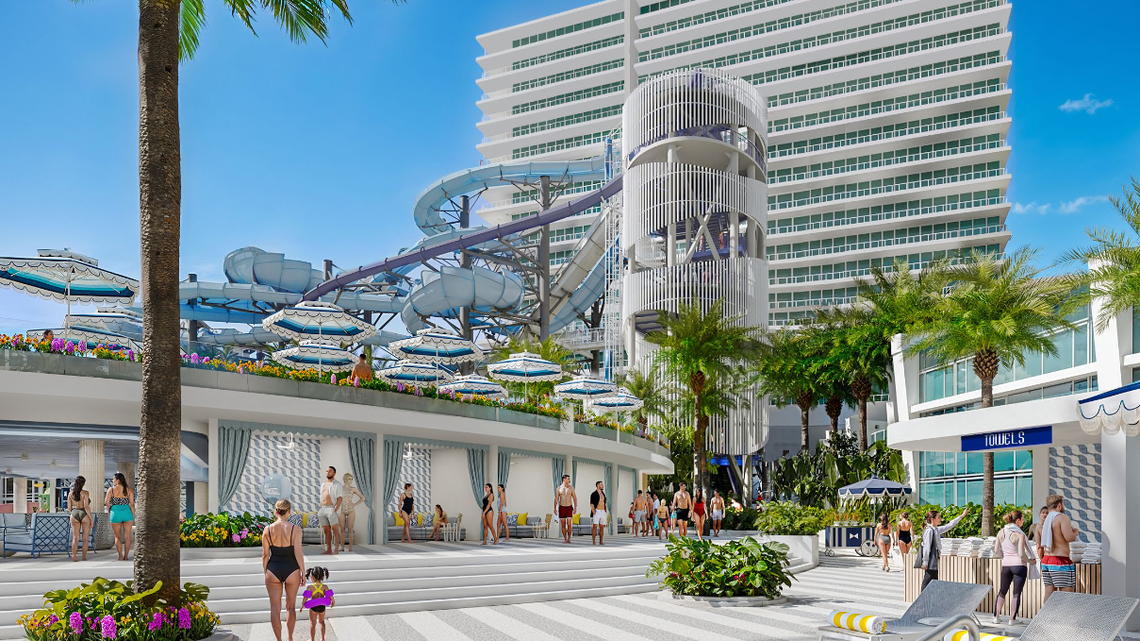
Miami Beach officials and dozens of residents gathered Tuesday morning on the boardwalk in front of the Fontainebleau Hotel to voice their opposition to a state House bill that would allow the hotel to build water slides on its pool deck.
Language added to the legislation late last month as a result of lobbying by the Fontainebleau would let the hotel bypass a review process by the Miami Beach Historic Preservation Board and install the water slides, a proposal that has drawn a wave of backlash in the Mid Beach neighborhood.
The legislation seeks to streamline development processes throughout Florida by including a number of new requirements in local governments’ comprehensive development plans. Provisions contained in both the House and Senate versions aim to reduce development application fees and provide more clarity to builders whose plans get rejected.
“Tallahassee is not the zoning board of Miami Beach,” Mayor Steven Meiner said at Tuesday’s press conference. “That’s what this is about.”
A review process that has been in place for decades, Meiner said, “is now threatened because of literally a single issue.”
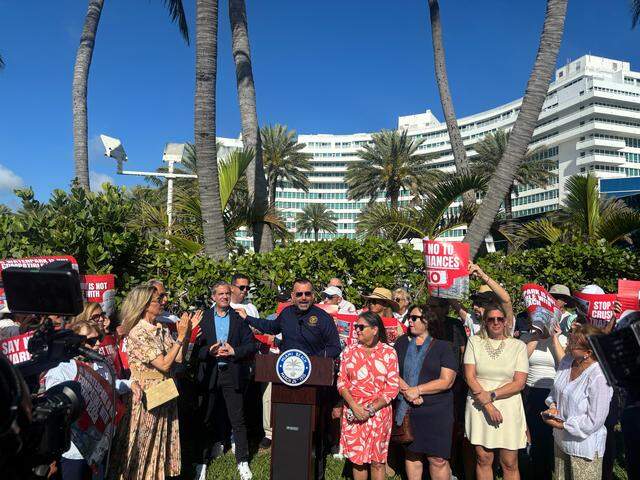 Miami Beach Commissioner Alex Fernandez (center) acknowledges Mayor Steven Meiner during a press conference to oppose state legislation alongside other city officials and residents in front of the Fontainebleau Hotel on Tuesday. Aaron Leibowitz aleibowitz@miamiherald.com
House bill HB 399, sponsored by Doral Republican Rep. David Borrero, passed last week, 71-38.
Republican Rep. Fabián Basabe, who represents Miami Beach, voted against it, previously telling the Herald/Times he had concerns that the resort development amendment was “added late without full committee vetting” and was “drafted so narrowly it benefits only one or two properties in a built-out community facing infrastructure strain.”
The bill’s Senate companion, SB 208, is scheduled for a floor vote Wednesday. There are key differences between the bills, and it’s unclear what the final proposal, which has to be agreed upon by both chambers, will look like should the Legislature pass it.
The Senate version doesn’t contain the most controversial provisions of the House bill, including the resort amendment that would benefit Fontainebleau. It also doesn’t include a different House provision allowing development in the Everglades with a simple majority vote of the Miami-Dade County Commission. Currently, two-thirds of the 13-member board must approve projects, creating a high bar for greenlighting development.
Both the House and Senate versions, however, propose a study on eliminating the Urban Development Boundary, which limits development in the Everglades and other protected areas. While there are other urban boundaries throughout Florida, the impact would be so great on Miami-Dade, it was singled out in a staff analysis.
Commissioner Alex Fernandez, who sponsored a resolution that the Miami Beach City Commission unanimously passed on Feb. 25 opposing the legislation, noted that the opposition spans political parties and geography. On Monday, Fernandez joined a coalition of city, county and state lawmakers from South Florida who spoke against the proposals to study eliminating the Urban Development Boundary.
On Tuesday, Fernandez said the legislation’s “sweeping consequences could be irreversible for our community, from as far west as the Everglades to as far east as Miami Beach,” Fernandez said.
After the press conference, Fernandez emailed his constituents, asking them to write Tallahassee officials urging them to vote against the bill, including the Senate president and the governor’s chief of staff.
The governor has the power to veto legislation passed by the Legislature.
This story was originally published March 10, 2026 at 4:10 PM.

Miami Herald
Aaron Leibowitz covers the city of Miami Beach for the Miami Herald, where he has worked as a local government reporter since 2019. He was part of a team that won a 2022 Pulitzer Prize for coverage of the collapse of the Champlain Towers South condo building in Surfside. He is a graduate of Columbia Journalism School’s Toni Stabile Center for Investigative Journalism.