
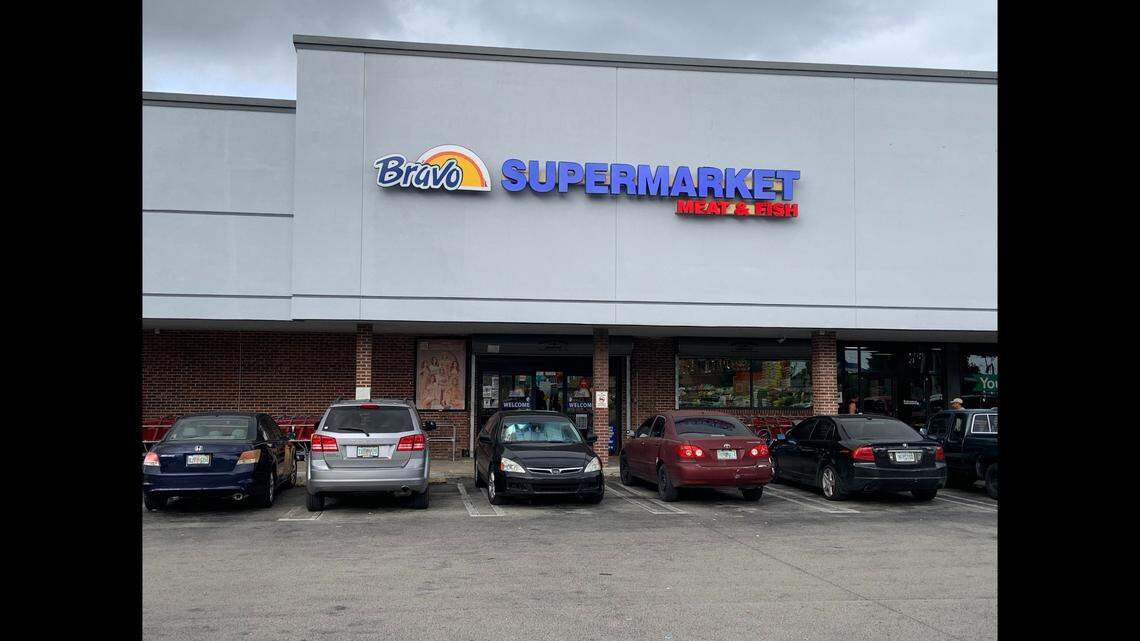
Inadequate handwashing, poor food storage and general lack of cleanliness caused a South Miami-Dade supermarket to fail state inspection for the second time in 27 months.
Oh, and there was also that claim about a cancer-preventing food product made in the Bravo Supermarket at 11247 SW 152nd St. in Richmond Heights.
At least, this time, unlike the December 2023 inspection, only natural juices moistened the ham and the rice looked insect-free.
READ MORE: Live bugs in rice. A drain hose dripping on ham. Fly on fish. Bravo supermarket problems
Other problems caught the eyes of Florida Department of Agriculture and Consumer Services inspectors Guisella Uribe and Wenndy Ayerdis on their March 2 visit, and they made liberal use of their Stop Use Order and Stop Sale powers.
“Advertisement for store-made juices packaged and displayed in the retail area stated that their coconut water prevents cancer.”
The store took the advertising board down.
The processing area’s coconut cutting machine blades were “encrusted” with “old food residue.”
Similarly, in the seafood area, “old food residue was encrusted on the conch meat tenderizer blades.”
The meat department’s band saw sat “beneath a heavily-leaking” air conditioning drain line.
The food service, processing, meat, produce areas had “Grease deposits, old food residue, and debris were found accumulated on the fan guards, sides of the fryer units, stove, and preparation tables.”
A box of raw chicken was “stored directly on the floor in the walk-in cooler.”
Food service employees “did not wash hands before donning gloves to handle food items for customers after handling money at the register.”
One food service employee “was observed dispensing soap into their hands and rapidly passing their hands under running water without rubbing the soap over their hands for at least 20 seconds.”
The processing area food employees “did not wash their hands between entering and exiting the food processing area, handling unclean wiping cloths and unclean utensils before returning to handle food items for customers.”
Had the processing area food employee done some handwashing, they would’ve been left with wet hands if doing it at the handwash sink without paper towels or a mechanical blower.
Food service and processing area food workers had trouble with the “single-use gloves” concept as they “did not change gloves as required between entering and exiting the processing area to handle food and unclean utensils, and then returning to continue serving food to customers.”
There was “no splash guard installed between the handwash sink and a rolling rack of bread” in the food service area.
Instead of being in buckets of sanitizer when not in use, wet wiping cloths sat on prep tables in the meat, food service and processing areas.
Instead of thawing in a walk-in cooler, “Bags of frozen vegetables were found thawing at ambient temperature in front of the stove” in the processing area.
“Reduced-oxygen packaged frozen fish were found thawing without first opening the packages inside the seafood cold-display unit,” despite labeling that states you remove the fish from the reduced-oxygen packaging before thawing (there’s an increased risk of bad bacteria breeding).
At the hot counter, a small hot holding case with pastelitos, empanadas and croquetas “was found in disrepair with an ambient temperature of 107 to 124 degrees.” That’s a problem when the case’s sole job is to keep food at or above 135 degrees for safe hot holding. A Stop Use Order took the case out of action.
In the same vein, where the shoppers roam, the cold unit that’s supposed to keep deli meat, hot dogs and bacon at or under 41 degrees measured 42 to 49 degrees. A Stop Use Order was put on the unit, which was lifted three days later after the unit was repaired.
The hot dogs, sausage, ham, bacon, pepperoni, bologna and Lunchables in that cold unit also weren’t cool enough and got smothered with Stop Sales.
Cooked mojo and mangú in the steam table measured 123 degrees and 125 degrees, respectively, and got hit with Stop Sales for being under 135 degrees. For the same reason, beef empanadas, cheese breads, ham and cheese breads, cheese pastelitos and guava and cheese pastelitos in the hot unit next to the cash register also got hit with Stop Sales. Basura.
In the seafood area, 181 boxes of Sea Star, Pelican Bay and Tropical salted pollock fillets needed to be at or under 41 degrees but were a balmy 59 to 69 degrees. A hat trick of Stop Sales sent all to the trash.
Speaking of trash, outside, there was an “accumulation of garbage around the dumpster.”
 Bravo Supermarket, 11247 SW 152nd St. DAVID J. NEAL dneal@miamiherald.com

Miami Herald
Since 1989, David J. Neal’s domain at the Miami Herald has expanded to include writing about Panthers (NHL and FIU), Dolphins, old school animation, food safety, fraud, naughty lawyers, bad doctors and all manner of breaking news. He drinks coladas whole. He does not work Indianapolis 500 Race Day.