
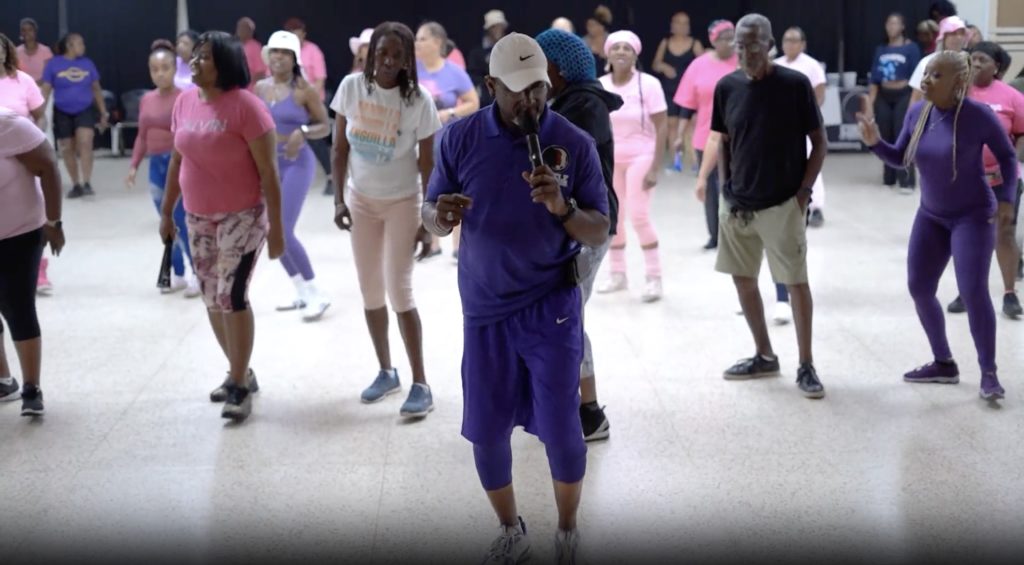
Dealing with grief and trauma can look different for everyone, and a group in Miami has found an unconventional way of helping people cope. Alessandro de Palma of Student Reporting Labs, the PBS News journalism training program, has the story.
Geoff Bennett:
A group in Miami has found an unconventional way of helping people cope with grief and trauma.
Alessandro de Palma from the “News Hour”‘s journalism training program Student Reporting Labs has the story.
Sharon Johnson, Participant, Dance Kickin’ Therapy:
Hello, everyone, I’m Sharon. And I’ve been attending now, and I love it. I take a lot from it. It’s a safe space.
I lost my daughter at the age of 32 and, last year, I lost my husband to lung cancer.
Alessandro de Palma:
Sharon Johnson is one of the many people working through their trauma with each step of this line dancing class.
Sharon Johnson:
I was going through a lot of grief. I didn’t know how to deal with it. I didn’t know where to put the feelings I was feeling. I didn’t know how to cope with it. Some of the things that even my grief counselor suggested was finding a hobby.
Once I found out about the line dancing, I thought that would be somewhere, because I can express myself. The things that I can’t talk about, I can express it through dance.
Alessandro de Palma:
The classes are run by the Circle of Brotherhood, a nonprofit organization based in Liberty City, Miami, a neighborhood which has historically seen high crime rates. Their goal is to help people dealing with grief and trauma, including victims of gun violence or those like Sharon, coping with any kind of pain and loss.
Sharon Johnson:
I’ve seen people line dance going to parties or clubs and seeing them doing it. It was intimidating at first, but it turned out to be just what I needed.
Alessandro de Palma:
Every Wednesday and Saturday, coach Darryl Thomas can be seen grooving to the music.
Darryl Thomas, Wellness Coordinator, Circle of Brotherhood: Dance kickin’ therapy is the community coming to relieve their stresses, their traumas through line dancing. This room will pack out real quick. It’s going to be a lot of participation from the young to the young at heart. I think our youngest line dancer is 8 and our youngest at heart is 91.
Alessandro de Palma:
And Thomas says he came here after learning that he was injured.
Darryl Thomas:
So I went to the optometrist and found out I had a detached retina. It happened out of the blue. They didn’t want me doing anything because of the strain, right? So I said, well, what am I going to do? I’m an active person. I play pickleball. I play golf. I do all these things and I couldn’t do those things.
I said, what can I do to continue to move around and be active? Line dancing. It started out with 25 people. Now we’re up almost to 60 people per class because the word was spreading through social media, through our Web site, through word of mouth.
Alessandro de Palma:
And the impacts of line dancing are felt in every step. According to a study this year, line dancing benefits mental health in communities by bringing people closer together, encouraging dancers to support each other outside of the classroom.
Sharon Johnson:
This is a type of therapy that can help you express yourself, place your grief or your — whatever it is you’re going through. It may not be grief, but whatever you’re going through, and know how to deal with it.
I’ve been through a lot, and I can tell you life is very short. So the time that I have here, I want to enjoy it and I’m going to enjoy it through dance, line dancing.
Alessandro de Palma:
For PBS News Student Reporting Labs, I’m Alessandro de Palma in Liberty City, Miami.