
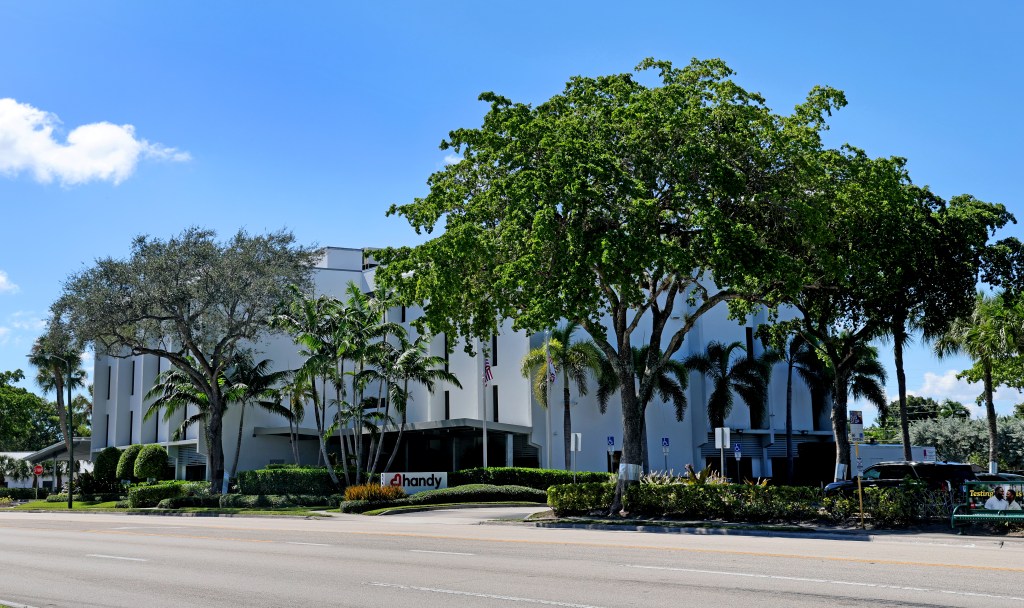
Broward Schools have agreed to pay $2.6 million over the next five years to rent space in an office building for 75 employees, despite the district facing severe budget cuts and having plenty of room at underenrolled schools.
The decision also could hurt the district’s recent efforts to try to limit charter schools from occupying empty space in district-run schools. A new state law allows what are known as “Schools of Hope” to operate in district-run schools where there is room, so the district has been looking for ways to reduce the amount of available space.
The School Board approved the rental agreement on June 17 with the nonprofit group Handy, whose name stands for Helping Advance and Nurture the Development of Youth, to house facilities staff. The cost is more than $500,000 a year for five years.
But now some board members told the South Florida Sun Sentinel they are having second thoughts as the district suffered a $77 million shortfall this past year, and a charter school company has already made a request to operate inside 27 mostly low-enrolled schools.
“It was a total mistake,” Board member Allen Zeman told the Sun Sentinel. “We literally have tons and tons of space. So why wouldn’t you move into a middle school or high school that has dozens of classrooms available that you can convert into space? You can take over a whole wing.”
The district has at least 50,000 more seats than students, which equates to more than 2,000 empty classrooms. Enrollment dropped 10,000 in the past year, and now School Board members are discussing laying off employees, slashing overtime, replacing outside school police officers with district employees and selling or leasing the K.C. Wright administrative headquarters to help deal with the financial problems.
“We should have been more protective than going out and spending half a million dollars on this lease agreement. In hindsight, it doesn’t look like a good idea at all,” Board member Adam Cervera told the Sun Sentinel.
The district decided to find a new home for its facilities employees after it sold its Rock Island Annex Facility, a series of office buildings on Northwest 26th Street in Oakland Park, in October. The Urban League of Broward County, which bought the facility for $5.36 million, plans to develop affordable housing on the site.
After reviewing several properties, the district chose the Handy building at 2101 N. Andrews Ave., in Wilton Manors, for its employees. Handy bought the 40-year-old building, which was the former headquarters of Moss & Associates construction, for $5.9 million in January 2025.
“The Handy facility will accommodate most of the BCPS staff currently at Rock Island, allowing for a quick and efficient transition,” district spokeswoman Keyla Concepcion told the Sun Sentinel. “Any remaining staff will be reassigned to other District locations.”
District employees have not moved in yet, “but the intent is to do so as soon as possible,” Concepcion said. She wouldn’t say whether the district has spent any money making upgrades to the Handy office space, referring the question to the district’s public records office.
The district’s agreement with Handy allows the district to house facilities employees, as well as some district contractors, in 15,000 square feet of the 85,000 square feet building. The district will occupy all of the fourth floor and part of the second floor of the facility, according to the contract.
The rent will start at $42,500 per month, or $510,000 the first year, and will increase by 1% for each of the five years, according to the contract.
“Looking at it right now, I would say financially it doesn’t seem like it makes a whole lot of sense based on the position we’re in,” School Board Chairwoman Debbi Hixon said. “But there were some circumstances I was told that caused that to happen.”
The Sun Sentinel asked Hepburn in August why the district chose the Handy site over one of its many underenrolled campuses.
“We had to vacate that building (Rock Island), according to the actual contract that we signed with the entities that purchased it, so that team needs to get out sooner than later,” Hepburn said at the time.
However, after closing, the district entered into a lease agreement with the Urban League that allowed employees to stay at the Rock Island property until May 2027.
A district summary attached to the June agenda item said the district would be spending less money at the Handy building than if the employees stayed at Rock Island, because the Handy lease includes utilities and maintenance and custodial services. Those costs at the aging Rock Island facility were estimated at $566,000 a year, the document said. However, the summary didn’t compare costs to locating inside a school.
Broward School Board member Rebecca Thompson said she now sees the agreement as problematic.
“This is definitely one of those contracts that we should revisit, and if there is space to house 75 employees in one of our schools, which I feel like we should easily be able to accommodate, that’s the direction we should go in,” she said.
The contract allows the district to get out if there is damage or a breach by the landlord or if funds are not appropriated in the district budget. The School Board adopts its budget each September. The Sun Sentinel asked a district spokeswoman multiple times if there were any other ways the district could get out, and her response was to send a link to the contract.
Kirk Brown, CEO of Handy, couldn’t be reached for comment Thursday, despite attempts by phone and email.
The School Board vote to approve the Handy contract in June was unanimous, although Thompson voiced some concerns on the dais.
She said at the time she believed the district likely had space that could be used either in the K.C. Wright administrative headquarters in downtown Fort Lauderdale or school campuses.
“I’m a little concerned why we’re going outside of our building capacity and paying for rental space,” she asked Hepburn at the June meeting.
Hepburn told the School Board the district was disposing of two other office buildings, and those employees would be moving to K.C. Wright. He said academic staff who were housed at K.C. Wright would be moving to school campuses.
“There’s not a lot of admin space, so that’s why we are utilizing the space that Handy has graciously allowed us to lease from them,” Hepburn said at the meeting.
But in recent weeks, Hepburn and School Board members have been more eager to move office staff into schools, especially after Mater Academy, a Miami-based charter operator, made a request to house 18,000 charter students on 27 district campuses, as part of the schools of hope program.
School Board members have voiced interest at the past few meetings in either selling K.C. Wright or renting out space in it.
“In the next year, I think we should take half of this building, seven floors, and we put those seven floors of staff into our schools, and we lease out each of those levels,” Board member Lori Alhadeff said at Tuesday’s workshop. “We could bring money back into our district, but also fill our schools. It’s very concerning with the hope schools, and so we need to make sure our schools are filled.”
Hepburn told Alhadeff the district was doing that. “We’re emptying out this building, purposefully,” he told her.
He said the district would be renting vacant space for revenue, including to lawyers, since the building is steps away from the Broward courthouse.
Hepburn told the Sun Sentinel after Tuesday’s meeting that it’s possible the plan to move employees into schools may help the district stave off schools of hope. More providers are expected to file their requests for space next month.
“I’m not sure if that’s going to help us totally with some of the schools of hope that we expect to start sending us letters next month,” he said. “But our priority right now is to utilize our facilities and be responsible with taxpayer dollars and fully utilize our facilities as much as possible.”
Concepcion said all these efforts are part of the district’s initiative known as “Redefining Our Schools.” The effort was started in early 2024 as a way to deal with the district’s dwindling enrollment.
“Through our Redefining Our Schools initiative, we’re not only improving the educational landscape but also strengthening community partnerships,” she said. “We’re proud to work with non-profit organizations such as the Urban League and Handy in this endeavor.”