
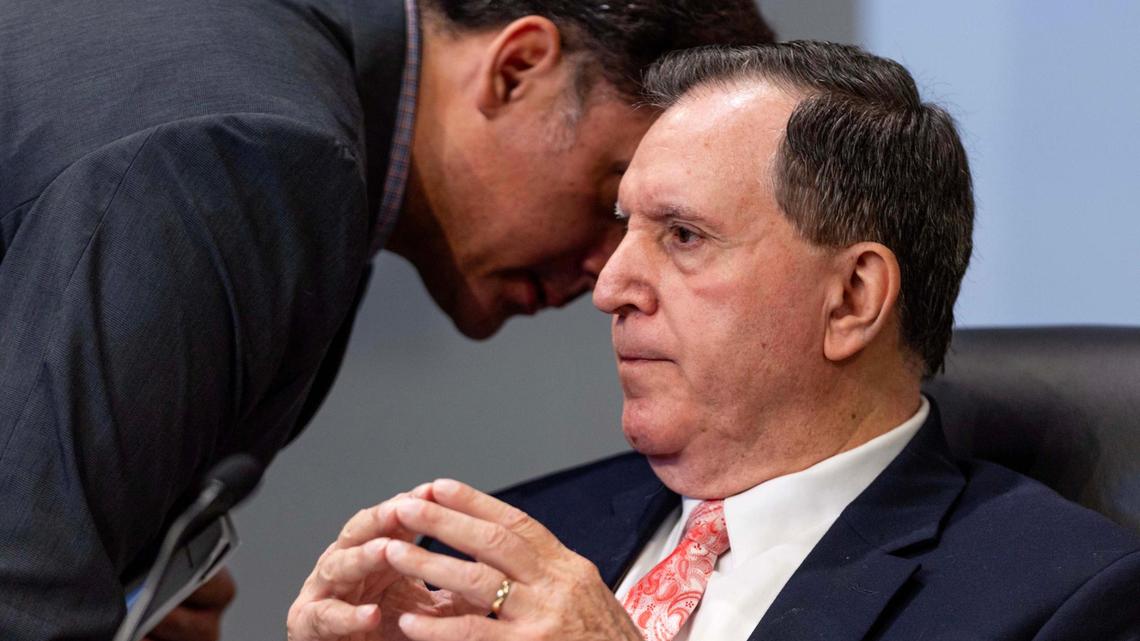
Commissioner Joe Carollo listens to an aide during a Miami City Commission meeting on Tuesday, June 17, 2025.
D.A. Varela
dvarela@miamiherald.com
The city of Miami plans to sue former Commissioner Joe Carollo over the legal fees it spent defending him in a high-profile lawsuit that Carollo lost in 2023 and that the U.S. Supreme Court just last week declined to hear.
On Thursday, the City Commission unanimously approved a proposal from Commissioner Miguel Angel Gabela to “institute a civil action” to recover attorneys’ fees and costs paid from public funds for Carollo’s defense in the lawsuit brought by Little Havana businessmen Bill Fuller and Martin Pinilla. In 2023, a jury awarded Fuller and Pinilla a $63.5 million judgment, finding that the men were victims of a political retaliation campaign pushed by Carollo after they supported his opponent in the 2017 election.
It’s unclear how much money exactly the city has spent to date defending Carollo in various lawsuits stemming from allegations that he weaponized city resources against the two men.
At a commission meeting last month, Commissioner Ralph Rosado asked City Attorney George Wysong how much money the city has spent in legal fees on the whole “fiasco.” Wysong said a rough estimate was approximately $6 million, of which insurance covered roughly $4 million. In a 2024 lawsuit filed against the city by its insurer, the insurance company said the cost of defense in related lawsuits “exceeds $10 million to date.”
The city also agreed to a $12.5 million settlement in a related lawsuit in 2024.
The city acknowledged Thursday that the move to claw back legal fees is largely symbolic. Fuller and Pinilla have yet to collect on the $63.5 million judgment they won, with the courts ruling that Carollo’s Coconut Grove home and his wages are shielded from seizure.
Wysong told commissioners Thursday that if the city were to prevail in court, it would still be behind Fuller and Pinilla in line as far as collecting any funds from Carollo. Wysong said it’s possible, though, that things could change and Carollo could win a “billion-dollar lottery.”
Speaking to the Miami Herald last week, Carollo echoed that sentiment. He said he simply doesn’t have the money to pay the city back. And even if he won “a huge lottery,” Carollo said, he’d have to pay Fuller and Pinilla first.
“Can you squeeze water from a rock?” Carollo said.
But for Gabela, who’s long been sounding the alarm about the city’s spending on Carollo’s legal fees, “enough is enough.”
He said he especially took offense to recent legal maneuvering to settle a long-dormant pension lawsuit that Carollo filed in 2006. Gabela said Thursday that Carollo, who was termed out of office at the end of last year, is seeking $1.5 million from the city to resolve that lawsuit.
“I say we go forward in recovering the fees that he cost the city of Miami because of what he’s doing now to us on the other side,” Gabela said, adding that Carollo has “already fleeced the taxpayer.”
Reached by phone Thursday, Carollo declined to say the dollar amount he’s seeking to resolve his pension lawsuit. He also clarified: “It’s not what I’m asking [for]. It’s what’s owed.”
Wysong pointed out that pension benefits would be “immune” from collection but said efforts to claw back legal fees could provide the city “leverage” elsewhere. Wysong also said he didn’t think it would be “extremely expensive” to sue Carollo over the legal fees, characterizing it as a “relatively quick action.”
Gabela’s proposal was first introduced in September, but it was indefinitely deferred. At that time, Carollo’s attorney Richard J. Diaz sent a letter to the city calling the proposal “financially reckless” and argued that under Florida law, “public officials are entitled to legal representation at public expense when sued for actions taken in the performance of official duties serving a public purpose.”
Diaz also argued that it was “premature” to attempt to claw back legal fees because the lawsuit that resulted in the $63.5 million judgment was still pending a motion for rehearing.
The issue of timing appears to be resolved now. Wysong said Thursday that the lawsuit is “completely dead” after the U.S. Supreme Court rejected an appeal last week.
“So the timing is appropriate to sue on that,” Wysong said.
Attorney Jeff Gutchess, who represents Fuller and Pinilla, celebrated the latest Supreme Court ruling last week.
“With that decision, this case has finally reached its end,” Gutchess said in a statement. “For years, my clients — small business owners — endured retaliation, financial harm, and significant stress on their families for exercising their First Amendment rights. The courts made clear that such conduct is unconstitutional. It is unfortunate that the City of Miami chose to spend millions of taxpayer dollars defending this abuse rather than accepting responsibility. Today’s outcome reaffirms that constitutional protections apply to everyone, and that government retaliation has consequences.”
One lawsuit stemming from the same general allegations remains ongoing. The judge recused himself from that case during an explosive hearing this week, sending it into limbo after years of litigating.
.jpg)
Tess Riski covers Miami City Hall. She joined the Miami Herald in 2022 and has covered local politics throughout Miami-Dade County. She is a graduate of Columbia Journalism School’s Toni Stabile Center for Investigative Journalism.