
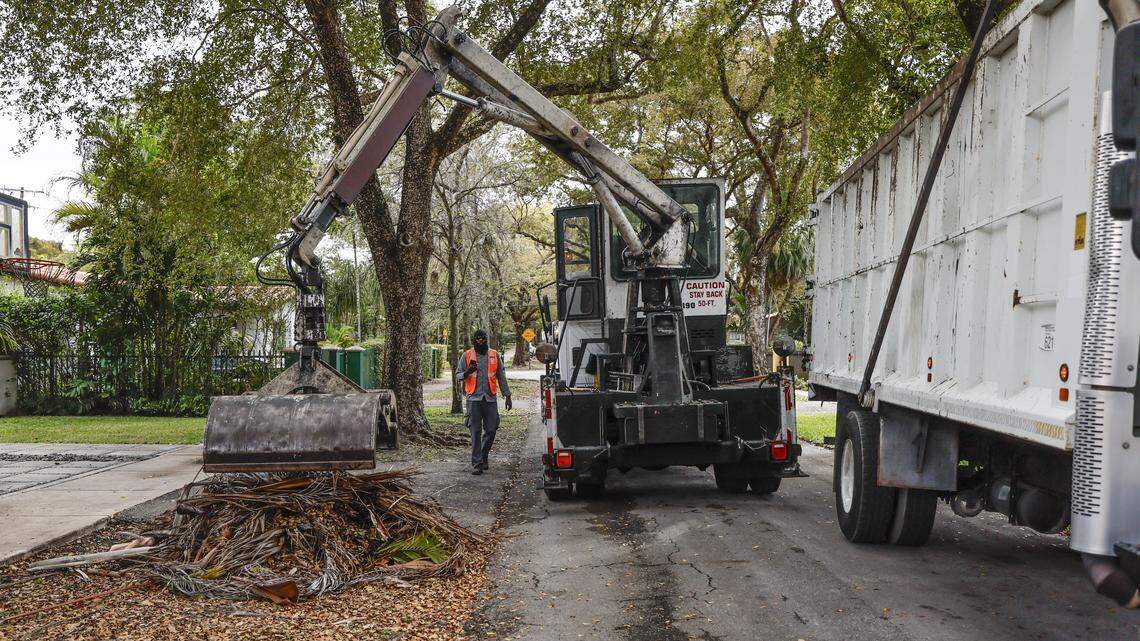
Yard debris is collected from the swale in front of a residential property in Coral Gables, Florida, on Friday, March 6, 2026.
PHOTO BY AL DIAZ
adiaz@miamiherald.com
The city of Coral Gables plans to extend its lease with Miami-Dade County for a swath of land that is key to the county’s landfill operations, a decision that will slightly delay the city’s plans to take the land back for its own use as a site to convert yard waste into a charcoal-like material that can be used in fertilizer, concrete and sidewalks.
Commissioners on Tuesday gave the green light for City Manager Peter Iglesias and City Attorney Cristina Suarez to finalize a deal that would give the county at least one more year to use nearly five acres of city-owned land for its waste-transfer site, a holding ground for trash the county collects from all over Miami-Dade before taking it to the landfill.
In return, the county will pay the Gables $1.5 million upfront, nearly triple what it paid last year, for the property it has used for the past 30 years and is part of the city’s public works facility on Southwest 72nd Avenue. The county will also give the Gables permission to use a county-owned former landfill in South Miami-Dade “for the temporary placement of hurricane debris,” such as fallen trees, branches, and leaves, as needed, during the year-long lease, according to the agreement.
Perhaps more critically, the lease extension — which gives the county the right to operate on Gables land through March 2027, with an option to renew again into 2028 — gives the county more time to clean and restore the land and find a new site for its waste transfer station, since the city has made clear it plans to take back the site.
The Miami-Dade Department of Solid Waste Management, in an email to the Miami Herald, said it plans to “explore and consider all options” for where it will operate after the lease extension is up.
Coral Gables wants the county gone as quickly as possible as it prepares to create a multimillion-dollar facility on the property. The plan is to use large, futuristic ovens to bake fallen trees and other vegetative waste into biochar, a charcoal-like material that can be used as fertilizer in golf courses and parks and mixed into concrete and asphalt for sidewalks and parking lots, as the Herald previously reported. The material known as “black carbon” has the potential to clean dirty water, nourish soil and even be used in roads.
The technology produces lower emissions than a simple bonfire, leading to cleaner, healthier air that contributes less to climate change. And the machines the Gables plans to buy from Palm City-based manufacturer Air Burners use powerful streams of air to limit the release of smoke, significantly reducing the presence of cancer-causing pollutants, and are capable of producing energy to power the facility and give the Gables some extra charge for its large fleet of electric vehicles.
Iglesias and Coral Gables Mayor Vince Lago have previously described the biochar-making machines as a path to a cleaner future for the city and an opportunity to both save and make money. Miami-Dade County, which has too much trash to handle, has also begun to explore biochar making through a pilot project at the South Dade Landfill.
Iglesias, in a statement to the Miami Herald, described the short-term lease extension as a way to ensure “continuity of service while also providing Miami-Dade County time to plan and transition its operations to another location” while giving the city time to continue planning and evaluating its upcoming sustainability initiative.
In the Gables, the plan is to drop $3.47 million for two biochar-making machines from Air Burners, with a total expected price tag for the project a hefty $7.5 million. The total cost includes an expansion project on the property that would involve cleaning up a nearby contaminated piece of land and the opening of an unrelated training facility for city firefighters.
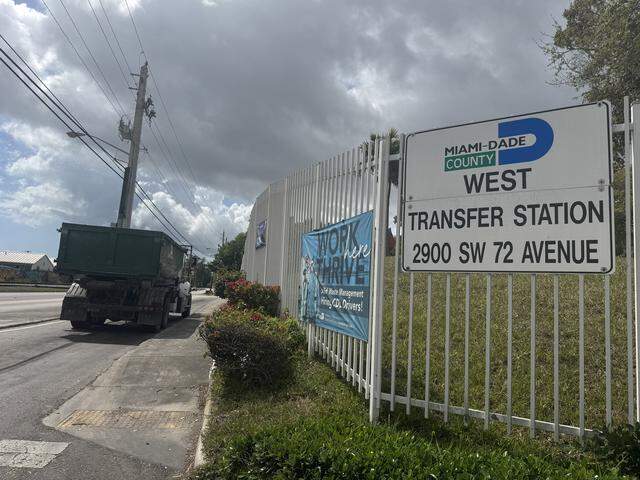 Coral Gables leases a swath of land that is part of its public works facility on Southwest 72nd Avenue to Miami-Dade County. Miami-Dade uses it as a waste transfer station, a holding ground for trash the county collects from all over Miami-Dade before taking it to the landfill. Michelle Marchante mmarchante@miamiherald.com
But Gables leaders estimate that its waste-to-energy and biochar initiative will save the city $1 million annually and also bring in revenue. Iglesias previously told the Herald that the city plans to offer its biochar-making services to other cities, as well as commercial landscapers, with hopes to possibly sell and ship biochar all over the country. The Gables expects to recoup the $7.5 million remediation and setup costs in three to five years. It also plans to seek partnerships with FPL and other entities, as well as apply for federal and state grants, to help offset the project’s costs.
Ashley Miznazi is a climate change reporter for the Miami Herald funded by the Lynn and Louis Wolfson II Family Foundation and MSC Cruises in partnership with Journalism Funding Partners.
Miami Herald
Michelle Marchante covers the pulse of healthcare in South Florida and also the City of Coral Gables. Before that, she covered the COVID-19 pandemic, hurricanes, crime, education, entertainment and other topics in South Florida for the Herald as a breaking news reporter. She recently won first place in the health reporting category in the 2025 Sunshine State Awards for her coverage of Steward Health’s bankruptcy. An investigative series about the abrupt closure of a Miami heart transplant program led Michelle and her colleagues to be recognized as finalists in two 2024 Florida Sunshine State Award categories. She also won second place in the 73rd annual Green Eyeshade Awards for her consumer-focused healthcare stories and was part of the team of reporters who won a 2022 Pulitzer Prize for the Miami Herald’s breaking news coverage of the Surfside building collapse. Michelle graduated with honors from Florida International University and was a 2025 National Press Foundation Covering Workplace Mental Health fellow and a 2020-2021 Poynter-Koch Media & Journalism fellow.
Support my work with a digital subscription