
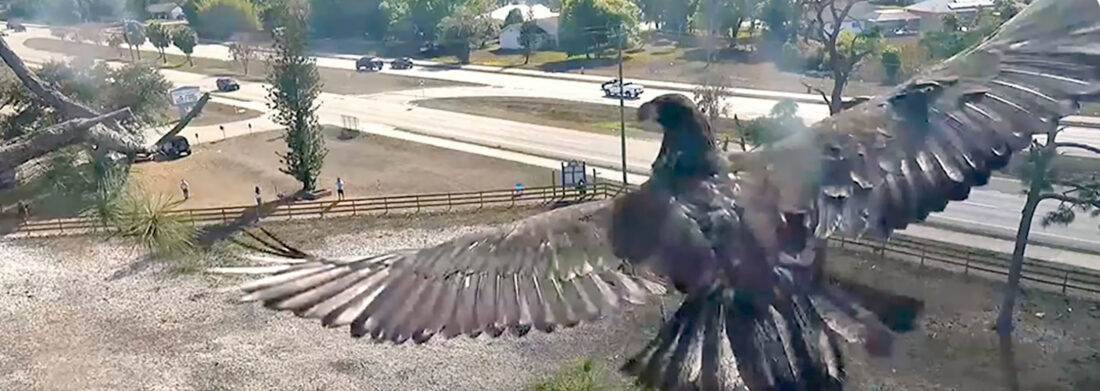
From an egg laid on Nov. 12, 2025, E26 hatched on Dec. 18. On Feb. 26, the bird branched (just one day before F23 went missing and presumably died) before fledging 12 days later, on its 82nd day of life.
COURTESY OF SWFL EAGLE CAM
From an egg laid on Nov. 12, 2025, E26 hatched on Dec. 18. On Feb. 26, the bird branched (just one day before F23 went missing and presumably died) before fledging 12 days later, on its 82nd day of life.
COURTESY OF SWFL EAGLE CAM
With all the drama that’s been happening at the nest of Southwest Florida’s most famous eagle family, it would be understandable if some people forgot that the eaglet in the tree at Pritchett Farm was about to take flight for the first time.
That moment happened early Tuesday night when E26 made its triumphant first flight out of the nest. The eaglet also later took a second shorter flight.
The flight happened around 6:30 p.m. E26, who had been flying to the top perch with M15 the past few days, could be seen on video taking off from that perch. The eaglet flew around for a bit and came back to the nest, albeit a little awkward at the landing.
Moments later, E26 took a second flight, this time nailing the landing on a higher perch in the nest tree.
Ginnie Pritchett-McSpadden, co-founder of the Southwest Florida Eagle Cam, said it’s an exciting time to be around the nest and watching.
“The eaglet has been jumping real high, hitting new heights and different branches,” Pritchett-McSpadden said. “We knew it would be soon. The eaglet took its first roundabout around the pasture, then did it again a few seconds later. It hasn’t slowed down since then.”
E26 was laid on Nov. 12, 2025 and hatched on Dec. 18. On Feb. 26 the bird branched (just one day before F23 went missing and presumably died) before fledging 12 days later, on its 82nd day of life.
Male parent M15 has been helping E26 fly higher up the tree. They were seen perched together a few nights ago.
E26 will be exploring the area, practicing its flying and learning how to hunt and clean itself for the next few weeks. It will stay around the nest and M15 will keep feeding it until the day comes when the eaglet decides the leave the nest for good. Pritchett-McSpadden said the average time for a juvenile eagle to leave is a little past the 100 days mark.
“E26 has been in a really great spot. Old enough to feed itself and is in the final stages of developing its flying,” Pritchett-McSpadden said. “We’ll see M15 showing it the basics of hunting and surviving outside the comfort of the nest. It’s a fun time to watch the eaglet gain that independence.”
What happens after that is anyone’s guess. M15 is again an eligible bachelor. Several potential female suitors have been seen around the nest, some of them not quite of age yet.
In 2023, M15 had to fight off many female eagles so he could raise his young by himself after the death of former mate Harriet. He left for the summer and returned to the nest with F23.
Pritchett-McSpadden said there has been an intruder spotted at the nest and that it will get interesting in the next couple weeks to see what happens.
“We’re going to see a lot of intruders and potential new mates come to the tree and fight for that territory,” Pritchett-McSpadden said. “It will either be a younger female who doesn’t have a mate yet and coming into maturity or an older one who has lost its mate.”
PHOTO COURTESY OF SWFL EAGLE CAM
From an egg laid on Nov. 12, 2025, E26 hatched on Dec. 18. On Feb. 26, the bird branched (just one day before F23 went missing and presumably died) before fledging 12 days later, on its 82nd day of life.
To reach CHUCK BALLARO, please email news@breezenewspapers.com