
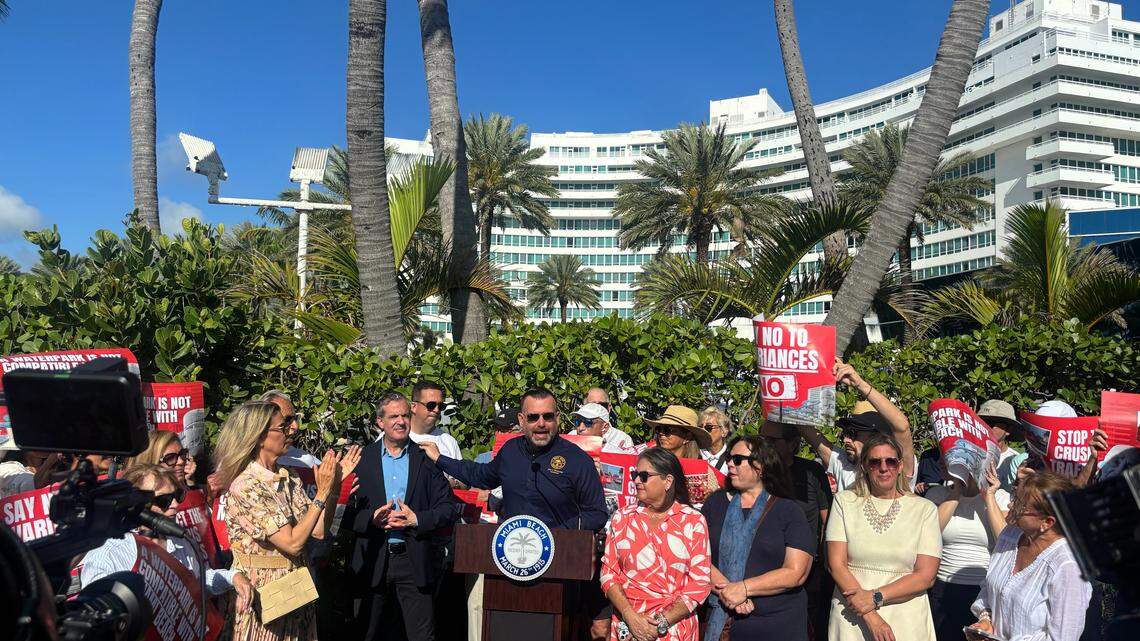
Miami Beach Commissioner Alex Fernandez (center) with Mayor Steven Meiner during a press conference to oppose state legislation alongside other city officials and residents in front of the Fontainebleau Hotel on March 10, 2026.
Aaron Leibowitz
aleibowitz@miamiherald.com
The Florida Legislature has become pretty adept at forcing their wishes on local communities. In the legislative session that ended Friday, lawmakers proved they can do that with laser-like precision with a provision in a bill that looks custom-made to bypass the wishes of many Miami Beach residents.
The Legislature rushed to pass the controversial House Bill 399 in the last hours of session. Thankfully, the worst part of the legislation is gone. It would have jeopardized Miami-Dade County’s Urban Development Boundary, the 78-mile-long legal line that limits development on rural lands and the Everglades. It’s a major tool to contain urban sprawl.
Thanks to pushback from some of Miami’s Republican senators, the bill no longer lowers the voting threshold needed on the County Commission to expand development beyond the UDB. Sen. Alexis Calatayud, R-Miami, successfully amended the legislation to remove that part.
“For decades, [the UDB] has directed growth inward, where roads, water, sewer and transit infrastructure already exist, rather than pushing development into environmentally sensitive lands and flood-prone areas,” Calatayud and Miami Waterkeeper Rachel Silverstein wrote in an opinion piece for the Miami Herald earlier this month.
This is the good news. Now, onto the bad news: HB 399 still likely requires Miami Beach to sign off on variances from the city code to allow tall water slides in the Fontainebleau hotel’s pool deck area. Residents have opposed the project.
The bill doesn’t specifically mention the city or the resort, but sponsor Rep. David Borrero, R-Doral, previously told the Herald that he “worked with a lobbyist that represents” the Fontainebleau on the measure. The bill heads next to DeSantis, who’s likely to sign it, the Herald reported.
The legislation allows up to 20% of the area of a “large destination resort” to be redeveloped without a vote by a local board, as long as “such changes are consistent with the existing permitted or accessory uses.” Developers have until July 2031 to take advantage of this, thanks to an amendment approved Friday.
Why are lawmakers from as far away as the Panhandle making decisions that impact Miami Beach, via a bill filed by a House representative who lives in Doral and a Senate sponsor, Sen. Stan McClain, from the Ocala area? No lawmaker from the Beach could have sponsored this provision without facing the ire of local officials and constituents.
Local opposition to a project can be an inconvenience for developers but when the state puts its thumb on the scale, it removes citizens from the process. If the water slides attract more visitors and increase traffic on the already-congested barrier island, as opponents fear, who’s affected? Certainly not the lawmaker from Central Florida.
“Miami Beach isn’t Disney World, and we’re not Orlando with acres of buffers separating theme park resorts from neighborhoods,” Miami Beach Commissioner Alex Fernandez told the Herald Editorial Board. “Our community is a dense, built-out city where residential and hotels exist side by side.”
The Fontainebleau said in February that its “proposal is about reinvesting in one of Miami Beach’s most iconic landmarks in a way that honors its history while preparing it for the future — all while maintaining the property’s existing footprint, and without increasing density or adding traffic.”
Even if this project is a bonus to the Beach, shouldn’t the hotel convince the Beach of that?
On Feb. 10, the Fontainebleau was scheduled to go before the city’s Historic Preservation Board. People packed city chambers, many of them to oppose the water park. Minutes before the meeting was set to begin, a hotel representative asked for the hearing to be deferred, the Herald reported.
Less than two weeks later, on Feb. 23, Borrero filed the amendment that helps the resort, legislative records show. He told the Herald at the time: “The Historic Preservation Board has prevented their project from moving forward” and this is a “simple project to put in certain slides on that pool [area].”
Perhaps hundreds of residents are wrong about this project, but that’s not the point. No one can accuse Miami Beach or South Florida of not being developed enough. If lawmakers continue to chip away at local control over development, they will tip the scale even more in developers’ favor and against the people.
BEHIND THE STORY MORE What’s an editorial?
Editorials are opinion pieces that reflect the views of the Miami Herald Editorial Board, a group of opinion journalists that operates separately from the Miami Herald newsroom. Miami Herald Editorial Board members are: opinion editor Amy Driscoll and editorial writers Isadora Rangel and Mary Anna Mancuso. Read more by clicking the arrow in the upper right.
What’s the difference between an op-ed and a column?
Op-Eds, short for “opposite the editorial page,” are opinion pieces written by contributors who are not affiliated with our Editorial Board.
Columns are recurring opinion pieces that represent the views of staff columnists that regularly appear on the op-ed page.
How does the Miami Herald Editorial Board decide what to write about?
The Editorial Board, made up of experienced opinion journalists, primarily addresses local and state issues that affect South Florida residents. Each board member has an area of focus, such as education, COVID or local government policy. Board members meet daily and bring up an array of topics for discussion. Once a topic is fully discussed, board members will further report the issue, interviewing stakeholders and others involved and affected, so that the board can present the most informed opinion possible. We strive to provide our community with thought leadership that advocates for policies and priorities that strengthen our communities. Our editorials promote social justice, fairness in economic, educational and social opportunities and an end to systemic racism and inequality. The Editorial Board is separate from the reporters and editors of the Miami Herald newsroom.
How can I contribute to the Miami Herald Opinion section?
The Editorial Board accepts op-ed submissions of 650-700 words from community members who want to argue a specific viewpoint or idea that is relevant to our area. You can email an op-ed submission to oped@miamiherald.com. We also accept 150-word letters to the editor from readers who want to offer their points of view on current issues. For more information on how to submit a letter, go here.