
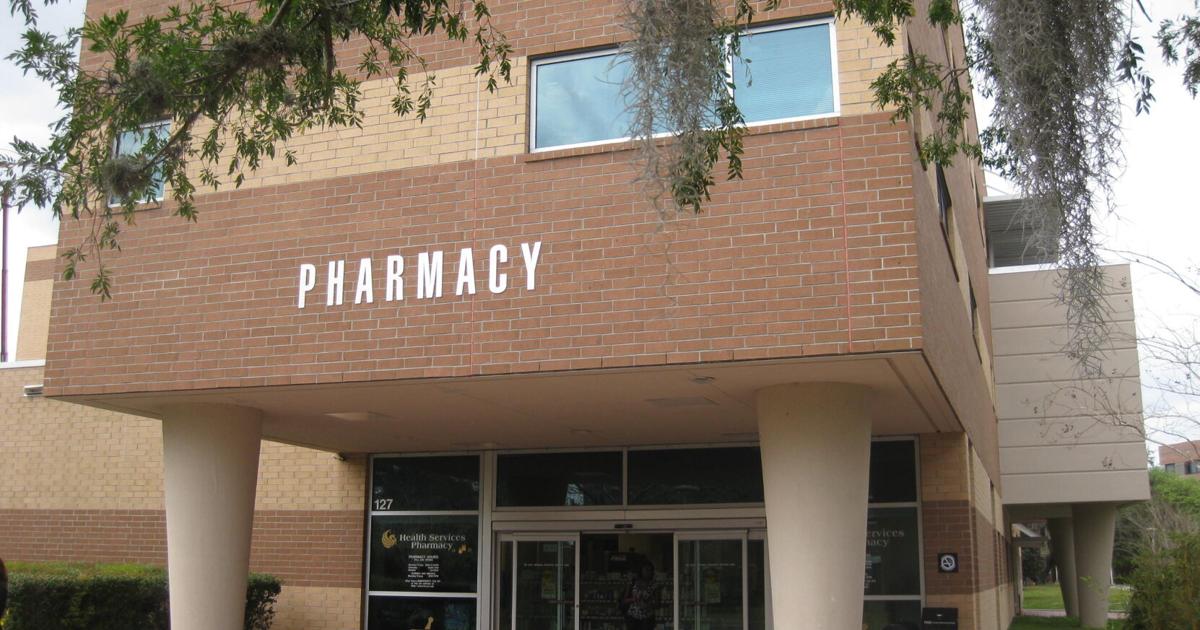

The UCF Student Health Services pharmacy posted an alert to its website regarding an ADHD medication shortage, stating that the inventory is not enough to meet UCF student demand. College students with ADHD are estimated to be around 2% to 8% in the national average, according to the National Library of Medicine.
Courtesy of UCF Student
Health Services
Students may face difficulty getting prescription medication for attention-deficit/hyperactivity disorder at the pharmacy on campus, as Student Health Services at UCF is experiencing a shortage.
SHS posted an alert on its website about a shortage of ADHD medication in the pharmacy, which could affect students who take it daily.
“Student Health Services (SHS) pharmacy is at a critical point with ADHD medications where inventory is not enough to meet the demands of UCF students,” the website alert said. “SHS receives a minimal sporadic supply of these medications, if at all, and our pharmacy is subjected to daily, weekly and monthly quotas of controlled ADHD medications.”
The ADHD medication shortage has been ongoing since Oct. 12, 2022, when the Federal Drug Administration released the formulation of amphetamine mixed salts, commonly referred to by the brand name Adderall or Adderall IR, according to an FDA report from August 2023. This shortage affected nearly 2.8 million kids ages 5 to 17, according to a CDC report.
ADHD can have different impacts depending on the person, explained Aaron Centeno, a junior psychology major who has ADHD.
“I have hyperactive-type ADHD, and it’s something that makes it really difficult for me to concentrate,” Centeno said. “Someone with a more severe form of it will obviously experience more consequences, so I see it as negative when this happens, especially in the academic setting, where you can’t concentrate in class, be involved in a thousand things at once or focus on studying.”
In October 2025, the Drug Enforcement Administration’s production quota for d-amphetamine was increased from 21.2 million grams to 26.5 million grams, according to MedFinder.
In January 2026, the DEA finalized production quotas for 2026, including an additional 14.3% increase for DL-amphetamine. Several generic manufacturers have expanded production capacity, according to MedFinder. Despite the DEA’s efforts to increase medicine production, the shortage persists nationwide, as reflected in the SHS pharmacy notification.
The shortage can be explained by multiple factors, including manufacturers’ inability to keep up with the production of the medicine, according to MedFinder.
Dr. Yung Nguyen-Siddiqi, interim executive director of SHS and assistant professor of medicine at the UCF College of Medicine, said the DEA regulates the distribution of medicine.
“There have been manufacturing issues,” Nguyen-Siddiqi said. “Manufacturers may not be able to obtain the ingredients needed to make ADHD medication. And then also because ADHD medications usually are stimulants, they are controlled substances. So the DEA has put a limit on how much can be made.”
Angeles Malave Colon, junior psychology major, said UCF staff should be paying attention to this situation.
“Obviously, on a daily basis, it affects everything: concentration, short-term memory, organization, staying on track—all of that is impacted,” Malave said.
“Medication acts as a regulator; without it, people may experience impulsivity and a lack of concentration, significantly impacting areas like studying and working. The whole idea of a university is for its students to feel comfortable, heard and accepted. Without medication, the academic performance of your student population with ADHD can be severely hampered,” Malave added.
Despite the shortage, the pharmacy’s solution is to work on a dosage that works for each student, Nguyen-Siddiqi said.
“We work with our patients here to get the closest, most appropriate medication for them,” Nguyen-Siddiqi said. “And there are months where we may have to even switch your medication to something else.”
While the shortage is still ongoing at the UCF Pharmacy, any updates can be found on the SHS website.