
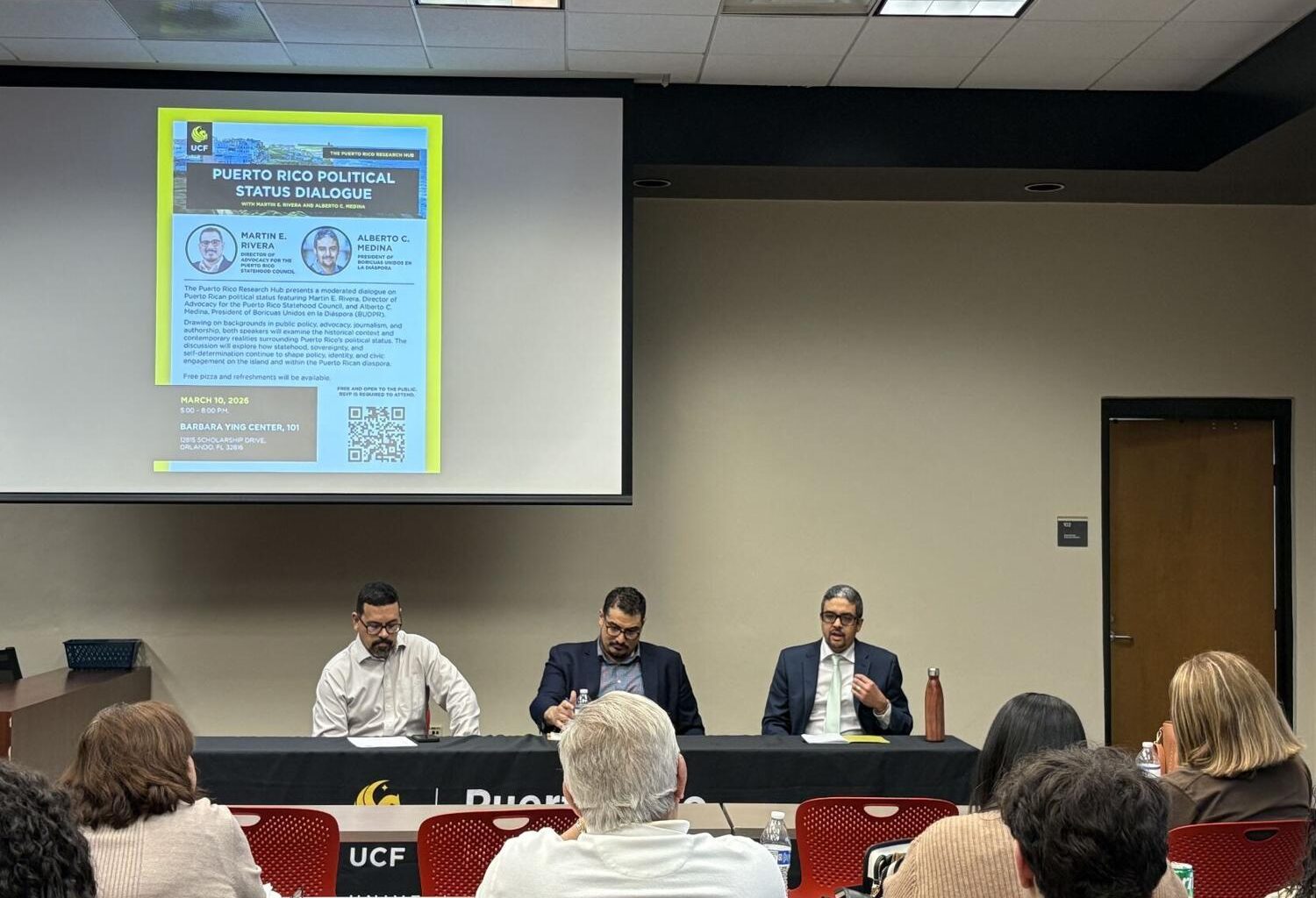

Fernando Rivera, director of the Puerto Rico Research Hub (left), moderates as Martin E. Rivera, director of advocacy for the Puerto Rico statehood council (middle), and Alberto C. Medina, president of Boricuas Unidos en la Diáspora (right), discuss Puerto Rico’s political status on Tuesday at the Barbara Ying Center.
Nora Rivas
UCF Global’s Puerto Rico Research Hub hosted a Puerto Rico political status dialogue between advocates to argue the probability of statehood and independence on Tuesday in the Barbara Ying Center.
The dialogue was led by Martin E. Rivera, director of advocacy for the Puerto Rico Statehood Council, and Alberto C. Medina, the president of Boricuas Unidos en la Diáspora.
Both speakers discussed the probability of both statehood and independence in Puerto Rico by examining the historical factors having to do with Puerto Rico’s political status.
Speakers Rivera and Medina are both born-and-raised Puerto Ricans. Rivera works with political officials and Medina specializes in Puerto Rican advocacy for independence.
The dialogue was open to all audiences, including UCF students. Gabby Torres, senior psychology major, said she wanted to fortify her knowledge on Puerto Rican politics despite already having strong opinions of her own.
“I’m curious about what people have to say about Puerto Rican independence and statehood and the pros and cons of each side,” Torres said. “I’m personally pro independence, but I want to hear both sides of the argument just to be well-versed.”
Rivera, being on the side that favors Puerto Rican statehood, said he wishes for a binding bill that allows Puerto Ricans to choose constitutional and viable options that aren’t colonial or territorial.
“It’s an issue of civil rights, and we want to help our fellow citizens who have not just contributed to Puerto Rico and the nation, but also here in Florida,” Rivera said.
Rivera emphasizes the importance of voting for young people, especially university students at UCF. They can help push for an overall resolution in Congress regarding the political conflicts in Puerto Rico, he said.
Medina, on the other hand, said he wishes for Puerto Rico to become an independent country and believes that Puerto Rico is being overlooked by Americans interested in foreign advocacy.
“My goal, our goal, in the independence movement in the United States is precisely to build a political movement that will take this on as an issue in the same way that so many people have taken on support for Palestine or whatever other issue,” Medina said.
Medina said he finds irony in what many Puerto Ricans face in the United States, a country that values independence as a whole.
“This is an American issue of whether the United States should still have colonies,” Medina said. “In the year that it’s celebrating the 250th anniversary of its own independence, it continues to deny independence to other nations.”
An argument made against Puerto Rican statehood by those who favor Puerto Rican independence is mainly the fear of losing their identity, language and culture, Rivera said. Integration does not affect Puerto Ricans; on the contrary, they flourish no matter where they reside, Rivera said.
“We still have a long way to go to have actual representation to the Puerto Ricans in Florida,” Rivera said. “Since I moved here to the States, I’ve slowly seen the preservation of our culture, the flourishing of our culture and the increased power of our people here in the States.”
Even with their opposing views, both Rivera and Medina hope for Puerto Ricans not to have to be forced to leave their motherlands due to economic, health, environmental or civil reasons.
“[Lack of funding] leads to a mass exodus from the island, especially when it comes to medical needs,” Rivera said. “I want my people to stay in Puerto Rico and not have to leave to find that economic prosperity that they seem to get here in the States.”
As discussed in the dialogue by Rivera and Medina, because of the harsh political situations in Puerto Rico that lead to mass poverty among the citizens, they have no other choice but to leave their home countries to seek a better life in the United States.
Puerto Ricans, Medina said, have a warped view of the United States and later have to face the harsh realities of the country.
“I think a lot of people on the island have sort of a rosy view of what the U.S. is politically, what U.S. society is, and I think that leads to some incorrect assumptions about statehood fulfilling these promises of equality,” Medina said.
Medina said that Americans also face civil hardships, especially immigrants from Puerto Rico who face the struggles of white supremacy. Medina said that the political status of Puerto Rican statehood does not fix the inherent inequality that minorities face in the United States.
Whether people like Rivera want their island to be a part of the United States or others like Medina want a completely sovereign and independent nation, one thing they have in common is their pride in being Puerto Rican.
Aimee Escribano Zuniga, a doctoral student of nursing, said she attended the discussion because of her inherent pride in being Puerto Rican despite having grown up in the United States.
“We all have different missions, but overall we’re all here because we love Puerto Rico,” Escribano said. “We want to preserve our culture and that goes for anybody, even those that are 1% Puerto Rican. It’s very strong blood.”