
Welcome to the Catalyst’s Community Voices platform. We’ve curated community leaders and thinkers from all parts of our great city to speak on issues that affect us all. Visit our Community Voices page for more details.
I have lived in St. Pete for 49 years now. I have been told that a half-century lifts you almost to the status of that rarest of state birds, the native Floridian. Most of what I know about the Sunshine State I have learned from living. But as a professional reader, I have gained some Sunshine savvy from books.
I have just read one that has sharpened my view of our flawed paradise. The book is titled Anywhere Else, and it’s a collection of Florida essays by Rachel Knox. I know Rachel as a St. Pete writer, and a seller at Tombolo Books. I read her book in two sittings and came away with a clarity of vision, like having a literary cataract surgery.
Turns out, most of the Florida books I own have been written by men. Jeff Klinkenberg, Craig Pittman, Dave Barry, Carl Hiaasen, Bill DeYoung and Tom Hallock. Add historians such as Ray Arsenault and Gary Mormino. Toss in poets like Peter Meinke and Tyler Gillespie.
Oops, I thought. Where are the women?
OK, I have learned from the novels of Lori Roy, Lauren Grauf, and Karen Russell. Add the journalism of Lane DeGregory, Stephanie Hayes, Lucy Morgan and Anne Hull. Let’s add classic works by Marjorie Kinnan Rawlings, Zora Neale Hurston and Marjory Stoneman Douglas, the so-called Mother of the Everglades.
If you read all of these works, I would argue you would still be missing something, or someone crucial. I will call that person Florida Woman.
Welcome to a Florida woman
The best way to introduce you to Florida Woman is to make believe that I am writing a novel about her. Unlike the often-derided Florida Man, Florida Woman is no clown. She feels more to me like one of those girl power protagonists from the 1990s, like Buffy the Vampire Slayer.
Instead of vampires, Florida Woman would be fending off drunken frat boys on Spring Break or horny old snowbirds from Toronto. In my novel, she was born in Gulfport, maybe to a single mom. Graduated from a high school that the kids nicknamed Bogie.
Of course, she got a fake ID, and over time would work her ass off in jobs on or near the beach, in or around seaside bars with names that have words like Salty, Pelican, Rusty, Driftwood, or Oyster.
She and her girlfriends would decide to celebrate someone’s birthday with tattoos. Hers would be a tramp stamp on her lower back that would reveal angel wings. She would be well pierced: ears, navel, a tiny piece beside her nose. Her hair would be transparently bleached. Her skin would be haphazardly tanned.
The joke we call Florida
Craig Pittman has built a cottage industry telling tales of Florida Man, a combination of caricature and archetype, born of crazy narratives topped with zany headlines:
Florida Man, fly fishing, hooks the zipper of his pants.
Florida Man jumps from airplane – forgets his parachute – manages to survive.
Florida Man’s valuable Rolex stolen – by a raccoon.
I made up the first two, but witnessed the third.
Such narratives – generalized – make Florida a laughingstock.
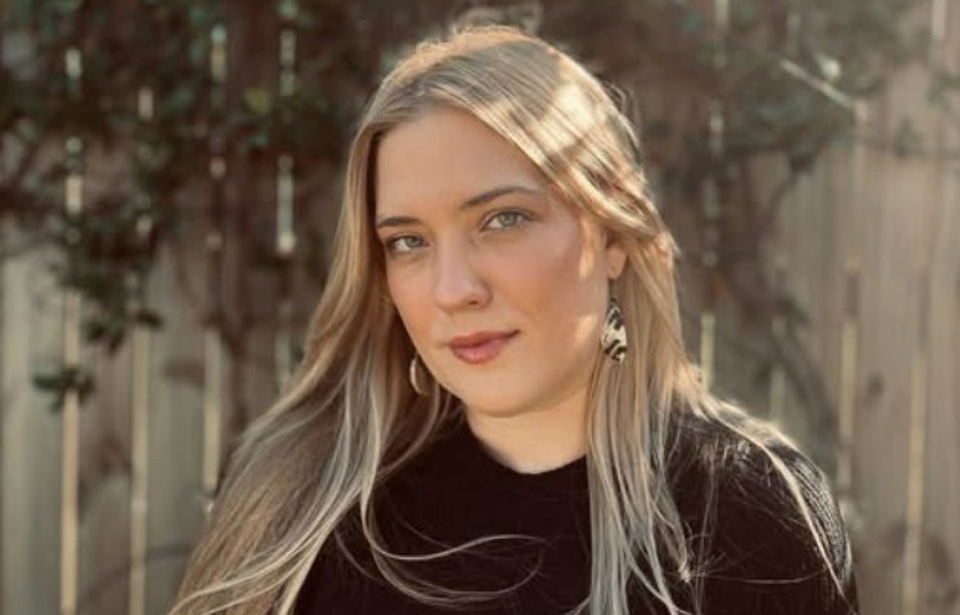
Enter Rachel Knox, the chronicler of Florida Woman. In short, she loves Florida because she hates it. And hates Florida because she loves it. In essays that combine personal experience, history, and cultural criticism, she cultivates ways of understanding our state that have been mostly missing in earlier accounts.
At the age of 23, raised in St. Pete, she heads to the Big City.
“The whole time I lived in New York, I missed Florida dearly – wanted to brag about it, to show others its good side, to describe the way the sky looks during on of our million-dollar sunsets. I wanted to make everyone who chuckled sit down at the edge of a dock, eat a Cuban sandwich, and wash it down with a cold beer or Rum Runner. I wanted to walk through a silent pine forest in the early morning, looking for scrub jays. I wanted to take them mudding, to the rodeo, to the fish fry on the corner, the lighthouses dotting the coasts. Down the cobblestone streets of St. Augustine, America’s oldest city, where a gust of salt air and a squint of the eyes might make you believe you’re in Seville five hundred years ago. To steer them down Crystal River in the Spring, when the manatees swarm and bump up against your kayak with whiskered noses. And then challenge them: try to tell me, no, that this place is a joke.”
Such elegiac litanies are antidotes to the poisons of paradise, lived directly by a real-life Florida girl, now a Florida woman, now a Florida author, who grew up in a beautiful garden of flowers, with serpents in every corner. Think of a female Jimmy Buffett, in the sense that Margaritaville suggested the pleasures of beach life while the life of the narrator is one of hopelessness and dissolution.
What helps this book transcend the standard Fear and Trembling memoir is that in each chapter Knox merges her personal history with an insightful bit of cultural criticism, drawing upon everything from the exploitive 1998 movie Wild Things to the surprising homoerotic Florida letters of Ralph Waldo Emerson to the corny luminescence of mall paintings by Thomas Kincade. Somewhere in her life and education, Florida girl Rachel Knox developed a brilliant critical eye.
Florida and the myth of America
In my graduate school days, I remember studying the Myth of the West. Our earliest literature tends to be about men escaping from civilized towns to the frontier wilderness, wherever they may find it. Think of Rip Van Winkle, to Moby Dick, to Huckleberry Finn. Freedom means lighting out into the territory. But it also meant escaping the civilizing influence of women. But where do the women go to escape?
Rachel Knox has made me think of Florida, with its detumescent peninsularity, as a microcosm of the American story. In the beginning this place had indigenous people (now made public primarily as builders of casinos) who, over time, are invaded from different angles. Think of Spanish conquistadors. Think of settlers from Northern states. Think of New Yorkers colonizing the East Coast down I-95. Think mid-Westerners populating our West Coast. Think of Cuban refugees. Think of Canadians in the winter.
It’s as if they go to Disney World and, instead of “It’s a Small World,” they hop on a ride called “The Nine Circles of Hell.”
Light and dark in the Sunshine City
Any reader of this book, from Florida or beyond, will enjoy the world that Rachel Knox re-creates. But those who live in St. Pete will love revisiting familiar places, seeing them in a rich new way.
“The sheer volume of wildlife in Florida is unsettling. Everywhere I go, there are creatures. I made a list on my phone’s Notes app, and in just one day, I saw wild peacocks on Park Street, escaped from the rich people’s houses; feral parrots in Gulfport; a flock of ibis bobbing for worms in the empty lot behind Lynn Blue Crab; a heron can-can-stepping in the middle of Fifty-Eighth Street while traffic waits patiently; dozens of lizards; box turtles; a giant dead wasp in a patio chair at my mom’s; two crows scrounging for dropped fries at Woody’s Waterfront and three dolphins while I wait for a car to surrender its metered spot on Pass-a-Grille.”
Let Rachel Knox be you Florida guide. I predict you will hate this state more than ever – and love it even more than that.
Tombolo Books’ launch event for Rachel Knox and Anywhere Else: Essays on Florida takes place Tuesday, March 24 at 7 p.m., with the author interviewed by poet Tyler Gillespie. Admission is free, but RSVPs are requested at this link.