
(Credits: Far Out / Bandcamp)
Sat 14 March 2026 10:57, UK
What is Bob Dylan‘s ‘Mr Tambourine Man’ all about?
For my money, it’s about juicing life down to the pith. It is about those rare evenings in the halcyon days of your youth when you stay out late enough to watch the sunrise. The fated nights that happen in your pre-wrinkled reverie where energy and jubilation seem to stick to you like the wrapper to a warm toffee, and when the rising sun finally casts a shade of weariness, you wander to some sofa to the tune of ‘Daylight come, and me want to go home’.
In the backdrop of the horrors of the 1960s – the imminent dreaded Vietnam War draft – it is easy to see how clinging to a good time could’ve taken hold on a less personal level. This is why Hunter S Thompson figured the song typified the times. As he documents in Fear and Loathing in America: “This, to me, is the Hippy National Anthem,” he writes about Dylan’s classic.
“To anyone who was part of that (post-beat) scene before the word ‘hippy’ became a national publicity landmark (in 1966 and 1967), ‘Mr. Tambourine Man’ is both an epitaph and a swan song for the lifestyle and the instincts that led, eventually, to the hugely-advertised ‘hippy phenomenon‘,“ Thompson concluded. This sentiment makes the protagonist, whom Dylan couldn’t stop listening to, all the more important.
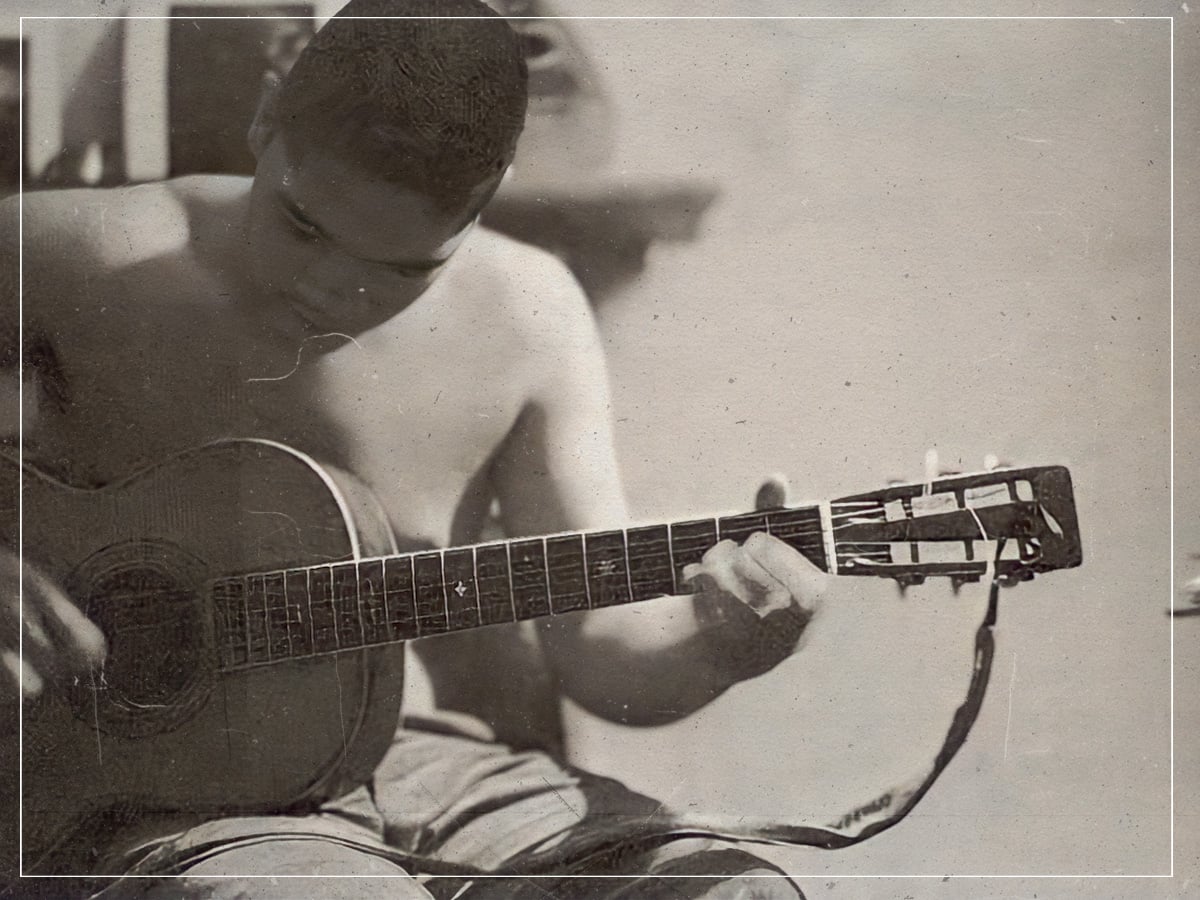
“’Mr. Tambourine Man’, I think, was inspired by Bruce Langhorne,” Dylan writes in the liner notes of Biography. ”Bruce was playing guitar with me on a bunch of the early records. On one session, [producer] Tom Wilson had asked him to play tambourine. And he had this gigantic tambourine. It was, like, really big. It was as big as a wagon wheel.”
 (Credits: Far Out / Alamy)
Langhorne was a charming fellow, the sort of upbeat associate who would often bring about nights where sleep could wait. He hailed from the sunnier climes of Tallahassee, Florida, where his father taught at the unfortunately segregated Florida Agriculture and Mechanical College for Negroes. But he moved to 555 Edgecombe Avenue in New York with his mother shortly before he turned five.
This building was home to a wealth of Black creative talent including Paul Robeson and Count Basie. Langhorne was wholly inspired. Soon, he’d search out his own canvas in Greenwich Village, but along the way he always retained the sunny spirit of his earliest years.
A notably upbeat performer amid a rather solemn folk scene, Dylan as recalled the image of him and his “wagon wheel” tambourine fondly. “He was playing, and this vision of him playing this tambourine just stuck in my mind,” Dylan said. “He was one of those characters…he was like that. I don’t know if I’ve ever told him that.”
The giant tambourine in question was actually a Turkish frame drum, and Langhorne did indeed play it well. That wasn’t the only thing he played well. “If you had Bruce playing with you, that’s all you would need to do just about anything,” Dylan would also say. The pair had been buddies since the original vagabond arrived in Greenwich Village. Langhorne was one of the vagabonds who had arrived there just a little bit before him.
Enamoured by the blossoming folk scene, Langhorne looked to learn everything he could. He took to learning the violin as a boy, but his odd upbringing – coming from the distant stretch of Florida – also rendered him somewhat of an outsider, and soon, this would have a huge impact on his instrument of choice.
One evening, while trying to impress his pals as a boy, Langhorne lit a homemade firecracker. It exploded in an instant and took the best part of three fingers with it. So, his days as a violinist were over.
However, music still appealed and playing the rather more robust guitar was still a possibility. And when he did start strumming, his impairment gave him a fascinatingly distinct sound. His sense of rhythm had to be right on, and so it stands to reason that his tambourine playing would be captivating, too.
While he might not have ever had huge success outside of Greenwich Village in a solo capacity, and if you mention his name in Tallahassee you’ll see blank faces in response, but the nation’s premier songwriter always wanted a piece of his distinct, intoxicating sound, the sort that can make you see magic swirling ships amid his jangling half notes.
So, over the years, he’d play with Tommy Mackem, Joan Baez, Gordon Lightfoot, Richie Havens, Odetta, and just about anyone involved in the folk revival movement and those adjacent to it. This included Dylan. They first played together in 1961, a time when Dylan had played with very few others, and Langhorne would later say, ”I thought he was a terrible singer and a complete fake, and I thought he didn’t play harmonica that well….”
But a turning point approached that made his tone rather less scathing. “I didn’t really start to appreciate Bobby as something unique until he started writing,” he recalled. And when he started writing, Langhorne was as captivated as Dylan’s own protagonist is with Langhorne in ‘Mr. Tambourine Man’.
This led to a prolific session musician career for Langhorne, playing on the bulk of Dylan’s 1960s work in some capacity and plenty of other masterpieces, too. He then turned his hand, or the portion of it that remained, to film composing. It is not without irony that one of the first features he worked on was the Peter Fonda-directed 1971 film The Hired Hand.
But by 1992, he had all but retired from music, instead focusing on hot sauce, setting up the African spiced condiment Brother Bru-Bru’s African Hot Sauce. In some ways, this typified his character. He was the original vagabond, too talented not to be etched in history in some mythic way, but also too casual and cavorting to fear fireworks or pursue the spotlight himself. He passed away in 2017, surrounded by his beloved family, and hailed as a true legend to the few folks who knew him for the maestro he was.
The Far Out Bob Dylan Newsletter
All the latest stories about Bob Dylan from the independent voice of culture.
Straight to your inbox.