
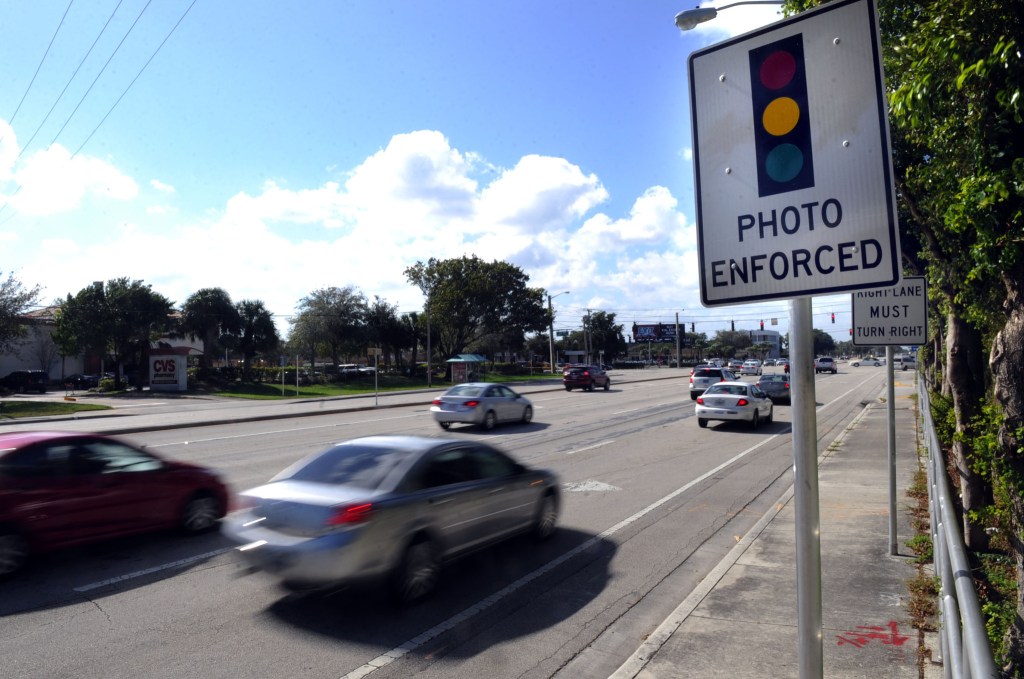
Traffic lawyers are weighing the effect of a Broward judge’s decision saying it’s unconstitutional to fine drivers busted by the network of red-light cameras installed in intersections across the county.
The ruling does not apply outside of Broward, or even outside of cases that come before another judge. But they set the stage for a fight that could end up decided by the Florida Supreme Court.
Broward County Judge Steven DeLuca issued the ruling last week in the case of a Tamarac woman, 24, whose car was photographed crossing the intersection of Northwest 25th Court and University Drive in Sunrise on May 27, 2025. After the woman ignored a citation, she received a second for failing to respond to the first one.
The Tamarac woman’s lawyer, Bret Lusskin, argued that the citations were illegal because they assumed the registered owner of the car was also the driver who ran the red light, an accusation that the state should be required to prove before a citation is issued.
Lusskin is one of the founders of “StopTheCams.org,” a nonprofit aimed at overturning the Florida law allowing municipalities to ticket the owners of cars photographed running red lights.
“For years, red-light camera enforcement has depended on a legal shortcut: assuming the registered owner of a car must be guilty unless they prove otherwise,” Lusskin said. “That turns the Constitution upside down. If the government wants to accuse someone of running a red light, it must prove who was driving, not force citizens to prove they weren’t.”
The first violation notice comes with a $158 fine established by Florida law. It is addressed to the vehicle owner and contains a photograph of the violation as captured by the camera. If the vehicle owner pays the fine, the issue goes away with no effect on the driver’s license. But under the law, if the first notice is ignored, the second is treated as a Uniform Traffic Citation, with license points included as a possible penalty.
That, DeLuca said, is where the law runs afoul of the Constitution.
“While these offenses are labeled ‘civil,’ they remain fundamentally quasi-criminal in nature,” DeLuca ruled. “The state may not employ presumptions or burden-shifting devices that relieve it of proving guilt beyond a reasonable doubt.”
Right now, DeLuca’s ruling has a limited impact. It applies to the Tamarac woman’s case, and DeLuca can be expected to apply it to future cases that come before him. But other judges do not have to agree.
“I would say that in all likelihood, the current red-light camera citations pending in Court will probably remain in flux for some time, as the municipal agencies will decide whether to appeal the opinion,” said traffic ticket lawyer Russell Bernstein.
Lusskin agreed, adding it’s highly likely that other judges will disagree with DeLuca.
“It’s not even binding on any other judges in the same court,” Lusskin said. “But it establishes that there’s a constitutional problem that will have to be resolved one way or another on appeal.”
DeLuca expects to use the same argument to defend vehicle owners targeted by speeding and speed-zone cameras.
In the meantime, Lusskin is advising ticketed drivers and vehicle owners to get in touch with a lawyer and make note of DeLuca’s decision.