


Bishop Leo Frade, the head of the Episcopal Diocese of Southeast Florida, at Trinity Episcopal Cathedral in Miami in May 2015. Bishop Frade stepped down from his post in January 2016.
Al Diaz
Miami Herald file
Bishop Leo Frade, the retired bishop of the Episcopal Diocese of Southeast Florida, wasn’t surprised when Cuban leader Miguel Díaz-Canel announced Friday that Cuba and the United States were talking and moving away from confrontation.
With President Donald Trump urging Cuba to make a “deal” with the United States after he moved to cut off oil supplies to Cuba from Venezuela and Mexico, Cuban leaders are desperate. Water and electricity are hard to come by, and the medical system is collapsing.
“They have to realize it’s the like the end of a movie. You can’t stay in the theater when the picture has ended. It’s done,” said Frade, 83, who was born in Havana.
READ MORE: Cuban leader Miguel Díaz-Canel confirms talks with the Trump administration
Frade, who brought more than 800 ex-political prisoners from Cuba on seven flights he took from the port of Mariel to the U.S. in 1980, said the worsening conditions in Cuba are the key difference between Cuba’s talks with the Trump administration and with former President Obama. Under Obama, Cuba was still getting support from Venezuela and Russia.
“During Obama, we did something, but they did nothing,” said Frade, who served as the Episcopal bishop in Miami from 2000 to 2015 and the bishop of Honduras from 1984 to 2000. “But, now, when they try to turn on the light, there is no light.”
Frade’s views were echoed by other priests in South Florida, many of whom were praying this would mark the beginning of a better life for Cubans on the island and Cuban leaders would be held accountable.
READ MORE: Same old story’: Cubans in South Florida skeptical after Díaz-Canel confirms U.S. talks
Vicar Eliosbel Pereira Almaguer at the Shrine of Our Lady of Charity in Miami, named after the patroness of Cuba, said he was praying the negotiations with Cuba would result in something positive for the Cuban people, who have suffered from years of oppression.
“That’s what we wish for, and that’s why we pray,” Pereira said.
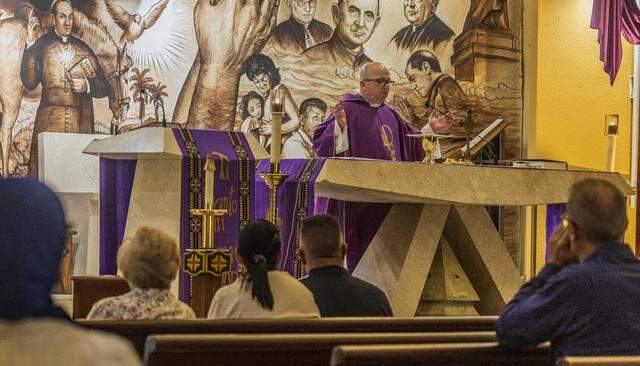 Father Eliosbel Pereira Almaguer, parochial vicar at La Ermita de Caridad, Our Lady of Charity National Shrine, in Miami leads a Mass hours after Cuban leader Miguel Díaz-Canel had confirmed that Cuban leaders are talking with the Trump administration, Friday, March 13, 2026. Pedro Portal pportal@miamiherald.com
Rev. Alberto Cutié, the rector at St. Benedict’s Episcopal Church in Plantation and a former Catholic priest, said the church has to respond with wisdom and nuance as many Cuban families are still recovering from 67 years of oppression under the Cuban Communist regime.
“People don’t want to hear dialogue about making peace with the dictators, but when leaders can be held accountable,” he said.
.JPG "Fix14 Cutie New hmg (1).JPG") The Rev. Alberto Cutié, right, arranges the vestments of Bishop Leo Frade, left, the Episcopal bishop of Southeast Florida, on May 13, 2025, when Father Cutié became the new rector of St. Benedict’s Episcopal Church in Plantation. Hector Gabino El Nuevo Herald file
The Rev. Alberto Cutié, right, arranges the vestments of Bishop Leo Frade, left, the Episcopal bishop of Southeast Florida, on May 13, 2025, when Father Cutié became the new rector of St. Benedict’s Episcopal Church in Plantation. Hector Gabino El Nuevo Herald file
Cutié, 56, knows about the tyranny many Cubans have lived under. His father was jailed twice as a political prisoner in Cuba, once for 16 days in 1961 and for 72 days in 1966.
“He never did any contra-revolutionary activities. Was just a good engineering student who tutored his buddies after school, and they were paranoid they were plotting something. Not the case at all,” Cutié said in an interview with the Herald Saturday.
His parents, who were born in Santiago, left Cuba in 1967 for Spain before moving to San Juan, Puerto Rico, in 1969, where Cutié was born. They moved to South Florida in 1976; his father died in Miami in 1992, but his mother still lives in Kendall.
From what he hears from Cuban exiles, Cutié said many don’t want to see Cuba become like China, having a capitalist society but a Communist government.
Cubans in Miami often do not have a unanimous view of the country’s political regime, said Miami Archbishop Thomas Wenski, the head of the Catholic Church’s Archdiocese of Miami.
“There’s no one opinion in Miami,” he said. “The Cuban community in Miami is quite diverse and their attitude toward Cuba is shaped by time they left Cuba. A generation or two were born in the U.S.”
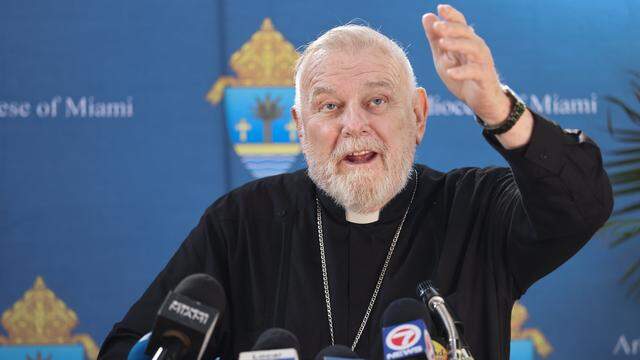 Miami Archbishop Thomas Wenski, left, at an American Business Immigration Coalition press conference urging President Trump not to rescind Temporary Protected Status for Haitians, Tuesday, Jan. 27, 2026, in Miami, Florida. Carl Juste cjuste@miamiherald.com
Wenski has traveled to Cuba several times over the past 30 years and emphasized the importance of Cuba’s communication with the United States.
The Archdiocese of Miami helped after Hurricane Melissa battered eastern Cuba as a Category 3 hurricane in October, leaving thousands of people without homes. The Catholic Church delivered U.S. aid directly to Cubans on the island, but there was scant communication with Cuban officials, Wenski said.
READ MORE: Catholic Church to start delivering U.S. aid for victims of Hurricane Melissa in Cuba
For Cutié, his Sunday sermon won’t necessarily focus on Cuba’s recent developments. But he will lead prayer and mention the country, as he always does.
“More than a sermon, in times of prayer, we mention Cuba, Venezuela and we always pray for whoever is in trouble,” he said. “We don’t keep our eyes away from Iran, Sudan or Haiti.”
Miami Herald staff writer Grethel Aguila contributed to this story.