
TAMPA, Fla. — The USF Health Morsani College of Medicine is nearly doubling the number of hours students will spend learning about nutrition.
This comes as the U.S. Department of Health and Human Services and the Department of Education got voluntary commitments from schools around the country to teach at least 40 hours of nutrition education or require an exam equivalent.
What You Need To Know
More than 50 schools around the country committed to increasing nutritional training for med students
The USF Health Morsani College of Medicine is increasing its nutritional training to 76 hours over four years
The U.S. Department of Health and Human Services (HHS) said an estimated one million Americans die from chronic food-related illness every year
The National Institutes of Health will contribute $5 million to support medical school programs that integrate nutrition education into their curriculum
Medical students are working hard, but second-year student Gabriela Sanchez says the work is worth the reward.
“Especially when you go out and use what you’ve learned in the community, and you do kind of like that volunteer aspect, you can really apply what you learned,” said Sanchez, a medical student at the USF Health Morsani College of Medicine.
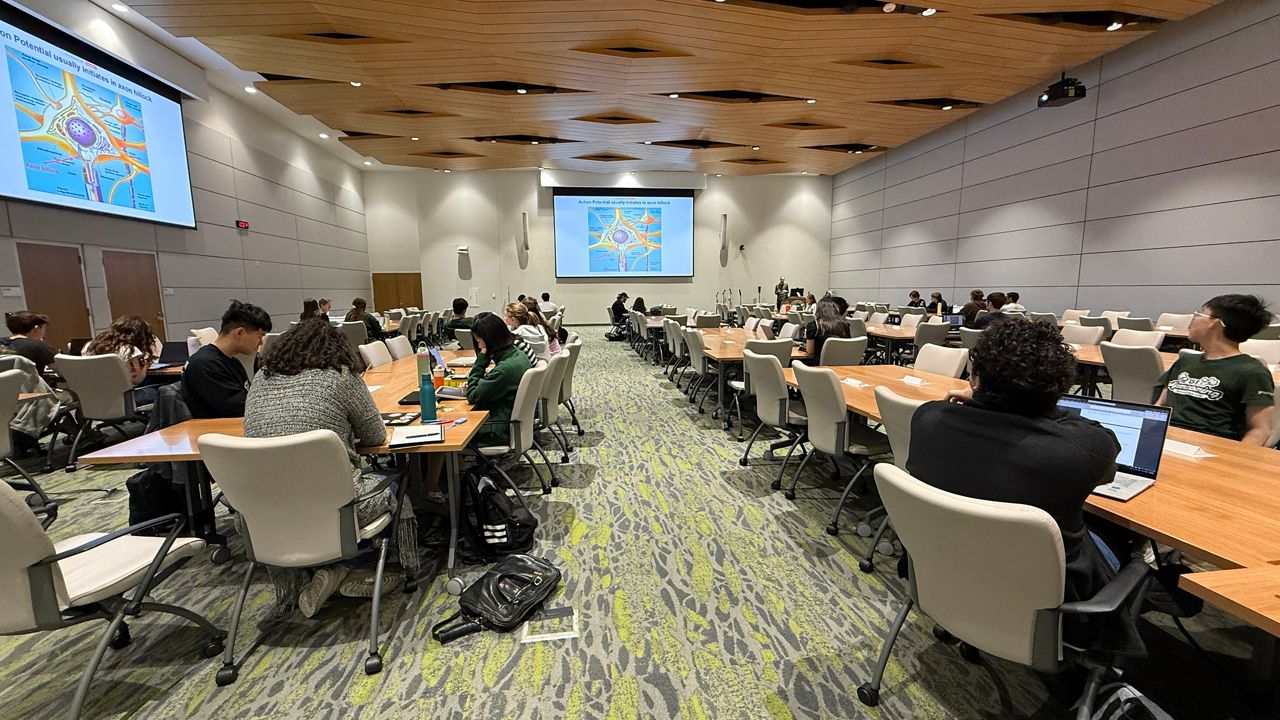
Part of being a medical student is learning nutrition. Students at the Morsani College of Medicine learn about food-related illnesses through 36 hours of nutrition training.
“We can talk about nutrition in a general sense of like what we should be getting on a daily basis. There’s also health conditions that make nutrition complicated for certain people, where we want to make sure we’re not being deficient in certain things,” Sanchez said.
But starting in June, that will double to about 76 hours of nutrition training. The USF Health Morsani College of Medicine is joining more than 50 med schools across the country in committing voluntarily to 40 hours of nutrition training that the U.S. Department of Health and Human Services (HHS) is encouraging.
“I do think it’s a good idea, so long as we also have the time to be learning everything else that we need to be learning too, right?” Sanchez said.
Nutrition training is already built into their courses, so the senior associate dean for undergraduate medical education said adjusting the curriculum will be easy without pushing out too much material. School officials said their students are taught to be lifelong learners and to stay up to date on the literature throughout their career.
“What we teach them in those 76 hours for nutrition is not going to be the end-all, be-all. In fact, five years from now, we will probably be teaching them something slightly different because it will evolve,” said Dr. Debroah DeWaay, senior associate dean for undergraduate medical education at the USF Health Morsani College of Medicine.
Dr. Debroah DeWaay was at HHS’ announcement to celebrate the med school’s new commitment. A spokesperson for HHS said an estimated one million Americans die from chronic food-related illness each year. So that’s why they are making healthy eating a priority.
“Med students will come out of school having this education, having this backbone, so that they can continue to help their patients and continue to help them figure out their nutrition so they could live healthier lives,” HHS Press Secretary Emily Hilliard said.
While Sanchez is still exploring what specialty she wants to focus on after graduation, she said having food knowledge is always important.
“No matter what field you’re going to go into, it’s going to be something you run into. So, you need to have an understanding, at least a basis, to be able to recognize what’s going on,” Sanchez said.
The National Institutes of Health is contributing $5 million to support medical school programs that integrate nutrition education into their curriculum. The money will help institutions create coursework, clinical training and research.