
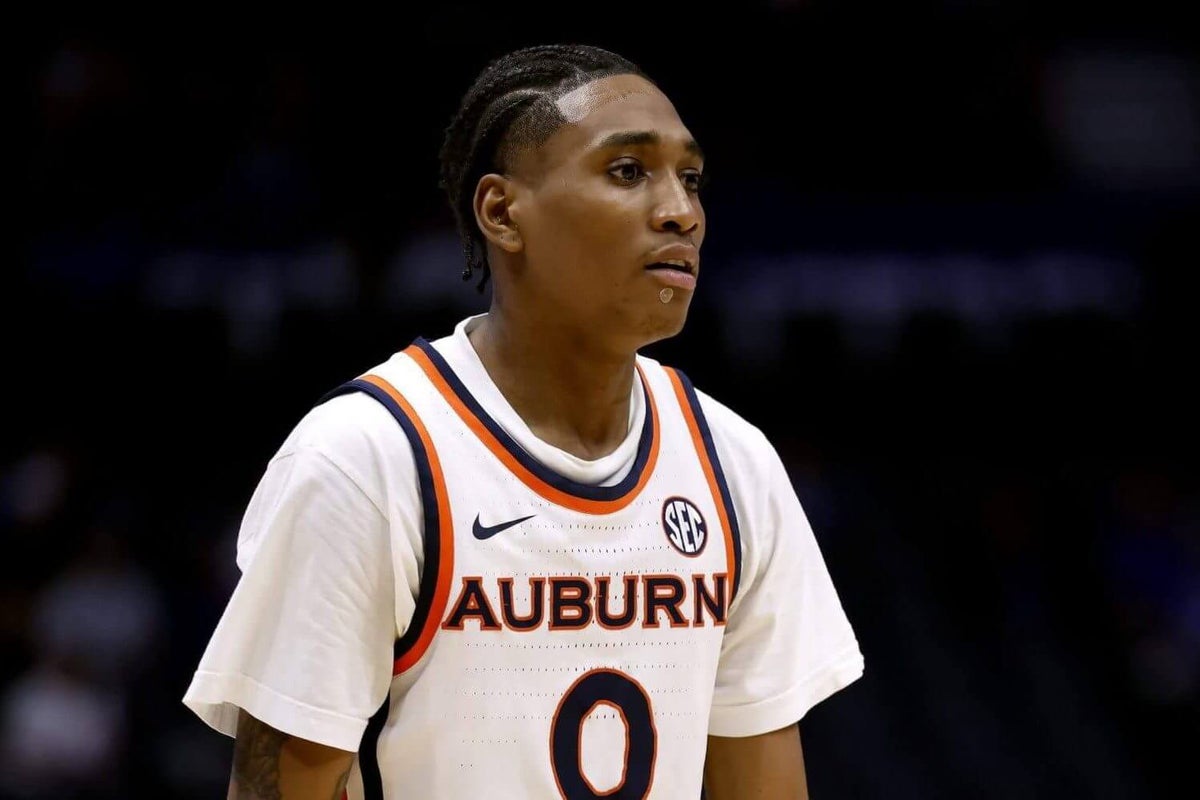
Just one year after reaching the men’s Final Four as a No. 1 seed, Auburn failed to make the NCAA Tournament, as Miami (Ohio) took the final at-large spot to settle one of the most contentious debates of the college basketball season.
Auburn had one of the best single wins of the season, beating defending champion Florida on its home floor 76-67 in January. The Tigers also had the third-best strength of schedule in the country, per the NCAA’s NET rating.
However, the Tigers went just 17-16 (7-11 in SEC play), with a 4-13 record in Quadrant 1 games. They would have been the first team ever selected for the NCAA Tournament with 16 losses. Oklahoma, San Diego State and Indiana were the other three “First Four Out” teams.
Former Auburn coach Bruce Pearl, in his first year in the CBS studio for the selection show after retiring and leaving the job to his son Steven Pearl, was left to react live on air to the Tigers’ omission.
“Auburn beat three champions this year: Florida, St. John’s and Arkansas,” Bruce Pearl said. “They played the toughest schedule in the country. Don’t know that they were rewarded for it.
“It’s hard to get another couple SEC teams in when the SEC already has 10.”
The Tigers dropped eight of their last 10 games of the regular season, then bowed out in the second round of the SEC tournament to Tennessee.
Miami (Ohio), the first Division I men’s basketball team to finish the regular season without a loss since 2021, was upset 87-83 by No. 8 seed UMass in the quarterfinals of the Mid-American Conference tournament. The RedHawks’ tournament case drew national scrutiny as their wins piled up. They played zero Quadrant 1 games, didn’t win their conference tournament and did not make the MAC final. Their strength of schedule entered Sunday ranked 339th out of 365, and their nonconference strength of schedule sat at No. 363, third from the bottom. But they will head to Dayton for a First Four matchup with SMU.
“No question, you can either win your way in or lose your way out,” Pearl said. “I always say, ‘If you put one in, who are you going to take out?’ For me, SMU, with a 191 out-of-conference strength of schedule, I don’t know if they should have been rewarded. They only won five games away from home. For me, it would have been either Oklahoma or Auburn taking that spot.”
Pearl concluded by saying, “I’m proud of my son.”
First
Round
Second
Round
Sweet 16
Elite
Eight
Final
Four
Final
Four
Elite
Eight
Sweet 16
Second
Round
First
Round
Here’s what to know about the other three teams that just missed the Big Dance and the factors that might have led to their exclusion.
Oklahoma
Record: 19-15 (7-11 SEC)
Profile strengths: Four Q1 wins, no bad losses
Profile weaknesses: Quantity of losses, middling metrics
Oklahoma won six of its last seven games, averaging 84 points per contest, and was as hot as anyone leading into a run to the SEC tournament quarterfinals, including a win over First Four team Texas, which brought the Sooners to the brink of the bubble.
Ultimately, Oklahoma could not overcome a nine-game losing streak from early January to early February. The Sooners posted a combined 10-15 record in their Quad 1 and 2 games. The program announced earlier this weekend that coach Porter Moser will return for 2026-27.
San Diego State
Record: 22-10 (14-6 Mountain West)
Profile strengths: Strong nonconference strength of schedule
Profile weaknesses: 3-8 Q1 record
The Aztecs went 6-2 in Quad 2 games and played a challenging nonconference schedule, facing two eventual No. 1 seeds in Michigan and Arizona. The problem was that they lost those two games by an average of 31.5 points. They kept their at-large case alive with a run to the Mountain West Conference title game, outlasting fellow bubble-hopeful New Mexico on Friday night and losing to top-seeded Utah State in Saturday’s final.
Indiana
Record: (18-14, 9-11 Big Ten)
Profile strengths: Two high-end Q1 victories
Profile weaknesses: Poor record (6-14) against the top two quadrants
Indiana beat UCLA and Purdue in back-to-back games in late January and played the 33rd-toughest schedule in the country, but the Hoosiers went just 6-14 against the top two quadrants and dropped six of their last seven games. Two poor losses to a Northwestern team that finished under .500 proved too much for Darian DeVries’ team to overcome.