
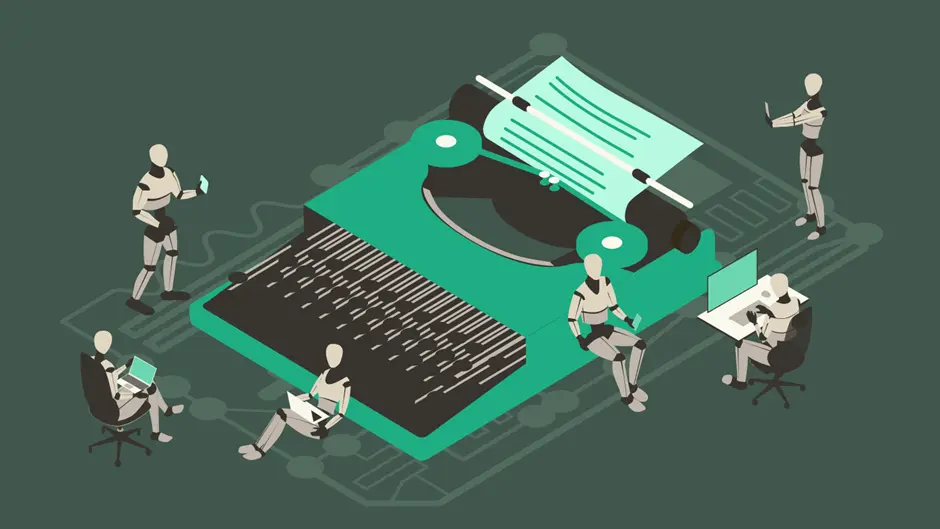
As the use of artificial intelligence (AI) proliferates into almost every discipline and work setting, the fear critics voice is that this new technology—which mimics human intelligence—will supplant workers.
Many of its defenders argue that AI is just a new technological advance, not unlike computers and calculators, that can serve as a useful tool in almost every field.
The journalism world is not untouched by AI. About 9 percent of major newspapers use artificial intelligence to produce news content, according to a study by the University of Maryland. Experts estimate that small publications use AI more extensively.
It is thus imperative that journalism students learn how to use the new technology, experts agree.
“Artificial intelligence is transforming our production and reception of news, accelerating the pace of distribution, amplifying the pronouncements of sensational content, and accentuating the potential for access,” said Karin Wilkins, dean of the University of Miami School of Communication. “While we witness the changing nature of journalistic workflows, our essential need for credible information remains.”
Through the aid of three grants, the School of Communication has established an AI task force to provide training and resources for faculty members to use AI in their classrooms, as well as for their own professional advancement.
Boriana Treadwell, senior lecturer at the school, heads one of the streams of the AI task force. She believes that AI can be a very useful tool for journalists.
“I actually think that when used responsibly and ethically AI is extremely useful to journalists,” she said. “Before AI came to our rescue, journalists spent an inordinate amount of time on tasks that were menial. Now AI can carry out these tasks, freeing us to do more important work, like on the ground reporting.”
She cites the many ways that AI chatbots, like ChatGPT, Copilot, and Claude, can help journalists:
Transcribe audio taped interviews into written texts.
Create and provide timelines.
Scan data from numerous texts, public records, and legal documents.
Scan lengthy legal, governmental, and other kinds of documents and summarizing its contents, as well as highlighting key points.
Find trends from various texts that can be turned into stories.
Provide numerous suggested headlines for articles depending on the style of the text.
For broadcasters, AI can clean up video and audio, provide captions, and can extend music tracks, if needed.
Generative AI can also draft news stories. Several news organizations, including The Cleveland Plain Dealer, use it for this purpose and have reporters submit notes and then AI drafts the stories.
Human editors then review the copy before publication. Other news organizations, including The Associated Press, Business Insider, Bloomberg, and Yahoo News use AI in different ways to enhance their news coverage.
Marcia Gomez, a senior lecturer who created a class called Where AI Meets Public Relations, said that AI cannot replace the job of a journalist.
“Chatbots can speed up drafting and summarizing, but they can’t replace the relationship-driven work of reporting—earning trust with sources, digging for facts, and making editorial judgments,” she said. Most major newsrooms experimenting with AI still keep journalists responsible for vetting and accountability, she added.
But using AI in the news organizations poses ethical issues.
Treadwell said that it is always important for news organizations employing the technology to be transparent about its usage. Human reporters and editors must always check the AI output for mistakes, called hallucinations, she said.
To ensure that her students did the work themselves, she insists that they keep a record of their reporting (whether it is written notes or taped interviews) that she can look at for accountability.
“Accountability is important in our business,” she said.
A one-day event will be held on April 10 at the School of Communication to explore the many ways Artificial Intelligence (AI) is affecting all aspects of communication.
Learn more about “Ai in Communication” here.