
By Matthew Cimitile, University Communications and Marketing
In 2018, USF historian J. Michael Francis uncovered that the first known St. Patrick’s
Day procession took place not in New York City or Boston or even Ireland, but rather
St. Augustine, Fla.
Conducting research in Spanish archives, Francis came across a passage that on March
17, 1600, St. Augustine’s residents marched through the streets to honor the feast
day of San Patricio, or St. Patrick.
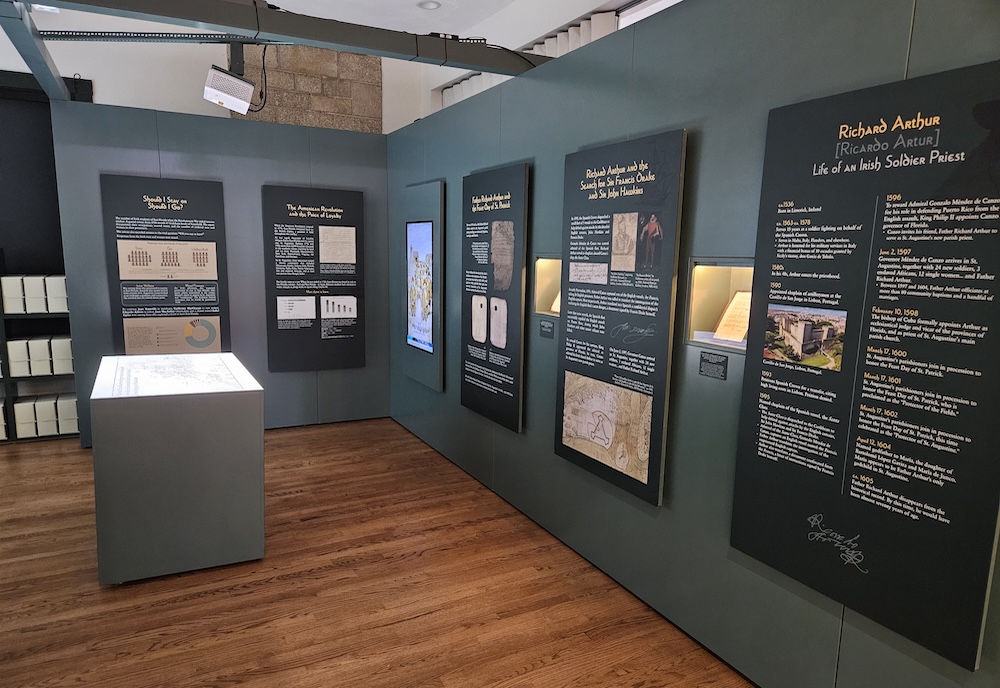
Now that discovery has led to a new museum exhibition that highlights the Irish diaspora
in St. Augustine and East Florida. On March 9, the exhibition opened at the St. Augustine Visitor Information Center, chronicling the history of the Irish diaspora in Florida and their impact from 1595-1840.
“Through animated stories and narratives, traditional museum panels, illustrative
maps, documents and more, this exhibit provides people with a greater sense of the
long-standing Irish connection with Florida, starting with the first recorded Irishman
who came in 1595,” Francis said.
The exhibition will run through April 30. Organizers hope it will then travel to locations
across Florida and even across the Atlantic to Ireland.
“While this exhibition is about the Irish diaspora, I think a broader takeaway is
that it challenges some of our preconceptions,” said Sarah Kavanagh, the Consul General
of Ireland in Miami. “Most of us assume that the story of the Irish in America begins
in nineteenth century Boston, New York or Philadelphia, in British colonies or a newly
created USA. In fact, persecution and dispossession drove many Irish Catholics to
the continent and thence to the Spanish Empire in the Americas and the Caribbean.”
The seeds of the exhibition began when Kavanagh contacted Francis in 2025. She had
read about the St. Patrick discovery and presented the idea of further commemorating
this important event through an exhibit. Francis gave it some thought and came back
with using the first celebration of St. Patrick as a springboard to highlight the
larger history of the Irish in eastern Florida.
“They loved the idea. And then of course I realized ‘what have I just done?’ I made
this a lot more complicated and a lot more work for me,” he said amusingly.
Francis, who is also the chief academic adviser for La Florida: The Interactive Digital Archives of the Americas, turned to collaborators who helped produce the award-winning La Florida project to bring to life an exhibit on the history of the Irish in the state. The
team began combing through archival collections from Spain and the United States in
an effort to locate every Irish person who resided in colonial East Florida.
With that information in hand, they began to develop the key features of the exhibition,
which includes:
15 animated stories of Irish people in colonial Florida – including Darby Glavin,
the first recorded Irishman in Florida. Each story is projected onto a screen and
narrated by contemporary Irish people
A 3-dimensional reconstruction of St. Augustine in 1788
Historical documents from Spanish and St. Augustine archives
Informational panels providing greater context
A timeline of the major events of the period
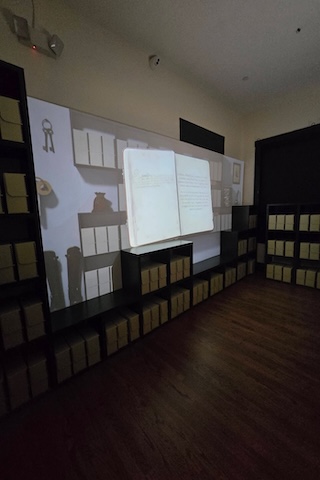
Animated stories of Irish people in colonial Florida.
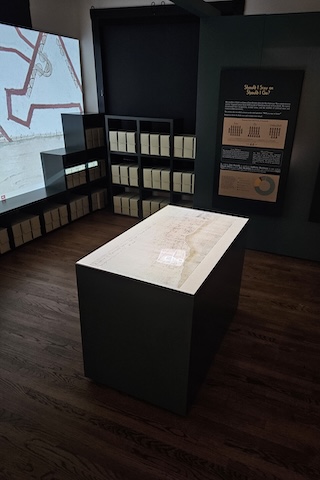
Reconstructed map of colonial St. Augustine.
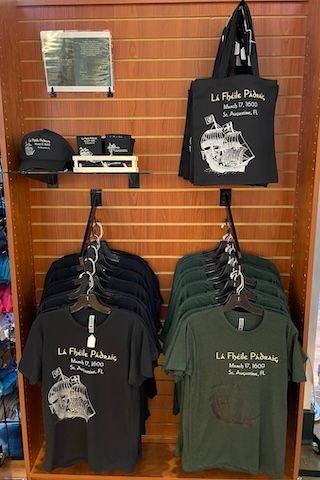
Merchandise celebrating the first known St. Patrick’s Day procession.
While this work took place, the team coordinated with St. Augustine’s City Commission
to host the exhibit. The commission suggested the Visitor Information Center as an
ideal location. One of the most visited places in the city, it is also on the National
Register of Historic Places, which posed its own set of complications for hosting
a museum exhibition.
“We couldn’t attach anything to the wall, ceilings or floors, so we had to get creative
and really problem solve how we would overcome that challenge. We pretty much had
to build a room within a room to hang up the museum display,” said Rachel Sanderson,
executive director of Sin Barcos, whose nonprofit organization collaborated with Francis on the exhibition and works
to enhance visibility and interest in Florida’s rich colonial past.
The City Commission approved the museum exhibition in late January, giving the team
a little more than a month to install it prior to St. Patrick’s Day.
“Normally, an exhibit like this, with all the planning, research, permissions and
installation would take two years to put together,” Sanderson explained. “We pulled
it off in about four months.”
The hard work paid off. The opening celebration was filled with visitors and dignitaries,
including Niamh Smyth, the Irish Minister of State for the Department of Enterprise,
Tourism and Employment. Some in attendance were surprised to learn the rich Irish
history in Florida. Others remarked on the unique use of storytelling and animations
to bring to light this history.
“Ireland made a major investment in Florida by opening a diplomatic mission in 2022.
This on-the-ground presence has allowed us to take forward some major projects, including
this one. I am thrilled we were able to work together to bring our vision to life,”
Kavanagh said.
The Irish diaspora in colonial Florida exhibition is a partnership between Sin Barcos Inc., the Consulate General of Ireland, Miami and the City of St. Augustine.