
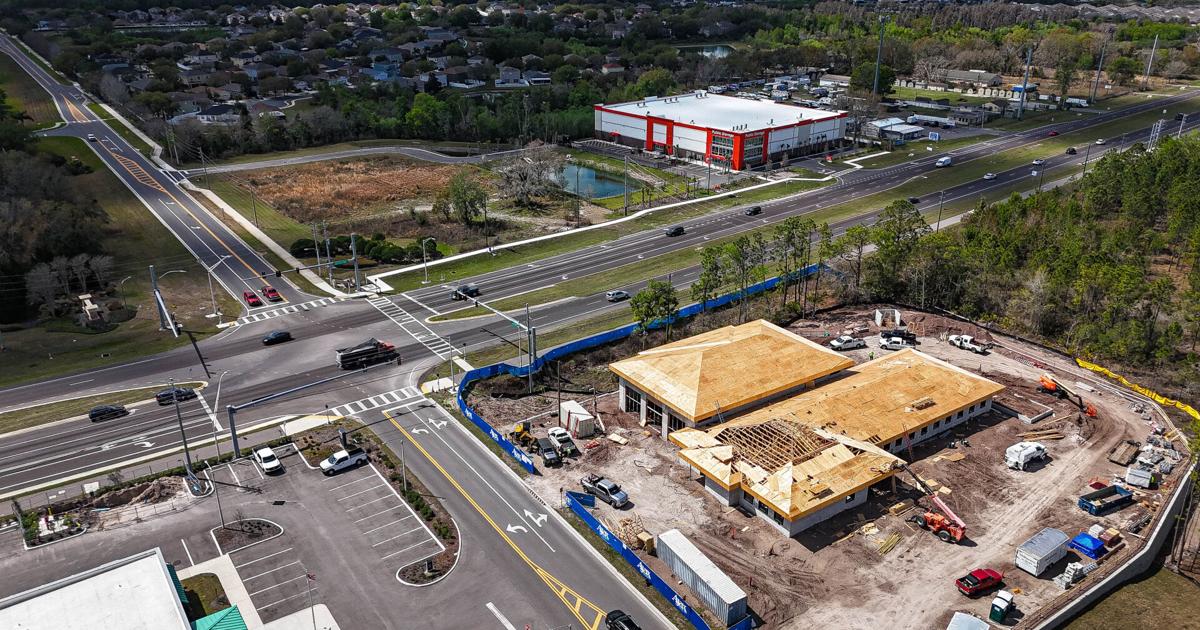
CITRUS PARK — Most firefighters retire before the age of 60. Hillsborough County Fire Rescue believes the same should go for fire stations.
That’s why construction is well underway on a replacement for Fire Station 13, with a tentative opening this summer. The new $8.5 million facility at 7313 Ehrlich Road will replace a 60-year-old former volunteer station at the Citrus Park Sports Complex at 7502 Gunn Highway.
The old station, officials said, has outlived its usefulness. Its tight footprint next to a busy recreational complex creates operational problems, and the building lacks drive-through apparatus bays and modern decontamination equipment.
The replacement will be the template for every new or rebuilt station in the county going forward, said Rob Herrin, public safety information section chief for Hillsborough County Fire Rescue.
“Ever since COVID, Hillsborough has grown tremendously in population and response time, which, in turn, increases the demand for public safety,” Herrin said. “We’re modernizing the ones that need it, improving what we already have.”
The new Station 13 will feature an approximately 7,200-square-foot, three-bay design with seven individual sleeping quarters. It will house five first responders — three on a fire engine and brush truck, and two on a rescue vehicle. The project is funded through a combination of county commission money and an American Recovery Act grant.
Future stations will share the same upgrades: a modern dispatch alerting system, decontamination equipment to remove carcinogenic particulate matter from firefighters and their gear, individual bunk rooms that encourage social distancing and a mini-chiller air conditioning system designed to extend the life of building systems.
Herrin said the decontamination system is the most critical feature. The state recognizes a series of cancers as presumptive for firefighters, he said, and the new equipment will “help get those contaminants off your person before going back to work or to the quarters.”
Station 13 is one of six new or replacement stations under construction countywide: No. 10, Armdale; No. 15, Palm River; No. 21, Thonotosassa; No. 47, North Sun City (new); and No. 48, South Progress Village (new).
Six more are in the design phase, funded by the county commission: No. 11, Brandon; No. 20, West Hillsborough; No. 33, Falkenburg; No. 49, Airport Industrial (new); No. 50, Racetrack (new); and a combined station that will merge No. 26, Cork Knights, and No. 30, Midway, into one large facility.
“Fire Rescue and the county have made it a priority to address these stations,” Herrin said. “Not just getting them modernized, but enough stations to handle the growth and the response time.”
Beyond bricks and mortar, the county in November launched the Peak Rescue Division, a roving unit of paramedics and ambulances aimed at improving response times for medical calls and transports.
The division added 48 first responders, including 20 rescue lieutenants and 26 paramedics. A section chief and training officer are also part of the unit, which began operations in the spring.
The division costs $5.8 million a year but is expected to pay for itself. Officials project 15,000 transports annually, with each billed at $800 plus mileage — an average of about $477 per call — generating more than $7 million a year in revenue.
The division operates five new rescue units, with 10 total vehicles on the move, untethered from fire stations. Units are staffed 12 hours a day, seven days a week, including holidays, running from 7 a.m. to 10 p.m. — the county’s busiest window for emergency calls.
The approach appears to be working. According to county data, 37% of the department’s 41 units were overutilized in 2025, down from 55% in 2024 and 79% in 2023, when no three-person peak units were in place. A pilot program with three-person peak units began in 2024.
Herrin said the results speak for themselves.
“Call volume, as we know it, can and will have its peak times,” he said. “But if you pair the roving unit with the new fire stations, that is working toward response times, which we have seen improve by as much as 45 seconds.
“Now, 45 seconds might not seem like a lot, but hold your breath for 45 seconds and that is a long time to go without oxygen or for fires to grow. When it comes to fires spreading or cardiac arrests, minutes — seconds — matter, so improving response time is paramount.”