
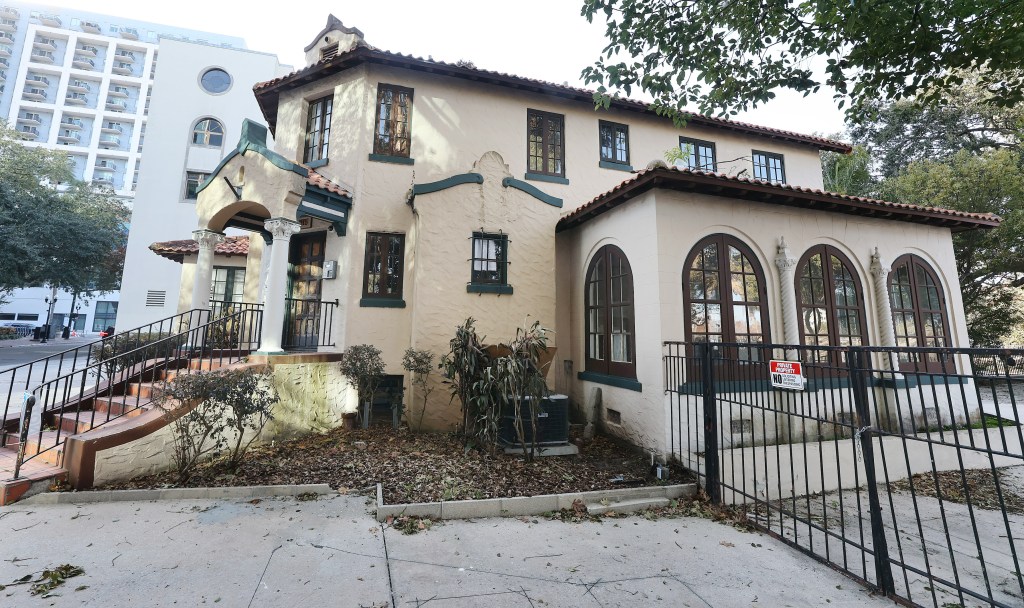
A nearly 100-year-old home near Lake Eola won’t be designated an historic landmark but will be preserved and incorporated in some way into plans for a new, nearby park entrance.
The Lubbe House sits on the southwest corner of Lake Eola in downtown Orlando. Last year, the city acquired the Mediterranean-style property as it worked to create a new Lake Eola park entrance near the corner of Central Boulevard and Rosalind Avenue. The specific plans for the house are still unclear.
Local preservationists wanted the house, built in 1927, designated a landmark, which would prevent its demolition.
But Orlando city commissioners voted 6-1 against the request on Monday. Following the lead of Mayor Buddy Dyer, commissioners cited the possibility of extra costs for the city, if the home received that designation. Repairs and renovations of historic landmarks can be more expensive because of rules on the materials that can be used, among other issues.
Dyer said the city still wants to do what’s best for Lubbe House, and officials will be seeking community input on its next chapter.
“Probably not a restaurant, probably not a wine bar, but we will figure out a good use and help us to upgrade the building itself,” he said.
Commissioner Patty Sheehan, the lone vote for landmark status, had feared the house would be torn down to make way for the park expansion, as did members of the trust, which petitioned for the designation.
Those fears were allayed in late February when Dyer confirmed the home wouldn’t be demolished. But for concerned local residents, a landmark designation would’ve been the ultimate reassurance.
“Landmarking is necessary to ensure that the Lubbe House survives,” Tana Porter, a member of the trust, told council members Monday.
Porter said the Lubbe House is “too remarkable of a place to lose.”
The two-story, 3,500-square foot home featured three bedrooms, two sun porches and a balcony. It was designed by Peter Samwell, whose portfolio also included the Park Plaza Hotel in Winter Park.
Mark Line, a member of other preservation groups in the city, said a landmark designation would allow the city to apply for grants to help restore the home, reducing expenses instead of adding to them.
The Black Bottom House of Prayer in Parramore, for example, suffered a caved in roof but a $500,000 grant helped with those repairs, he said.
Sheehan said Orlando could be both fiscally responsible and do the right thing. She said she favored landmark status because she wants a protection for the house to be official.
“We’re not thinking about the future and that’s my concern,” she said. “If you want to protect something, you got to protect it now.”