
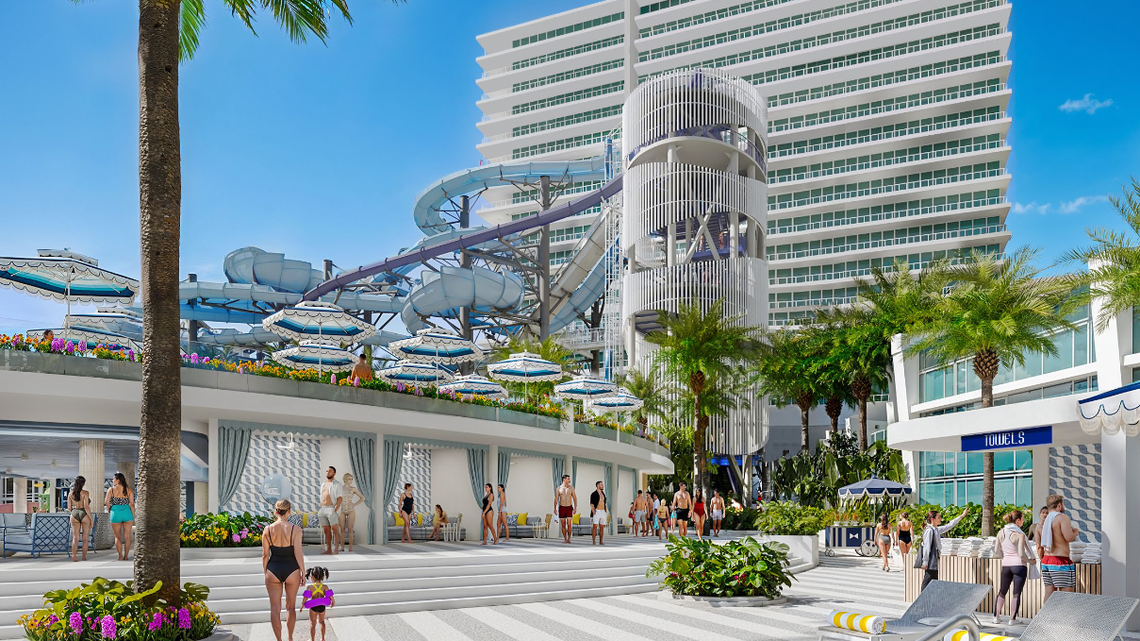
A rendering of the revised proposal by the Fontainebleau Miami Beach hotel to build a water park and renovate the pool area.
City of Miami Beach
The controversial bill the Legislature passed on Friday targeting Miami Beach may seem like a parochial issue. It is not.
No city or county in Florida is safe from Tallahassee’s increasing willingness to protect powerful industries and interfere with decisions, no matter how local or granular, normally left up to county or city hall.
With the passage of House Bill 399, the Beach probably will have to greenlight a controversial water park that residents have tried to stop from being built at the Fontainebleau hotel.
Before that, it was Key West, where a voter referendum limiting cruise ships was reversed by the state in 2021. Then, it was Miami-Dade County, which was on the verge of passing heat protections for outdoor workers in 2024 when lawmakers and the governor, urged by the agriculture and construction industries, banned such efforts.
Next, it could be any city, county or village who upsets a developer, business or political donor. There’s a not-so-subtle threat in bills and laws that curtail local autonomy: You cause too much trouble and the Legislature will squash you.
HB 399 was the most extreme example of this in recent years. Fontainebleau representatives were scheduled to go before the Miami Beach Historic Preservation Board in February. Residents packed city chambers. Minutes before the meeting was about to start, a hotel representative asked for the hearing to be deferred, the Herald reported.
Then came the legislation, less than two weeks later, that essentially may allow the Fontainebleau to proceed with its plans for water slides topping nearly 100 feet in its pool deck area.
The historic Fontainebleau is a key economic and tourism driver for the Beach and South Florida that employs a lot of people. Perhaps, in the end, many of the community’s objections — such as increased traffic — may turn out to be exaggerated.
But that’s why there are local boards, public hearings and rules in place. Once the state puts its thumb on the scale, that process goes by the wayside and citizen participation is diminished, making development approval a less democratic process.
This doesn’t mean that the state doesn’t belong in these decisions. Local zoning and planning codes already must follow Florida law and the state constitution. It is not as if advocates for local control want each little town to be its own kingdom.
And there are times when state involvement may be warranted. The Live Local Act facilitates the construction of workforce housing by taking away some local powers over zoning, density and height. While it’s still unknown whether the law will actually make homes cheaper, many housing advocates say it makes big investments in affordability.
We’re simply asking lawmakers to be reasonable. These state preemptions must serve a public good, not a particular business interest. Important conservative values such as property rights and economic freedom should not become a blanket excuse to do away with environmental protections and community input.
The regular legislative session that ended Friday was filled with examples of state interference.
HB 399 initially included a measure that would have made it easier to approve construction outside Miami-Dade’s Urban Development Boundary, which protects the Everglades and agricultural zones. Thanks to opposition from some Miami Republican senators, that portion of the bill was removed.
Another provision of the legislation stayed: It requires that local governments allow manufactured homes where single-family homes are allowed. The point appears to be to make houses cheaper.
Some communities will probably oppose the state big-footing local government in residential neighborhoods, but this is a small, incremental step compared to a bill titled “Blue Ribbon Projects.” That proposal, Senate Bill 354, died, but it would have allowed the construction of new city-sized developments of at least 15,000 acres with little oversight from local governments, if 60% of the land fell into an overly broad definition of “reserve area.” The bill was so far-reaching that many Republicans opposed it because of its potential impact on rural parts of Florida.
The Florida Legislature may consider its efforts in these cases as pro-business, but it looks increasingly like micromanaging of local communities. Worse, this level of state interference has become a weapon for the politically connected to stop Floridians from deciding how they want their communities to look.
BEHIND THE STORY MORE What’s an editorial?
Editorials are opinion pieces that reflect the views of the Miami Herald Editorial Board, a group of opinion journalists that operates separately from the Miami Herald newsroom. Miami Herald Editorial Board members are: opinion editor Amy Driscoll and editorial writers Isadora Rangel and Mary Anna Mancuso. Read more by clicking the arrow in the upper right.
What’s the difference between an op-ed and a column?
Op-Eds, short for “opposite the editorial page,” are opinion pieces written by contributors who are not affiliated with our Editorial Board.
Columns are recurring opinion pieces that represent the views of staff columnists that regularly appear on the op-ed page.
How does the Miami Herald Editorial Board decide what to write about?
The Editorial Board, made up of experienced opinion journalists, primarily addresses local and state issues that affect South Florida residents. Each board member has an area of focus, such as education, COVID or local government policy. Board members meet daily and bring up an array of topics for discussion. Once a topic is fully discussed, board members will further report the issue, interviewing stakeholders and others involved and affected, so that the board can present the most informed opinion possible. We strive to provide our community with thought leadership that advocates for policies and priorities that strengthen our communities. Our editorials promote social justice, fairness in economic, educational and social opportunities and an end to systemic racism and inequality. The Editorial Board is separate from the reporters and editors of the Miami Herald newsroom.
How can I contribute to the Miami Herald Opinion section?
The Editorial Board accepts op-ed submissions of 650-700 words from community members who want to argue a specific viewpoint or idea that is relevant to our area. You can email an op-ed submission to oped@miamiherald.com. We also accept 150-word letters to the editor from readers who want to offer their points of view on current issues. For more information on how to submit a letter, go here.
This story was originally published March 16, 2026 at 5:57 PM.