
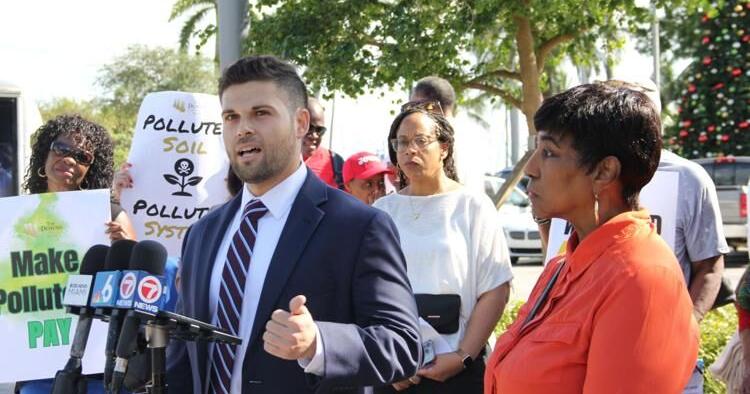
As the long-awaited Old Smokey class-action hearing got underway last week in a downtown courtroom, nearly three dozen current and former West Grove residents leaned in as three of their neighbors took the witness stand.
The hearing, which continues this week, will determine whether a lawsuit filed against the City of Miami over the potential harm caused by the Old Smokey incinerator can proceed as a class action, with thousands of potential claimants.
“It’s been decades since the smoke cleared but I was extremely pleased to see current and former residents come together last week to pack the courthouse and ensure that the impact of Old Smokey on our families and community would not be forgotten as we continue this fight for environmental justice,” Carolyn Donaldson said.

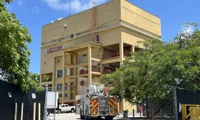
The former “Old Smokey” incinerator site in Coconut Grove, now the City of Miami’s Fire Rescue Training Center, is at the center of a lawsuit alleging toxic ash contaminated nearby West Grove neighborhoods.
(Don Finefrock for the Spotlight)
Donaldson grew up on Charles Terrace in the West Grove, just a block behind the trash incinerator at 3425 Jefferson St. that billowed smoke and ash across the neighborhood for more than 50 years before closing in 1970.
In the years since, Donaldson has mourned the loss of her siblings, parents and grandparents from diseases she believes may have been caused by exposure to the incinerator’s toxic smoke and ash.
She is one of more than 800 potential plaintiffs identified in a 2017 lawsuit filed against the City of Miami and SCS Engineering that contends that Grove residents were exposed for decades to toxic substances — including dioxins, arsenic, lead and barium — left behind when incinerator ash settled into the soil.
If the lawsuit is certified as a class action by Miami-Dade Circuit Judge Spencer Eig, the area of potential harm would cover an estimated 2,220 properties stretching from Coconut Grove to the other side of U.S. 1 in Coral Gables.
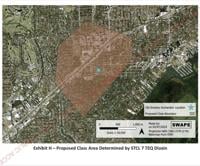
The proposed class area for the “Old Smokey” lawsuit, if certified, would extend across the West Grove and east of U.S. 1 into Coral Gables.
(Map by expert Paul Rosenfeld)
“This is the most superior way to handle this with one shot and take care of the problem and monitor these folks appropriately for the harm that may have already happened,” David Durkee, an attorney for the plaintiffs with the Downs Law Group, told the judge.
Last week’s hearing began with the testimony of three plaintiffs, selected as class representatives, all of whom lived in the West Grove while Old Smokey was in operation and in the decades after it closed.
Each witness recalled their upbringing, under the plume of Old Smokey, drawing sighs and murmurs of agreement from the crowd.
“As a child, it (Old Smokey) blew out smoke and particles, like dust – black, gray and beige-looking smoke,” lead plaintiff Yvette Styles told the court. “My mom used to keep the windows closed. That was for the smoke and the odor… It was bad. It was extremely bad.”
Thaddeus Scott, a Grove resident of 68 years, described those odors as synonymous with life in the neighborhood. “Those smells were uncomfortable smells,” Scott said. “We experienced it on a regular basis. It was part of the fabric of the community.”
The plaintiffs shared their memories of how the incinerator ash collected on cars, on fruit trees and neighborhood playgrounds, how the smoke stained the sides of buildings, and how the ash would settle in their hair and on their bodies when they were outside.
“I can remember getting little rashes on my body, skin irritations on my body, not knowing where they came from,” Scott said.
“We put out clothes on the line and then they (Martin’s family) would have to take them in because the ash would fall on them,” Sandra Martin said.
Martin lived near Old Smokey from 1952 to 1975. In 1998 she was diagnosed with breast cancer, which is now in remission. She’s also been diagnosed with diabetes.
Styles and Scott also share a diabetes diagnosis and both have hypertension. Scott has additional issues with high blood pressure, while Styles has had reproductive and thyroid problems.
The lawsuit contends that residents living up to a mile away from the former site of Old Smokey near Armbrister Park, where a Fire Rescue Training Center now stands, and who were exposed to its ash have an increased risk for serious health problems.
The City of Miami contests that claim. During two days of testimony last week, attorneys for the city focused on the medical histories of the three witnesses, questioning whether the described medical conditions could be linked to Old Smokey.
Co-defendant SCS Engineering – hired by the city to test and remediate the soil near Old Smokey after contaminants were first identified at the former incinerator site in 2011 – pursued a different line of questioning.
SCS attorney Jorge Guttman pressed witnesses on what types of businesses operated in and around the neighborhood — including hair salons, barbecue restaurants and auto repair shops — in an apparent effort to link the plaintiffs’ health conditions to alternative sources of pollutants.
To bolster their case, attorneys for the plaintiffs pointed to an expert study that found an increased health risk for residents exposed to Old Smokey’s ash.
Paul Rosenfeld, the author of the study, holds a PhD in soil chemistry from the University of Washington and has conducted environmental investigations similar to the Old Smokey study for over 25 years.
On Thursday, he testified that a soil analysis of selected residences in the vicinity of the former incinerator found pollutants associated with fly ash at levels exceeding federal safety thresholds.
Those results confirm a potential health risk for residents, Rosenfeld said.
As part of the study, Rosenfeld calculated the increased cancer risk for each plaintiff. A one-in-a-million risk is considered the safe limit by many regulatory bodies. Rosenfeld said he found a risk as high as 14.9 in a million for one plaintiff, and found no plaintiff was assessed below a two-in-a-million cancer risk.
At those risk levels, the City of Miami should be required to pay for medical monitoring for all residents who were exposed, attorneys for the plaintiffs contend.
Asked if he agreed with that position, Rosenfeld said, “I certainly think medical monitoring would be nice after the historical insult they (residents) have been given.”
Over the course of their testimonies, Martin and Scott made it clear they received no clear communication from SCS on its investigation into possible toxin exposure in the area or whether they were at risk living at their properties.
Unlike Styles, whose home soil was tested by the City of Miami, the other witnesses said their soil was never examined by the city or SCS, despite having granted them permission to do so.
“SCS never approached myself or the community about anything. I don’t know who was supposed to notify the residents of Village West that SCS was testing. I never heard of SCS until these court hearings,” Scott said when asked if he was aware SCS was hired by the city in 2012 to conduct environmental sampling.
Throughout the hearing, plaintiffs’ counsel referenced a nearly identical lawsuit filed against the City of Fort Lauderdale by residents seeking medical and property damages for chronic illness and leftover contaminants found in their soil from an incinerator.
After 13 years of litigation, the lawsuit ended in a class-action settlement, and plaintiffs were awarded $18 million for damages caused by the Lincoln Park incinerator – $132 million less than their original demand.
Attorneys for the West Grove residents say if that case (Walter Hinton v. City of Fort Lauderdale) was decided in residents’ favor, so should the matter of Old Smokey.
“You can’t really find any light between this case and Hinton. What was there is more important here. What was there is larger here. What was found there is found greater here,” Durkee said.
Jason Clark, an attorney at Down’s Law Group working on the case, told the Spotlight that Old Smokey operated for double the time Lincoln Park’s incinerator did, and in a much more concentrated area, making for a well-substantiated comparison.
The plaintiffs’ case will continue this week with testimony from two other expert witnesses — a toxicologist and a property valuation expert — before concluding with legal arguments on why the court should grant class certification.
Once the plaintiffs finish their testimony, the hearing will shift to the defense. Attorneys for the City of Miami and SCS are expected to call their own expert witnesses.
This story was produced by the Coconut Grove Spotlight, a nonprofit newsroom covering Coconut Grove and Miami City Hall, as part of a content sharing partnership with The Miami Times. Read more at coconutgrovespotlight.com.