
As the cost of living soars, the American dream slips away for many people.
Families across South Florida are struggling to pay bills, even though they are well past the poverty line. However, they still don’t have enough to truly survive in our community.
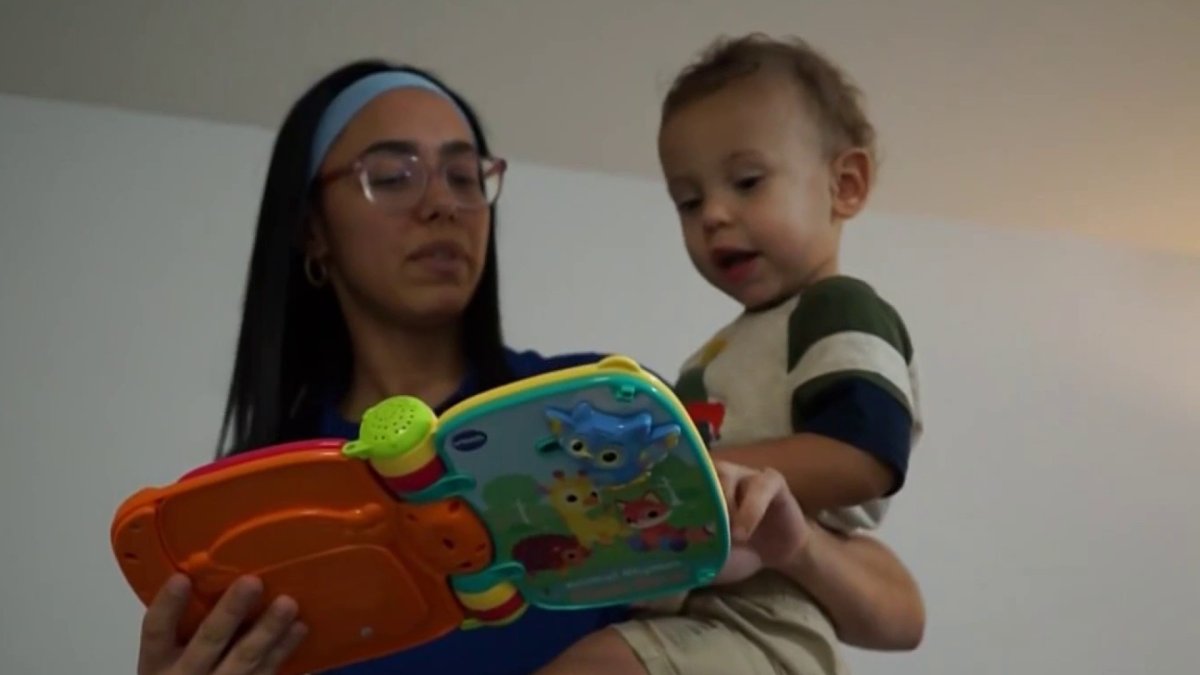
In a small apartment in South Miami, 24-year-old Barbara de Leon is found playing with her son, Thiago.
Leon arrived in Miami from Cuba roughly three years ago, and she wanted a new beginning. But instead, she was met with financial challenges.
“Before, we were living with limits,” she told NBC6 in Spanish. “We couldn’t go to work one day because then we wouldn’t get paid; we didn’t have any backups. It was a little bit complicated.”
Shortly after migrating to the U.S., Barbara found out she was pregnant with her son Thiago. Her partner worked at the time as a commercial truck driver, so she could take care of her son.
“So, he covered all of our costs,” she explains. “And the limit was our costs, the stuff for the baby, it wasn’t like we had a lot of…it wasn’t like we had so much extra.”
During that period of her life, Barbara and her family were considered to be an ALICE, or “Asset Limited, Income Constrained, Employed.”
“It is those individuals that are asset limited, but yet they are constrained as far as their income,” said Symeria Hudson, the president and CEO of United Way Miami.
An ALICE could be anyone, from your bus driver to the person serving you a meal at a restaurant, a teacher, or a childcare worker, Hudson said.
It’s anyone making $72,000 – which is the median household income in Miami-Dade – or less, annually.
“When you look at 54% of the households, which is over 525,000 households, you line two people up, one of them are going to be an ALICE, an ALICE family,” Hudson said.
Barbara said that during that time, the costs for her rent, electricity and food were roughly $34,000 a year.
She does not know how to drive yet, so she has to pay for Ubers to get her to and from work, the doctor’s, the grocery store – anywhere she needs to go. Other costs include doctors’ visits, specifically for Thiago, insurance costs, and unexpected funds for life emergencies.
United Way Miami estimates that for a family of four, just covering the basics is close to $90,000 a year. If there are two adults living with two children in childcare, they should be making about $51 an hour just to make ends meet.
But for many, that’s not the case.
According to the 2025 ALICE report, 15% of Miami-Dade households are living in poverty, qualifying for federal and state aid. The other 39% are ALICE who qualify for those safety nets.
“In total, that’s 54% of households living below the ALICE threshold, it’s up since 2023,” Hudson said. “And so now we’ve added 40,000 more households to this ALICE class.” “So that is alarming, quite, quite honestly, that means that things are not getting better. Even though the survival rate in terms of the actual, survival rate in terms of the actual wage is going up, the median income is going up as well, but there’s still a gap between what it takes to live in Miami-Dade County versus what people are actually making.”
As Thiago grew, Barbara decided she wanted to look for work. She had the support of her partner, but did not know where to turn to for work. She does not drive and does not speak English. But when she was looking for childcare services for Thiago, she found United Way Miami. They accepted her son into their early steps program and helped her with her resume, a course and certification, all to be able to teach. It’s the job she is currently doing at I Learn Preparatory.
“Now I am more comfortable, I feel comfortable in my career, I don’t feel stagnant,” she said.
Today, Barbara makes about $24,000 a year. Coupled with her partner’s salary, she said it’s sufficient.
“We are OK, we will say we are OK. We are not going to complain either, we are OK,” Barbara said with a soft laugh. “But, there is always that want to have better, you want to have more freedom and not have to worry about I can’t miss a day of work because it will affect my payments on rent, insurance, all of those things.”
So she continues to work hard and lean on the help of organizations like United Way, and has goals like learning English, driving, and moving up in her career.
“I want, I can, and I will do it,” Barbara said.
Over the last six months, United Way Miami has received over 40,000 calls from people asking for help regarding rental assistance, transportation, food and utilities.
To learn more about how they have helped families in need, you can look at the 2025 ALICE Report.
To learn how you can receive help, you can visit United Way Miami.