
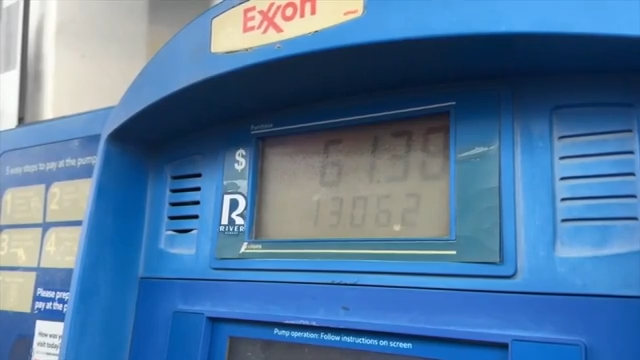
FORT LAUDERDALE, FLA. (WSVN) – South Floridians are reacting to increased prices at the pump, as the cost of gas continues to rise across the country as the conflict in the Middle East rages on.
In Fort Lauderdale, one particular station has seen prices rise about 70 cents a gallon in just the last 15 days.
Customer Ryan Pratt spoke with 7News on Thursday.
“It’s insane. I was at a light last night, and I saw $4.29 a gallon. I thought, ‘Man, I’m paying more for gas than I am milk, so it’s up there, man,” he said.
These increases are something everyone around the country has felt.
Milosh Miletic, who runs a food truck business in Fort Lauderdale, said he’s bracing for higher costs.
“We’re still waiting to see how it’s gonna go ’cause we do probably, like, pay month-to-month ’cause we’re still in a month before when the war didn’t start. I’m pretty sure it’s gonna affect us a lot,” said Miletic.
Miletic said business wasn’t always consistent, even before the war began.
“Well, you know, it’s a roller coaster,” said Miletic.
According to AAA, nationwide the average jump is around 92 cents a gallon in the last month. It’s even worse for diesel, with an about $1.33 jump.
“They are horrendous. Even though we have a gas card for the company and everything like this, I just think that the gas prices are way too high, especially in California and other places like that,” said Robert Williams. “For the average person really trying to get out here and get it, I mean, some things we got to cut back on, because the gas is too high.”
“My gas prices have doubled in the past two weeks,” said Pratt.
Experts say the problem is not a shortage as there is plenty of gas, but much of it is stuck at the Strait of Hormuz, which separates the Persian Gulf from the Gulf of Oman and the Arabian Sea and points beyond that.
“We’ve only begun to see the effects of the war. The Strait of Hormuz is basically closed,” said Dr. Craig Austin with Florida International University’s Department of Marketing and Logistics.
Twenty percent of the world’s oil flows through the strait. Because of the war in the Middle East, it is now at a standstill.
“There are over 600 ships in the Strait of Hormuz who are not moving, and so, it would take months to clear that,” said Austin.
While the United States is a net exporter, which means there is a lot of oil domestically, economists say that because everything is interconnected across the globe, there is a worldwide price for oil and everything is tied to that, so they believe prices will likely go higher before they start to lower.
“There is too much fear, too much uncertainty in the market for gases to come down, the volatility of the price is all due to the uncertainty,” said Austin.
That level of uncertainty presents major concerns for businesses like Miletic. In his case, he’s fortunate to operate at a location where he can connect his food truck to an electrical hookup at a food truck lot on State Road 84 and 595, bypassing some of the need for fuel.
Despite that advantage, he acknowledged that the cost of simply doing day-to-day business doesn’t appear to be going down anytime soon.
“Every day that the, let’s say, war lasts longer, I’m less optimistic. The thing with us Serbians is ’cause we, back in ’90s, survived like three wars, war humbles you in a way that you realize that you’re running a business day-to-day, you know, planning things and that’s something like that happens, and everything changes,” said Miletic.
Experts say finding ways to overcome uncertainty is one of the largest hurdles business owners will face.
Austin added that even if the war with Iran were to immediately come to an end, it would still take several months to allow the hundreds of tankers stuck waiting around the Strait of Hormuz to begin flowing at a normal pace, which would allow for global prices to readjust.
Copyright 2025 Sunbeam Television Corp. All rights reserved. This material may not be published, broadcast, rewritten or redistributed.
Join our Newsletter for the latest news right to your inbox