
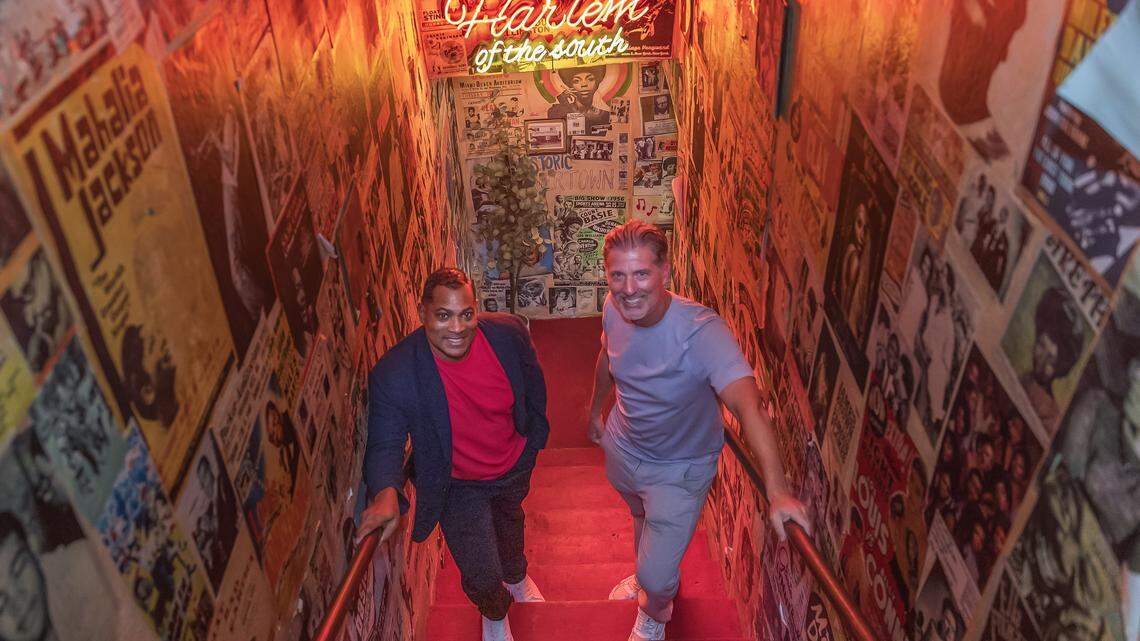
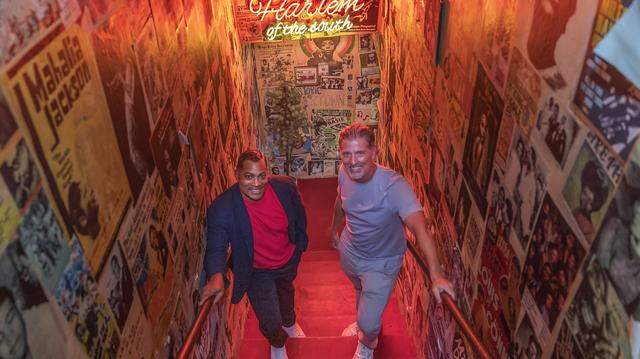
Co-owners Derek Fleming (left) and Michael Simkins (right), pose on the stairs leading up to the pool hall at the Red Rooster restaurant in the heart of Miami’s historic Overtown neighborhood on Friday, March 13, 2026.
Pedro Portal
pportal@miamiherald.com
In 2020, restaurateur Derek Fleming was excited. He planned a big party to celebrate the opening of Red Rooster, the Miami version of his popular Harlem, New York, restaurant. Patrons could see gorgeous Black art and taste delicious soul food and Caribbean cuisine.
But the pandemic happened. Red Rooster never had that celebration.
Fleming and his partners, real estate investor Michael Simkins and chef Marcus Samuelsson, pivoted and temporarily made Red Rooster a community kitchen serving up free meals.
“We worked with our farmers and brought food in, cooked it, and then gave out food to folks who were dislodged from their work or didn’t have homes,” said Fleming, 52. “We served over 7,000 meals.”
The experience reflects how Red Rooster has sustained itself over five years as a Black-owned business central to Miami’s culture and a community fixture in Overtown as the neighborhood undergoes a renaissance.
READ MORE: $175 million boost coming to resurgent Overtown, Miami’s original Black neighborhood
From New York City to Miami
Initially, Overtown community leaders like Overtown Community Redevelopment Agency Executive Director James McQueen were hesitant about what a new restaurant would mean for local residents.
“Originally, I was perplexed as to why we needed to go all the way to New York to get a restaurant to go in the space,” McQueen said. “Looking back, it’s the best thing that we could’ve done.”
McQueen was impressed by how Red Rooster ownership decided to postpone opening the restaurant and feed people in Overtown instead. “I knew right at that moment that they were the perfect fit,” he said.
In the last two years, McQueen said he has noticed an increase in Overtown’s residents. He expects residents in the 600 housing units at the community’s Atlantic Square mixed-use complex and 500 housing units at Block 55 at Sawyer’s Walk to pursue local dining and shopping options.
“As we grow the population base, we will see more food options populate the area,” he said.
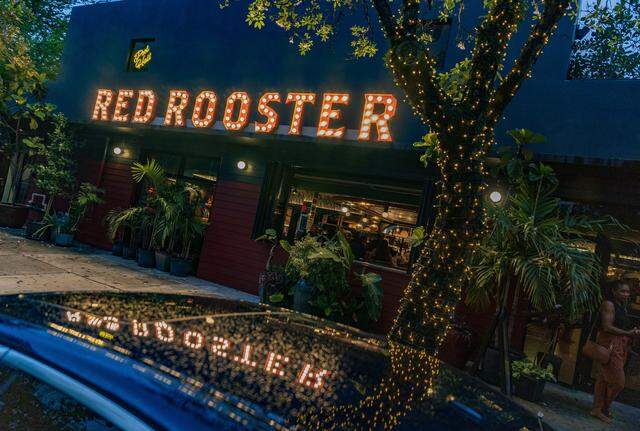 View of the Red Rooster restaurant in the heart of Miami’s historic Overtown neighborhood on Friday, March 13, 2026. Pedro Portal pportal@miamiherald.com
But in some cases, new businesses need to do outreach to better connect with the neighborhood’s residents. Booker T. Washington Senior High School is within walking distance of Red Rooster, but Principal Anthony Simons learned that many of his students didn’t feel welcome, as if they weren’t good enough to go there.
“We’re in a historic area, but a lot of kids don’t go to those places,” said Simons, 51. “A couple of student leaders said, ‘We aren’t allowed to Red Rooster.’”
Simons reached out to Fleming, and the restaurant hosted 75 students for a catered lunch last year. Other community leaders, like Miami City Commissioner Christine King and scholar Dorothy Fields, spoke to the high school students during the lunch.
“A year later, kids still talk about the event,” Simons said. “I want them to know they’re not excluded from anything in this country. They’re not second-class citizens.”
The magic behind the menu
Samuelsson, 55, has won eight James Beard awards and owns several restaurants worldwide. As a partner with Fleming in the first Red Rooster, he was compelled by Overtown’s history to help make Red Rooster Miami a thriving cultural spot. He noticed many similarities between Overtown’s heritage and Harlem’s.
“For me, Red Rooster has always been about more than a restaurant. It’s about honoring neighborhoods that have shaped culture, music and food in America,” he said.
Overtown’s history of hosting musicians like Louis Armstrong and Ella Fitzgerald during segregation captivated Samuelsson. Miami’s strong Bahamian and Caribbean influence was the metaphorical cherry on top.
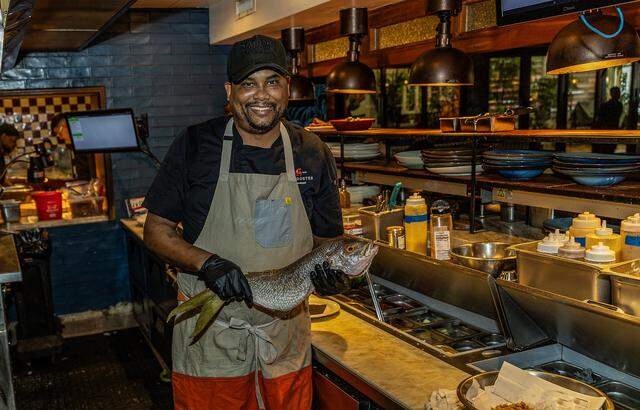 Charles Page Jr., executive chef, gets ready to prepare snapper at the Red Rooster restaurant on Friday, March 13, 2026. Pedro Portal pportal@miamiherald.com
Pittsburgh native Charles Page, 38, is the executive chef at Red Rooster and has been cooking since he was in the eighth grade. Page has traveled extensively across America and focuses on putting bits of that in his food.
“I lived in Atlanta, all up and down the East Coast, and traveled to Louisiana a lot,” he said. “That’s where a lot of my influences come from. Outside of that, it’s just me just tapping into the culture.”
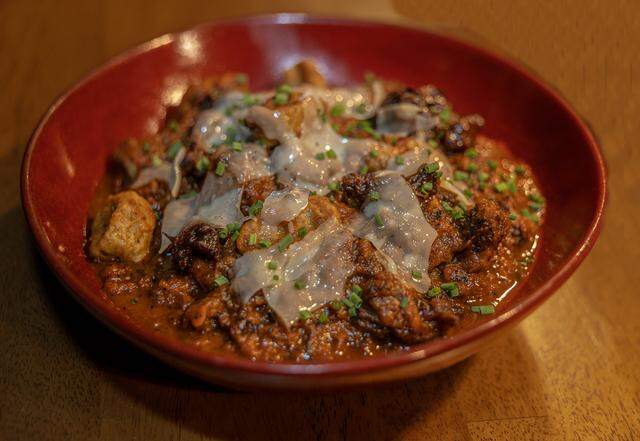 An oxtail bolognese with plantain gnocchi dish by executive chef Charles Page Jr. Pedro Portal pportal@miamiherald.com
Throughout the week, The Creamery, Red Rooster’s dessert space next door, serves sweet treats during the daytime hours. On Friday and Saturday nights, Red Rooster’s second-story pool hall hosts The Shrine, an event that celebrates Black music ranging from hip-hop to amapiano. Guests frequently take photos under the red lights above the staircase leading up to the pool hall.
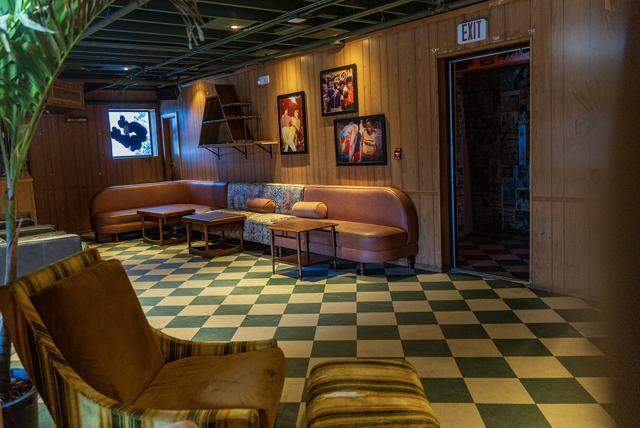 View of an area at the pool hall in the Red Rooster restaurant on Friday, March 13, 2026. Pedro Portal pportal@miamiherald.com Moving forward
Simkins, the restaurant’s co-owner, grew up in Miami Beach and graduated from the University of Miami. He had previously purchased properties in Overtown and initially owned the property where downtown Miami’s E11even nightclub is located. In buying properties in Overtown, he learned about its history and how many people called it “The Broadway of the South.”
“It was where Black people had to live, but thinking of the nightlife, it was pretty integrated,” said Simkins, 48. “Guys would play in Miami Beach hotels then come to Overtown to play.”
In 2013, Simkins was introduced to Fleming and wanted to partner with him to develop a restaurant in Overtown. That finally panned out with Red Rooster.
Looking ahead, Simkins sees the possibility of a Samuelsson-branded hotel opening in Overtown. Until then, he’s glad to see Red Rooster attracting guests like Gia McKenzie, a remote worker from South Carolina who is living in Miami for two months. On a recent evening, she told the Herald that Red Rooster has become a home away from home for her.
“I look forward to seeing people that look like me,” she said. “I look forward to seeing beautiful people. I love the ambiance and the art. [Coming here is] always money well spent.”
 Cropped.jpg)
Miami Herald
Michael Butler writes about minority business and trends that affect marginalized professionals in South Florida. As a business reporter for the Miami Herald, he tells inclusive stories that reflect South Florida’s diversity. Just like Miami’s diverse population, Butler, a Temple University graduate, has both local roots and a Panamanian heritage.