

ORLANDO, Fla. – This week, WalletHub has released its latest list of the most overweight and obese cities in America.
The study examines several health-related factors* to develop its ranking, including the share of overweight adults, heart disease rates, obesity-related deaths, and access to recreation centers.
Researchers also broached the fact that obesity-related medical treatments have been costing over $190 billion a year, with nearly 42% of adults in the country suffering from obesity.
[BELOW: The top attraction in the U.S. can be found on this Florida island]
“Obesity is becoming more and more prevalent in the U.S., and it’s costing us big time,” WalletHub analyst Chip Lupo said. “In the most overweight and obese cities, residents often lack easy access to healthy food and recreation opportunities, so investing in those areas should help improve people’s diets and exercise regiments, and reduce the financial burden overall.”
Overall, the fattest city turned out to be Little Rock in Arkansas, with McAllen, Texas (No. 2); and Memphis, Tennessee (No. 3) coming in close behind.
But it turns out that the Sunshine State actually fared pretty well, as it didn’t have a single city within the top 50.
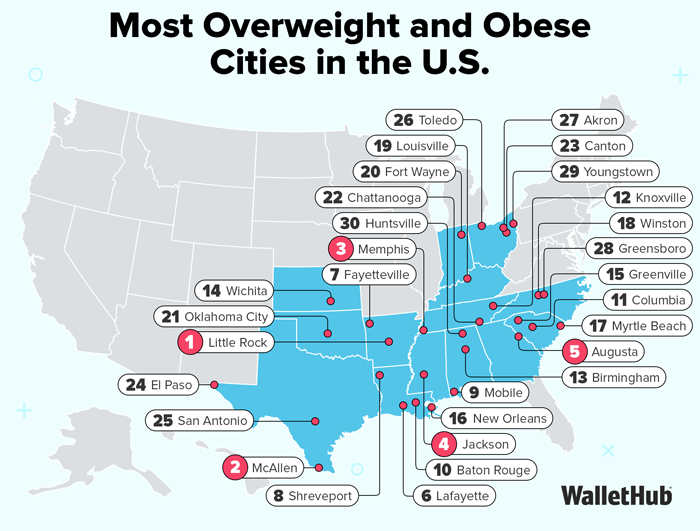
The highest-ranked Florida city on this year’s list is Orlando, all the way down at No. 51. The City Beautiful struggled with its health consequences in particular.
Meanwhile, the full Florida ranking is as follows:
RankCityScoreWorst-Performing Category51Orlando71.72Health Consequences61Jacksonville70.29Health Consequences62Tampa70.27Health Consequences88Miami64.30Food & Fitness
* The methodology used in this study is as follows:
Obesity & Overweight (60%)
Share of Overweight Adults
Share of Obese Adults
Share of Overweight Teenagers
Share of Obese Teenagers
Share of Overweight Children
Share of Obese Children
Projected Obesity Rates by 2050
Health Consequences (25%)
Share of Adults with High Cholesterol
Share of Diabetic Adults
Share of Adults with High Blood Pressure
Heart-Disease Rate
Obesity-Related Death Rate
Food & Fitness (15%)
Share of Adults with Low Fruit/Vegetable Consumption
Share of Residents Who Say They Eat Healthy
Limited Access to Healthy Food
Share of Physically Inactive Adults
City Friendliness toward an Active Lifestyle
Access to Parks & Recreational Facilities
Number of Health Educators and Community Health Workers per Capita
Breaking News Alerts
Get breaking news alerts delivered to your inbox.
Copyright 2026 by WKMG ClickOrlando – All rights reserved.