
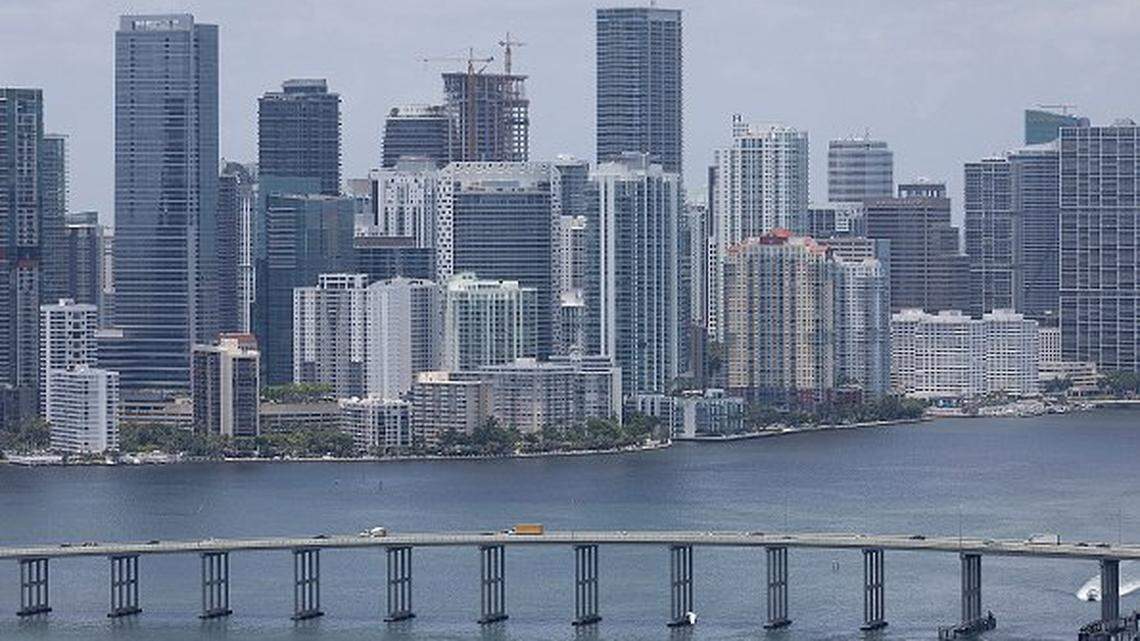
An aerial view of the Miami skyline is seen next to the waters of Biscayne Bay on July 21, 2022.
Joe Raedle
Getty Images
Miami has reached a moment when its government must catch up with the city it now serves — and voters are beginning to insist on it.
Over the past several election cycles, voters have made something unmistakably clear: “Business as usual” is no longer sufficient for a city changing as quickly as Miami.
Another batch of signatures was submitted recently as part of the effort to place the Stronger Miami proposal on the ballot. More than 20,500 have now signed the petition and that number continues to grow.
Those signatures are not an attack on the current city commission. They are evidence that citizens believe their participation still matters and that Miami’s governing structure deserves serious public discussion.
Four years ago, a small group of residents began raising a question that had rarely been asked publicly: whether the structure of Miami’s city government still fits a city that has grown dramatically in population, global influence and economic complexity. At the time, nearly every political and administrative leader in the room opposed meaningful reform.
Today, most of those leaders are gone.
Their departure reflects more than the normal turnover of local politics. Voters signaled clearly that Miami’s political structure had not kept pace with the city’s rapid growth.
The Stronger Miami petition initiative emerged from that disconnect. Many residents felt increasingly distant from decisions shaping their neighborhoods and their city. Reform proposals often struggled to gain traction and calls for greater accountability often met resistance. At times, commissioners responded by verbally attacking residents, accusing them of being bad actors or dismissing their comments out of hand as misinformed rather than engaging with the concerns being raised.
But in a democracy, voters ultimately have the power to change systems that no longer reflect their expectations.
Nearly every seat on the commission has changed hands through grassroots campaigns promising reform. A new mayor ran on a message of service over self and has introduced proposals aimed at increasing voter participation, clarifying executive authority and improving efficiency and transparency in city government.
Four newly elected commissioners gained office — and moral authority — by challenging a political environment many residents believed had grown insular and resistant to change.
Miami today is no longer a midsize municipality operating quietly within a tourist economy. It has become a global financial center, a gateway city and one of the fastest-growing urban economies in the United States.
Cities that grow this quickly eventually confront the same reality: Institutions designed for a smaller era must evolve.
Structural reform should not be mistaken for instability. Thoughtful reform clarifies responsibility, strengthens accountability and improves government’s ability to respond to citizens while managing the complexity of a modern city.
Other fast-growing cities have faced similar moments. As population, investment and expectations expand, mature governments refine how authority is structured and how decisions are made.
Miami has reached that point.
The Stronger Miami petition effort reflects a renewed civic impulse. Tens of thousands of residents have signed their names to a proposal they believe could improve how their city functions.
A city that has grown as dramatically as Miami has deserves a government capable of growing with it.
The voters are asking for the opportunity to decide that future. They should be given that chance.
Mel J. Meinhardt is a retired executive who began his career in public service as an officer aboard submarines in the Arctic and later as a strategist and technology manager for the CIA. He is a member of the neighborhood advocacy group One Grove Alliance, chairman of the board for Friends of the Commodore Trail and co-publisher of the Coconut Grove Spotlight.