
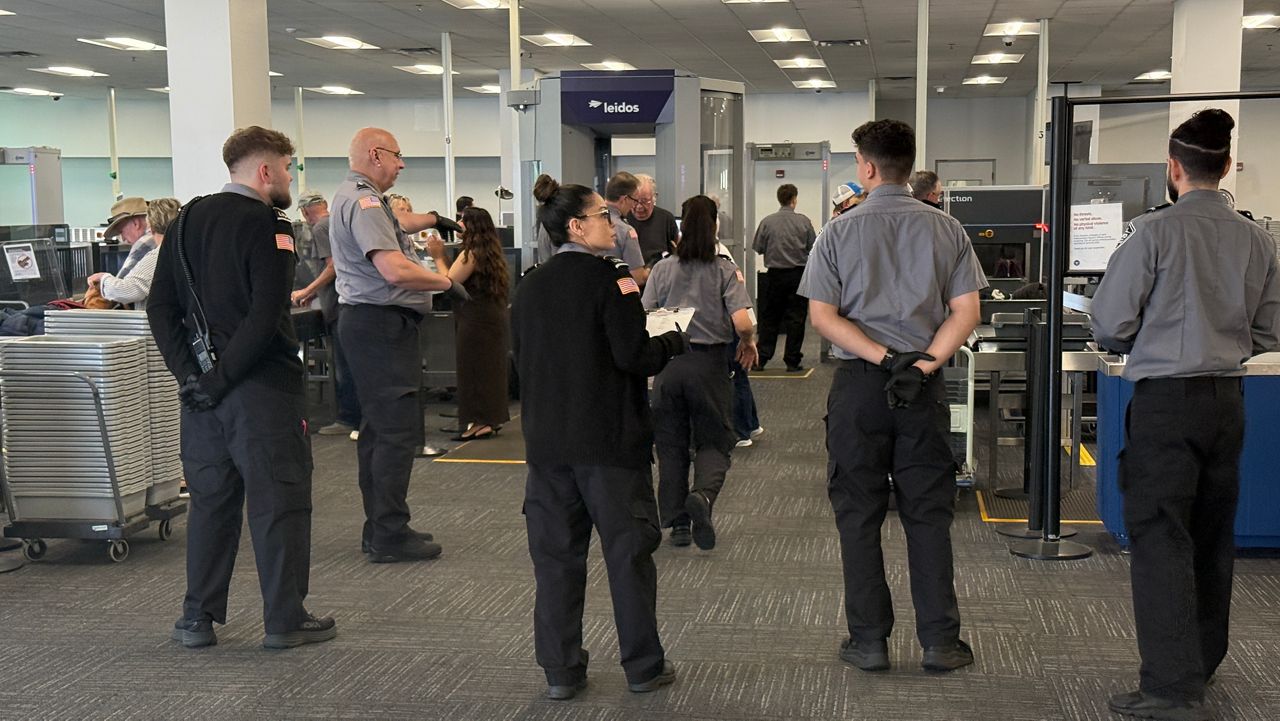
SANFORD, Fla. — It’s another week for TSA employees without pay due to a funding lapse at the Department of Homeland Security. Travelers have seen long lines at airports across the country as TSA officers call out in large numbers, but not all airports are dealing with the same concern.
What You Need To Know
We’ve seen long lines at airports across the country as TSA officers call out in large numbers, but not all airports are dealing with the same concern
20 airports across the country, including Orlando Sanford International Airport, have private contractors that provide security screening instead of federal workers
Right now, with the partial shutdown, the big difference is that all the private security screeners at the airports are getting paid, which means they aren’t facing staffing issues
20 airports across the country, including Orlando Sanford International Airport, have private contractors that provide security screening instead of federal workers.
Right now, with the partial shutdown, the big difference is all the private security screeners at the airports are getting paid, which means they aren’t facing staffing issues.
“It probably didn’t take us more than 5 to 10 minutes, just walk right through,” said Jack Dermer. He and his wife, Jan, are from Melbourne and fly out of Sanford often.
“It is not crowded. You get in, get to your plane, get on. It’s efficient,” said Jan Dermer. The couple has never noticed that it’s not TSA workers behind the machines.
“That is nice because everybody else is working without pay right now,” Jan said.
For more than a decade, VMD/Xcelerate has provided private security screening services.
“These screeners go to the exact same training that federal screeners do. Sometimes it might even be in the same class as federal screeners, so there is really zero difference in training,” said George Speake, the Deputy CEO at Sanford Airport Authority.
Speake said there is no financial difference in switching to private security.
“The morale is better, they don’t get affected by shutdowns like what we are experiencing right now, and we have some say so into kind of how things are operating here,” Speake said.
The list of airports allowed by TSA to operate privately are mostly small-to-medium-sized airports.
“It may or may not be cost-effective otherwise,” said Dave Benson, a former federal agent and threat assessment professional.
Benson said the TSA Screening Partnership Program is designed to ensure the screening is the same wherever passengers go, but it comes down to oversight.
“Each circumstance is different and you have to pay really close attention to make sure those standards are maintained,” Benson said.
Some have concerns about private screenings. Chris Finlay, the local president of the AFGE Local 556, has worked in both private screening companies and TSA, said in a statement: “The reality of privatization is that safety can become secondary to profit. The safety of the traveling public should never be influenced by a company’s bottom line.”
Other security experts say the real danger right now is TSA workers not being paid.
“I am concerned about morale, I am concerned about fatigue because that leads to potentially making mistakes,” Benson said.
Officials with the Orlando International Airport confirmed they had discussions in the past about having private security, but nothing came of the discussions.
Although wait times at MCO have not been extreme due to the lapse in DHS funding, the AFGE Local 556 union used the word “critical” to describe the situation.
Representatives say federal TSA employees are really struggling to put food on the table and pay for gas to get to work.