
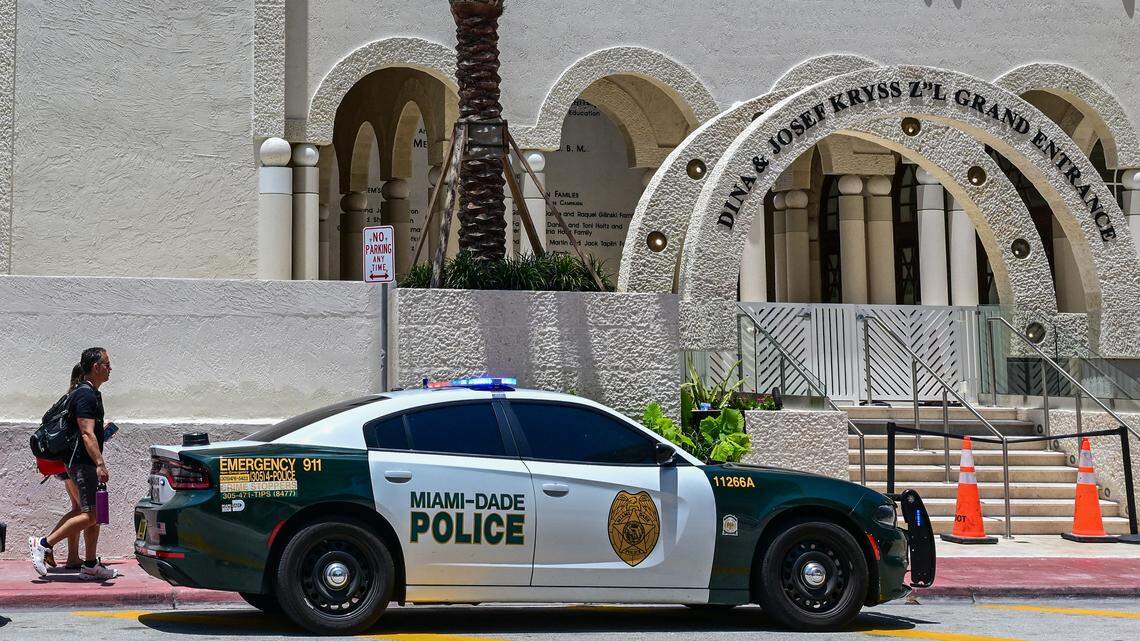
A Miami-Dade police car is seen outside the Shul of Bal Harbour synagogue in Surfside, Florida, on May 22, 2025, following a shooting that left two people dead, in Washington, DC.
GIORGIO VIERA
AFP via Getty Images
Armed volunteers with little to no security training would be allowed to provide security services at religious institutions and houses of worship under a bill headed to Gov. Ron DeSantis.
The House and Senate recently passed a bill (HB 95/SB 52) that would exempt volunteers who provide armed security services at churches, synagogues, mosques and other houses of worship from the required Class D and G licenses held by professional security services.
The Senate unanimously approved the measure and the House approved the bill on a 111-1 vote. Rep. Christine Hunschofsky, D-Parkland, was the only representative from either party who voted against it.
Under current law, a licensed gun owner can carry concealed firearms on religious property as long as the house of worship allows it.
If DeSantis signs the bill into law, a Florida statute that regulates private investigative services, private security services and repossession services would be amended to open the door for unpaid volunteers to protect religious institutions with their own firearms. The only requirement is that the volunteers must hold a valid license to carry a concealed weapon or concealed firearm.
The bill also specifies that the armed volunteers would be able to provide services on any property owned or leased by a religious institution, including property used for education.
Proponents of the bill argue that since shootings have become commonplace at religious institutions across the country, all houses of worship should be able to provide security for their congregants, regardless of their financial status.
“Some houses of worship can’t afford to hire outside security services, and they’re now beginning to use volunteers,” Sen. Don Gaetz, R-Niceville, said as he introduced the bill during a Senate Rules Committee meeting earlier this year.
While the bill is largely supported by House and Senate members, some have expressed concerns about the prospect of having armed guards with no training acting as a security guard.
At a House Criminal Justice Subcommittee hearing on Jan. 28, Rep. Dianne Hart-Lowman, D-Hillsborough, said she would feel “so much better if you would add that they were required to at least take a training.”
The bill is backed by gun-rights groups, including Florida Carry Inc., the National Rifle Association and the Gun Owners of America Inc. and has also been supported by some faith leaders who spoke at the Capitol during the bill’s committee hearings.
Locals react
James Somohano, the director of community security for the Greater Miami Jewish Federation, said that while he’s happy to see that security for houses of worship is top of mind for Florida officials, he would want to see more required trainings for the armed volunteers.
“Absent training and absent resources to make that security team an effective one, you may be placing those same members of that team in a horrible position from a liability perspective,” Somohano said.
Adequate security is something that synagogues have been vigilant about in recent years, especially amid rising antisemitism and the recent attack on a Michigan synagogue. A man rammed a vehicle into a Detroit-area synagogue last week — an incident the FBI called a “targeted act of violence against the Jewish community.”
Somohano said it is also important to consider how the legislation may affect a house of worship’s insurance premiums. One reason religious institutions hire private security firms in the first place is to remain under the private firm’s insurance umbrella.
“Insurance companies would inevitably increase their premiums when they assess risk, because they have these volunteer armed security guards,” Somohano said.
Somohano said he would prefer if officials gave houses of worship the resources to train volunteers to ensure that safety for everyone is considered.
“There’s a culture involved in having a firearm, you must feel so comfortable with it, you must do it consistently so that you can be effective,” he said.
This story was produced with financial support from Trish and Dan Bell and donors in South Florida’s Jewish and Muslim communities, including Khalid and Diana Mirza and the Mohsin and Fauzia Jaffer Foundation, in partnership with Journalism Funding Partners. The Miami Herald maintains full editorial control of this work.