
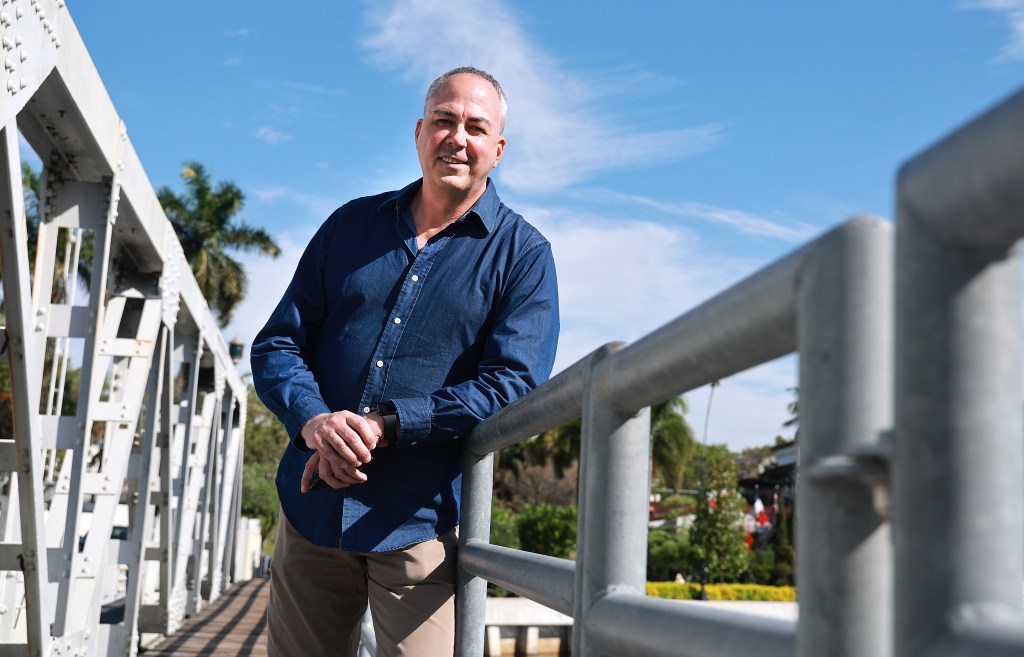
Michael Rajner was ubiquitous.
Working the hallways, offices and committee rooms of the state Capitol, he became the public face of a multi-front effort to reverse sweeping cuts in the program that pays for lifesaving HIV/AIDS medications for tens of thousands of Floridians.
The AIDS Drug Assistance Program pays for the expensive medications for about 28,000 people. In January, the Florida Department of Health notified recipients that it was slashing eligibility, a move that could have affected as many as 16,000 people.
Behind the scenes, Rajner was an in-your-face advocate, seizing every opportunity — in corridors, elevators, even restrooms — to press the issue and keep it in front of Republican and Democratic lawmakers.
“He was in my office many times,” said state Sen. Gayle Harrell, a Palm Beach-Martin-St. Lucie county Republican. “He was very effective.”
Weeks of efforts by Rajner and others proved successful, at least for now. Senators and representatives passed a stopgap fix that keeps ADAP intact, with some modifications, through June 30. Gov. Ron DeSantis is expected to quickly sign it into law.
Activist’s role
For Rajner, it was an unexpected, monthslong journey.
And for some who know the Fort Lauderdale activist as an outspoken, bullhorn-toting personality who sometimes shouts at and attempts to shame elected officials, candidates and bureaucrats, it represented a transformation to a different and more nuanced approach to advocacy.
Rajner didn’t act alone. He was part of a coalition that included representatives of the AIDS Healthcare Foundation and the Equality Florida LGBTQ+ advocacy organization that mobilized to save ADAP. And a group of state legislators in both parties pushed to allocate money needed to reverse decisions made by the state bureaucracy.
But absent Rajner, the outcome might have been different.
“Michael played a pivotal role,” state Sen. Alexis Calatayud, a Miami-Dade County Republican, said in a telephone interview. “He didn’t just ring the alarm. He started and kept beating the drum.”
During the Senate and House debates on the legislation that temporarily alleviated the crisis more than half a dozen Democratic and Republican lawmakers credited Rajner’s efforts.
“Thank you for being open and honest and being the voice of this, Michael,” said state Rep. Robin Bartleman, D-Weston. The result, she said, “is actually something that will absolutely 100% save lives.”
State Sen. Shevrin Jones, D-Miami Gardens, described him as someone “who’s been here every day, advocating and walking halls and rightfully, righteously, harassing us, for a very good reason.”
Looming crisis
In January, the Department of Health began notifying ADAP recipients of significant cuts: reducing the maximum income for an individual covered by ADAP from $63,840 a year (400% of the federal poverty level) to about $21,000 a year (130% of poverty).
Of the approximately 28,000 people on the program, 12,000 to 16,000 would lose coverage.
And the agency planned to eliminate some medications from the list of approved drugs it would cover and stop paying premiums for some recipients’ Affordable Care Act insurance coverage.
The Health Department said it was acting because of a $120 million budget shortfall caused by federal funding cuts. The AIDS Healthcare Foundation, which sued to challenge the changes, disputed agency numbers and conclusions.
With a widely used HIV medication costing $4,500 a month for people without insurance, the change portended a crisis for those facing removal from the rolls.
Beyond the impact on the health of the affected recipients, multiple Democratic and Republican lawmakers said the cuts were shortsighted. Off medication, people will get sick and require much more expensive treatment in hospitals, said state Rep. Chip LaMarca, a Broward Republican. Also, a person who is on medication and maintains what is called an undetectable viral load has zero risk of transmitting HIV to others, said state Sen. Carlos Guillermo Smith, D-Orlando, and state Rep. Anne Gerwig, R-Wellington.
Despite the significant implications of the changes, Democratic and Republican legislators said they hadn’t been told by the Department of Health what it was doing. Many first became aware of the issue when Rajner showed up to testify at a legislative committee.
“This issue was raised to the Legislature the first week of session because of Michael coming to testify before one of the appropriations committees. The Legislature wasn’t previously informed before he shared with us about the letters going to ADAP recipients,” Calatayud said.
Rajner said people weren’t looking at their phones while he spoke, sometimes emotionally, at that committee. “They literally were leaning in and listening and looking at me intently and wanting to learn more about this.”
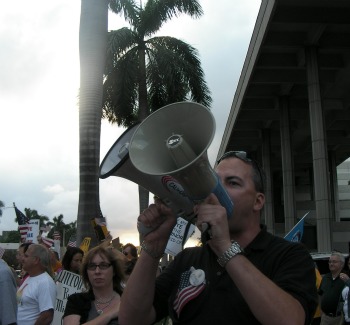 Activist Michael Rajner, holding two bullhorns, at a demonstration outside the Federal Courthouse in Fort Lauderdale in March 2011. (Anthony Man/South Florida Sun Sentinel)
Two months in Tallahassee
In early January, Rajner was planning a quick trip to Tallahassee to advocate for another bill and head back to Fort Lauderdale. “I never had any intentions of staying in Tallahassee for two months.”
When word started spreading about what was emanating from the Department of Health, Rajner and other activists decided they needed to pivot to ADAP.
After his testimony alerted legislators to what was happening, Rajner extended his Tallahassee stay. From the beginning of the annual session on Jan. 13, until the first part of the session adjourned March 13, he was there every week. He said he drove home, a six- to seven-hour car ride each way, all but two weekends.
Most weeks his dog, Blue, an 8-year-old French bulldog-pit mix, joined him. (When the days at the Capitol were extra long, people in Tallahassee volunteered to feed, walk “and love him.”)
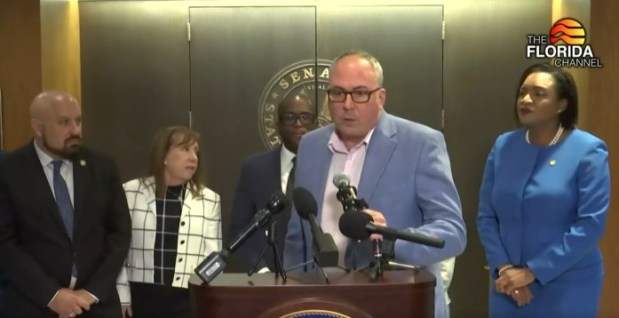 Michael Rajner discusses the AIDS Drug Assistance Program at a news conference outside the Florida Senate chamber on Feb. 25, 2026. Listening from left: state Rep. Mitch Rosenwald, Senate Democratic Leader Lori Berman, state Sen. Shevrin Jones, and House Democratic Leader Fentrice Driskell. (Florida Channel/courtesy)
A different style
Rajner held numerous civic, organizational and political roles, including service on a range of government boards. He’s been an activist for the LGBTQ+ community and on HIV/AIDS issues on the local, state and federal levels.
Currently he is chair of the Broward County Human Rights Board and a committeeman representing Broward County at the state Democratic Party.
Often during the last two decades he’s pressed strongly, and loudly, as he advocated before city and county governments and at the School Board. He sometimes antagonized officials, candidates and other activists. Some have cut off communication, walked away from him, or berated him.
He once decried a Broward mayor’s performance as “pathetic” — and nominated his dog at the time, Gidget, as a mayoral candidate.
LaMarca called him “a warrior for his issues.”
He changed his tack for the ADAP issue.
“He was careful in what he said. He presented a logical case, what is happening, and what impact it is having. Not overly emotional or screaming at people, which can have a negative impact,” Harrell said, adding there is balance between “being effective and assertive to a degree without being argumentative and obnoxious.”
The approach Rajner often used in Broward would not have worked in Tallahassee, said state Sen. Rosalind Osgood, D-Fort Lauderdale, who was chair of the Broward School Board during a period in which he was an outspoken presence on education issues.
“When you are passionate about something and you believe in something, sometimes it can come across as aggressive,” Osgood said. “The way Tallahassee works is very different from the School Board.”
Ken Evans, formerly a top leader in the Broward Democratic party and a friend of Rajner’s, said “Michael has matured into a seasoned activist.” Evans added that “he knows when to show strength and he knows when to show respect.”
Esteban Wood, director of advocacy and legislative affairs for the AIDS Healthcare Foundation, who was heavily involved in the issue, said it was “a bit of an evolution” but Rajner understood the best approach. “We lead with data. We lead with conservative arguments that will land with lawmakers.”
In some ways it was full circle for Rajner, 55. When he was growing up in Bergen County, New Jersey, he spent time working for a Republican state senator. (Few people know, Rajner said, that he spent his earliest years as a registered Republican.)
“As angry and as pissed off as you want to be, you just have to keep your cool while engaging,” Rajner said, adding that Tallahassee is not a place where “you can go up and have that ACT UP mentality and trust you’re going to get results. The opposite is going to happen. They’re going to shut down.”
Rajner brought something else to the discussion. He is an ADAP recipient and from 2009 to 2014 he was on the Department of Health’s ADAP advisory workgroup. (He was also twice named a top 100 HIV/AIDS activist in the county by Poz magazine and was a member of the Broward HIV Planning Council and was a national secretary of the Campaign to End AIDS.)
“He was able to humanize the issue for lawmakers,” Wood said, so it wasn’t thousands of “nameless individuals. Michael brought a human face to the issue.”
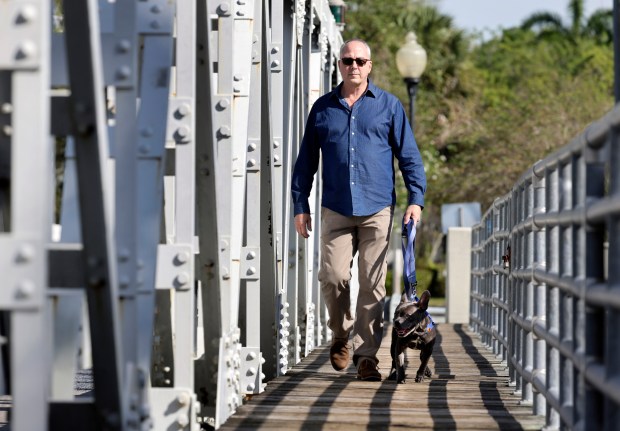 Michael Rajner walks his dog, Blue, in Fort Lauderdale on Thursday, March 19, 2026. Blue accompanied Rajner to Tallahassee almost every week during the legislative session. (Carline Jean/South Florida Sun Sentinel)
Health Department
By far the most contentious of Rajner’s Tallahassee interactions involved the Department of Health. “They were very nasty to us,” he said.
Rajner said he and other activists had a meeting at one point with top officials at the Department of Health, including Surgeon General Joseph Ladapo.
It came about because a legislative appropriations chair directed agency officials to meet with Rajner and others on the issue. Rajner said he was summoned with just an hour’s notice, and the advocacy team quickly assembled. The meeting was scheduled for 30 minutes. Nothing was resolved.
Later, when another lawmaker asked Rajner to come to her office to participate in a meeting with Ladapo, Rajner said a top aide to the surgeon general saw him in the conference room and announced they wouldn’t participate if he remained.
The Department of Health didn’t respond to questions about the AIDS Drug Assistance Program funding, Rajner’s efforts or the Rajner-Ladapo meeting.
Advocates aren’t alone in expressing frustration with Ladapo and the agency.
State legislators, including the Republican majority party’s committee chairs, repeatedly said they were stymied in efforts to get accurate information about recipients, spending and other issues relating to ADAP.
Several used time during the legislative debate to emphasize language added to the stopgap funding fix that requires the Department of Health to provide written reports about the program to lawmakers starting April 1.
“If you knew the teeth-pulling process of trying to just get information about simple numbers and people from a state agency to keep a program alive, you would be infuriated,” state Rep. Alex Andrade, R-Pensacola, the chair of the Health Care Budget Subcommittee, told his colleagues.
Road to Florida
When he was living in New York, Rajner learned he was HIV positive on Valentine’s Day 1996.
He started taking one of the earliest medications, AZT, which required multiple pills several times a day and was known for nasty side effects. “The first day I took them and I was in my bathroom laying on the rug in the bathroom for about seven or eight hours in excruciating pain.”
Unable to tolerate the drug, Rajner said he stopped taking it. He was diagnosed with AIDS in 1997.
Unsure how long he would live, Rajner moved to Broward County in October 2000 to escape New York’s cold weather and high cost of living.
He was active in HIV/AIDS issues, but not directly in politics for several years, until someone asked if he planned to attend a 2007 event hosted by then-Mayor Jim Naugle of Fort Lauderdale. The mayor and conservative and religious speakers described their moral and health objections to sex between men.
Rajner loudly declared his objections to what he heard, earning him the sobriquet “articulate shouter” from some in the news media.
After that, he organized and attended many protests, often with his own bullhorn. At a March 2011 rally in Fort Lauderdale, he carried two bullhorns. Currently, he said, he only owns one. He thought about bringing it to Tallahassee, but left it at home.
What’s next
House Bill 697, undoing most of the Health Department’s planned reductions, passed unanimously in the Florida Senate and Florida House.
It allocates $31 million for the rest of the state fiscal year. One expensive, heavily used medication, Biktarvy, won’t be covered; people who use it will have to switch to different medication.
As of midafternoon Friday, it awaits DeSantis’ signature.
Osgood said once DeSantis was fully aware of the situation, he agreed to sign a legislative-passed fix. Osgood flew with DeSantis on the state plane from Tallahassee to Saint Augustine in February for a ceremony at which the governor unveiled a statue of abolitionist leader Frederick Douglass. On that trip, Osgood said, she raised ADAP with the governor.
The fix lasts only through June 30.
Financing and benefit levels for the fiscal year that starts July 1 depend on negotiations. The House has proposed $68 million in additional funding and the Senate has proposed $118 million. That won’t happen until a special season on the state budget sometime in the spring.
“I’m hoping that Michael will be back in Tallahassee continuing until we get a permanent fix,” Osgood said.
There is no doubt, Rajner said. He will be there.
Political writer Anthony Man can be reached at aman@sunsentinel.com and can be found @browardpolitics on Bluesky, Threads, Facebook and Mastodon.