
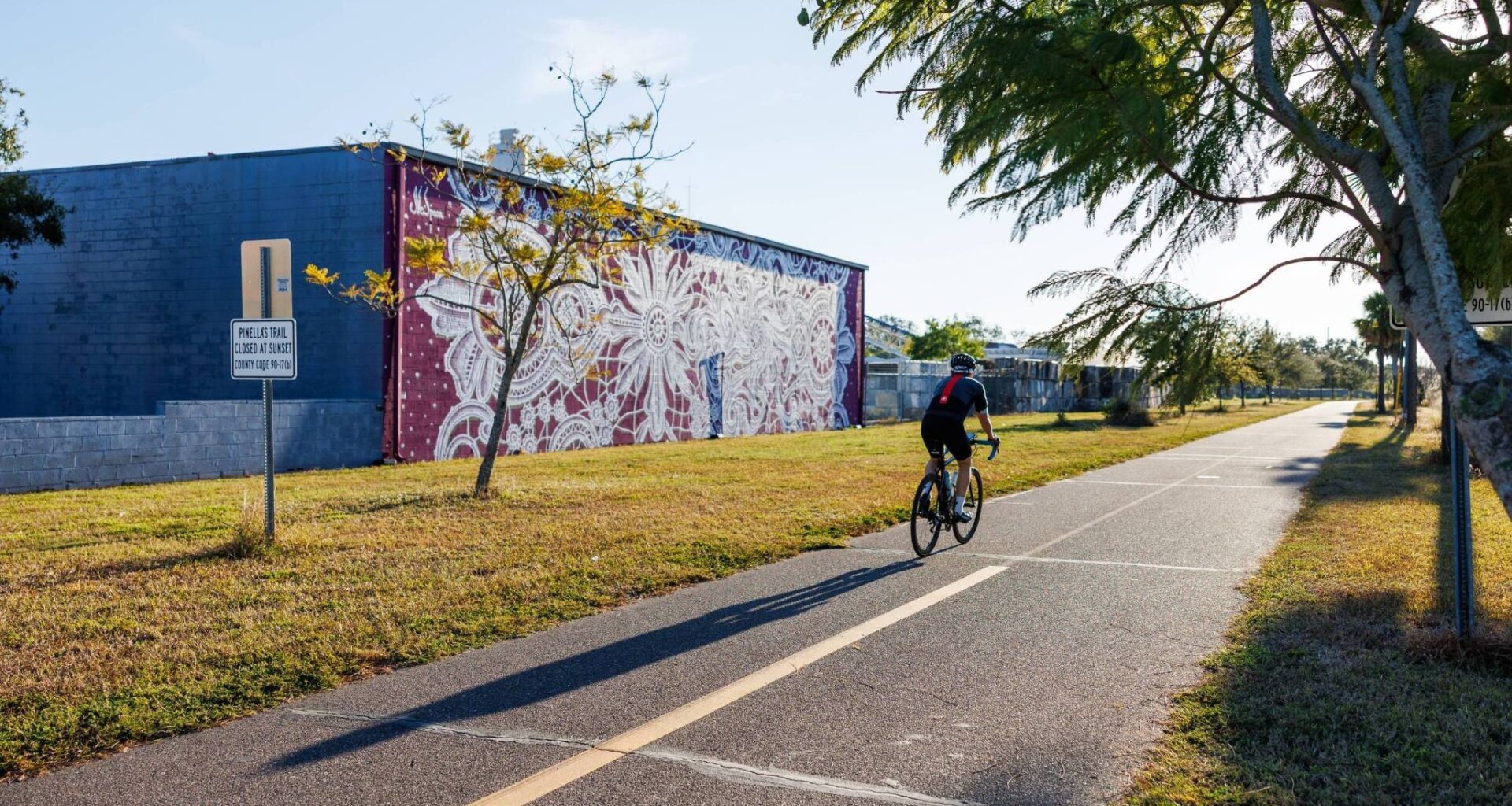
St. Petersburg’s new Trail Town designation will bring one of Florida’s top trail advisory bodies to the city next month.
The Florida Greenways and Trails Council is scheduled to meet April 8 and 9 at St. Petersburg Distillery. The visit comes a few months after the state designated St. Petersburg’s Greater Arts District as an official Trail Town, a label meant to recognize communities that build culture, commerce and public life around major trail corridors.
The City announced the designation in January after a joint application effort with The Sunline, a community-led initiative focused on improving sections of the Pinellas Trail. St. Petersburg joined 22 other Florida communities that have received the designation through the Florida Department of Environmental Protection’s Office of Greenways and Trails.
For St. Petersburg, the recognition centers on a three-mile section of the Pinellas Trail that ties together the Warehouse Arts District, EDGE District, Central Arts District and Waterfront Arts District. City officials have said that combination helped distinguish St. Pete from other applicants. The trail does not simply move people from one point to another. In this stretch, it also connects galleries, murals, restaurants, small businesses and major public events.
That overlap between transportation, public space and culture has become central to the city’s case. Cheryl Stacks, the city’s transportation and parking manager, previously said officials focused on the arts districts because of the close relationship between trails and cultural activity. The corridor also sits near signature St. Petersburg events including the Firestone Grand Prix, Localtopia, First Friday and the SHINE Mural Festival.
The state’s Trail Town program, launched in 2018, is designed to reward communities that make meaningful investments in trail access and amenities. For St. Petersburg, that included emergency markers, courtesy reminders, bike racks, public restrooms and easy access to nearby retail and dining. The designation also gives the city access to state promotion efforts and could help strengthen future grant applications tied to trail-oriented improvements.
Local leaders increasingly see the Pinellas Trail as more than a recreational asset. They see it as an economic development corridor.
During city discussions about the designation, council member Corey Givens Jr. highlighted the potential for small and minority-owned businesses to benefit from more foot and bike traffic along the route. City officials have also pointed to other Trail Towns as examples of what stronger trail activation can produce. In Dunedin, local leaders have credited the Pinellas Trail with helping transform once-struggling commercial areas into busy business districts.
The St. Petersburg designation also fits into a larger statewide trail map. The city serves as the western anchor of Florida’s Coast-to-Coast Trail, a planned paved route stretching roughly 250 miles to Titusville. State officials say the trail is now about 88 percent complete, further raising the profile of communities along its path.
The meeting is free and open to the public.