
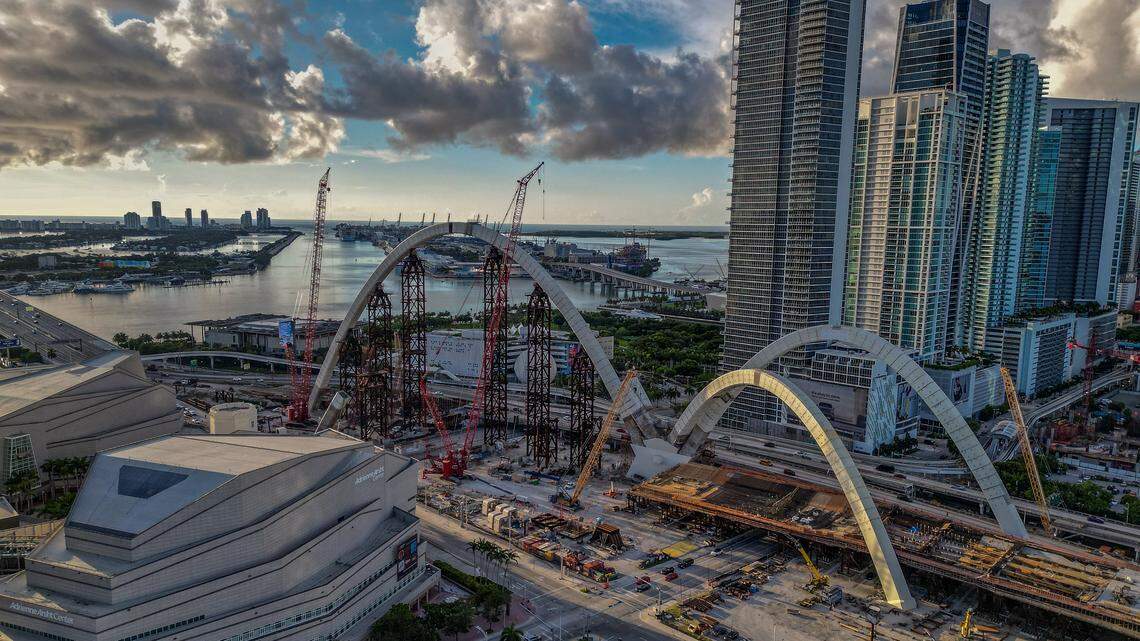
View of the Arsht Center (left bottom) and the ongoing construction of the arches for the I-395 signature bridge in Miami on Aug. 16, 2025.
Pedro Portal
pportal@miamiherald.com
Seven years into what the Miami Herald once called “the mother of all highway construction projects,” six concrete arches are rising slowly — at a glacial pace, some might say — over the city’s skyline.
It’s Miami’s “Signature Bridge,” a soaring structure meant to signal the entranceway to world-famous South Beach before the MacArthur Causeway — and a bold declaration that Miami has arrived.
But seven years is a long time to tie up traffic downtown, and the finish line keeps moving. It was 2024 at first, then 2027 — now it’s 2029. If Miami drivers knew when this project began in 2019 that they were signing up for a decade’s worth of traffic jams, re-routing and ripped up roads, would they have agreed? Is it all going to be worth it?
Miami drivers, stuck in a sea of red tail lights amid the construction, have had plenty of time to consider the question.
It’s the arches that get under people’s skin. Detractors say they look like the legs of a giant spider attacking downtown or the fast-food arches at McDonald’s. Recently, a TikTok video that appeared to show cracking in one arch caused a flurry of online anxiety. (A Florida Department of Transportation spokeswoman responded to a Miami New Times article on the post saying the flaws are “minor surface finishing inconsistencies” and not structural.)
But even if you buy the original intent of the designers — that the arches evoke the jets of a fountain springing from the sea — there’s no argument over this part: The construction project to reconfigure the interchange where Interstate-95, I-395 and State Road 836 meet is taking much longer than it was supposed to. Its price keeps going up, too — $818 million has become $866 million.
And those concrete spans at the center of it all — well, it’s hard not to see them as a symbol of everything that’s wrong with government projects, and this project in particular.
OK, a project this complicated probably wasn’t ever going to get done in five years — but double that amount of time and $48 million more than estimated? That’s more than mere construction slippage.
The project, known as Connecting Miami, is a partnership between the Florida Department of Transportation and the Greater Miami Expressway Agency. It includes rebuilding all of I-395 and double-decking a portion of State Road 836 to provide drivers with a direct connection to the MacArthur Causeway, free from local entrances and exits.
Yes, this intersection desperately needed to be reworked. And, certainly, frustration runs high right now at the time of year with the heaviest tourism (our economic lifeblood.) But pity the poor commuters who have to battle the traffic in this area every day until 2029.
One other point that’s extremely hard for us to swallow: There was supposed to be a 33-acre park created when the highways were elevated for this project. It was more than simple recreation space. The Underdeck, as it was called, would have rejoined parts of the city, including predominantly Black Overtown, that had been cut off and devastated when the highways were built in the 1960s.
The park was a chance for Miami to right an old wrong. But Last year, we learned that the Trump administration had killed the $60 million grant for park through the Big Beautiful Bill. City and county leaders say they haven’t given up. For now, though, the park is nothing more than a hope. How disappointing. How wrong.
The idea behind this colossal construction project was to create a smoothly flowing interchange. The arches, which are purely decorative, were supposed to be the crowning glory. Tampa has the Sunshine Skyway. Miami wanted its own version. As then-County Mayor Carlos Gimenez said in 2017, during the planning of this massive effort, this is supposed to be a “bridge for the ages.”
But widening highways to reduce gridlock actually doesn’t work, many experts say. Added capacity usually just results in more cars on the road, as studies have shown. There’s even a name for it: “the fundamental law of road congestion,” in which the number of vehicle-miles traveled increases in direct proportion to the available lane-miles of roadways.
This is an audacious project, for sure. That’s fitting: Miami should aim high. This is the gateway to Latin Americ. We have a growing tech scene. Billionaires are moving in. We should have free-flowing highways and really good mass transit and, yes, even a signature bridge. As developers will tell you, a view of the arches, all lit up in tropical colors — that’s a vision they can sell.
But the price we are paying as a society is too high. Drivers shouldn’t have to sit in endless traffic. The timeline shouldn’t keep slipping, and the cost can’t keep going up. At this point, the bridge that is supposed to define Miami’s downtown is in danger of being known not as a symbol of the city’s success, but of its excess.
BEHIND THE STORY MORE What’s an editorial?
Editorials are opinion pieces that reflect the views of the Miami Herald Editorial Board, a group of opinion journalists that operates separately from the Miami Herald newsroom. Miami Herald Editorial Board members are: opinion editor Amy Driscoll and editorial writers Isadora Rangel and Mary Anna Mancuso. Read more by clicking the arrow in the upper right.
What’s the difference between an op-ed and a column?
Op-Eds, short for “opposite the editorial page,” are opinion pieces written by contributors who are not affiliated with our Editorial Board.
Columns are recurring opinion pieces that represent the views of staff columnists that regularly appear on the op-ed page.
How does the Miami Herald Editorial Board decide what to write about?
The Editorial Board, made up of experienced opinion journalists, primarily addresses local and state issues that affect South Florida residents. Each board member has an area of focus, such as education, COVID or local government policy. Board members meet daily and bring up an array of topics for discussion. Once a topic is fully discussed, board members will further report the issue, interviewing stakeholders and others involved and affected, so that the board can present the most informed opinion possible. We strive to provide our community with thought leadership that advocates for policies and priorities that strengthen our communities. Our editorials promote social justice, fairness in economic, educational and social opportunities and an end to systemic racism and inequality. The Editorial Board is separate from the reporters and editors of the Miami Herald newsroom.
How can I contribute to the Miami Herald Opinion section?
The Editorial Board accepts op-ed submissions of 650-700 words from community members who want to argue a specific viewpoint or idea that is relevant to our area. You can email an op-ed submission to oped@miamiherald.com. We also accept 150-word letters to the editor from readers who want to offer their points of view on current issues. For more information on how to submit a letter, go here.