
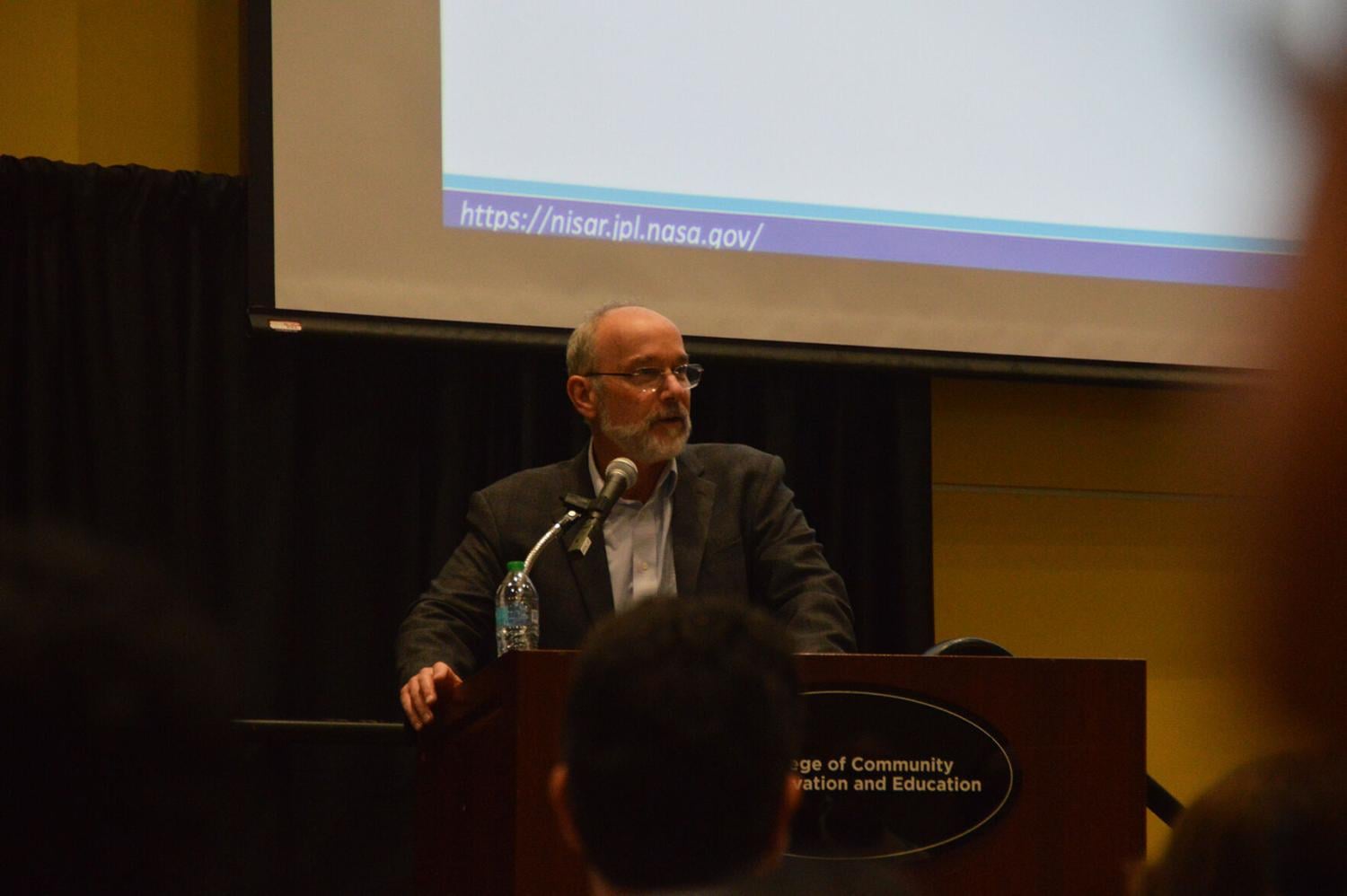

At the Morgridge International Reading Center, NASA Jet Propulsion Laboratory Scientist Dr. Paul Rosen highlights the importance of the U.S. and India collaboration in his NISAR talk as part of the Distinguished Lecture series hosted by The India Center on March 11.
Fabio Braggion
The India Center continued its Distinguished Lecture series on March 11 at the Morgridge International Reading Center with NASA Jet Propulsion Laboratory Scientist Dr. Paul Rosen.
Rosen gave a talk on his role in the NISAR satellite project and the U.S.-India collaboration that made it possible.
“This is a collaboration between ISRO, which is India’s space research organization, and, of course, NASA,” said biotech industry scientist Dr. Mohan Chellani.
Chellani was in attendance with Dr. Sharad Mehta, the co-founder of The India Center. Mehta explained how The India Center and this lecture series initially began as a branch of a Global Perspectives lecture series dating back to 2002. It was a meeting with former UCF President John C. Hitt that started The India Center.
“This project actually dates back to 2002, and we started in the Global Perspective lecture series. Somewhere around 2012, Dr. Hitt met with the ex-president of India here at UCF, and the idea of an India Center — a full-fledged India Center — germinated from there,” Mehta said.
Chellani continued by giving examples of how these lecture series have provided opportunities for some of the students at The India Center. Through study abroad programs in math, engineering and hospitality, students got to understand different methods of learning and working.
“For example, one of the students said that he wanted to go back again. He was so excited that he brought back that learning that he would have never experienced here,” Chellani said.
The talk itself discussed the NISAR mission, a collaboration between NASA and ISRO to create a satellite capable of measuring ecosystems with synthetic aperture radar. Dr. Rosen spoke about his role in the project while highlighting the fact that this could not be done by NASA or ISRO by themselves.
A mixture of graduate, bachelor and Ph.D students attended the event, asking questions to Dr. Rosen during and after the talk. One of these students spoke with Dr. Rosen about a personal connection they had to the project’s development.
“All the things I learned during my master’s, at the time Paul used to visit India for the meetings. What I didn’t know was that they were forming the base of NISAR, and they were giving us lectures. We were so lucky,” said Prateek Tripathi, a postdoctoral fellow in the Department of Physics at UCF.
Tripathi explained what an immense tool the data from the NISAR mission can be for researchers. The mixture of it being freely available, easy to process and thousands of image tiles already released will remove a bottleneck, allowing post-docs, students and researchers to use up-to-date, high-quality data.
“My main takeaway from this lecture is that NISAR has done a lot. Like the whole ten-year process was worth the wait. We got very beautiful data which we never had before,” Tripathi said.